



When you explore the intricate world of linguistics, you'll discover that language and the International Phonetic Alphabet (IPA) share an inseparable bond. You've likely encountered various accents and pronunciations that seem puzzling at first listen. That's where IPA steps in as your universal translator, breaking down every whisper, click, and tone into precise symbols. But there's more to this relationship than just mapping sounds—it's about revealing the very essence of human communication.
Key Takeaways
- IPA serves as a universal system for representing speech sounds across over 7,000 languages, enabling standardized linguistic documentation and analysis.
- Language analysis through IPA encompasses phonology, morphology, syntax, and semantics to understand comprehensive linguistic structures.
- IPA facilitates cross-cultural communication by providing a standardized method for documenting and preserving endangered languages lacking written forms.
- Modern technology enhances language analysis through IPA with automatic transcription tools and digital platforms for collaborative research.
- IPA bridges cultural and linguistic barriers by offering a systematic approach to studying and comparing different languages' sound patterns.
The Evolution and Development of IPA

While linguists had been studying speech sounds for centuries, the International Phonetic Alphabet (IPA) didn't emerge until 1886 when a group of French and British language teachers formed the International Phonetic Association.
You'll find that the IPA's development was driven by the need for a standardized system to represent speech sounds across all languages. The original alphabet included basic Latin and Greek letters, but as linguists discovered more sounds in various languages, they added new symbols and diacritics.

Today, you're using an IPA system that's undergone multiple revisions to accommodate the sounds found in over 7,000 known languages. The most recent major update occurred in 2005, and you'll notice it's become the universal standard for phonetic transcription in linguistics, dictionaries, and language learning materials.
Understanding Phonetics Through Language
Although the IPA chart may appear intimidating at first glance, you'll find that understanding phonetics becomes more intuitive when you explore how sounds function in your own language. You'll discover that your mouth naturally creates distinct positions for different sounds, forming patterns that match IPA symbols.
| Sound Type | Common Example |
|---|---|
| Plosive | "p" in "pat" |
| Fricative | "f" in "fan" |
| Nasal | "m" in "mom" |
| Lateral | "l" in "let" |
| Approximant | "w" in "wet" |
When you practice these sounds, you'll notice how your tongue, lips, and vocal cords work together. By focusing on your native language first, you're building a foundation that'll help you understand unfamiliar sounds in other languages, making the IPA system more accessible and practical.
Core Components of Linguistic Analysis


Linguistic analysis rests on four fundamental pillars: phonology, morphology, syntax, and semantics. You'll find that phonology deals with sound patterns and their organization within languages, while morphology examines how words are formed and structured. When you're studying syntax, you're looking at how sentences are constructed and the rules that govern word order in different languages.
Semantics, the fourth pillar, focuses on meaning – both at the word level and in larger contexts. You'll need to understand how these components interact with each other to fully grasp any language system. For example, when you're analyzing a sentence, you'll consider how its sound patterns (phonology) affect word formation (morphology), which influences sentence structure (syntax) and ultimately shapes meaning (semantics).
Cross-Cultural Applications of IPA
The International Phonetic Alphabet (IPA) serves as a bridge between these core linguistic components and practical cross-cultural communication. You'll find that IPA's standardized system allows you to accurately transcribe and analyze sounds from any language, regardless of its origin or writing system.

When you're working across different cultures and languages, IPA provides these essential benefits:
- You can document and preserve endangered languages that don't have written forms, helping maintain cultural heritage
- You're able to conduct comparative studies between languages, identifying patterns and relationships that might otherwise go unnoticed
- You can teach pronunciation effectively to language learners, breaking down sound systems into universal symbols they'll understand
This standardization makes IPA an invaluable tool for linguistic research, language documentation, and cross-cultural education.
Modern Technology in Language Documentation
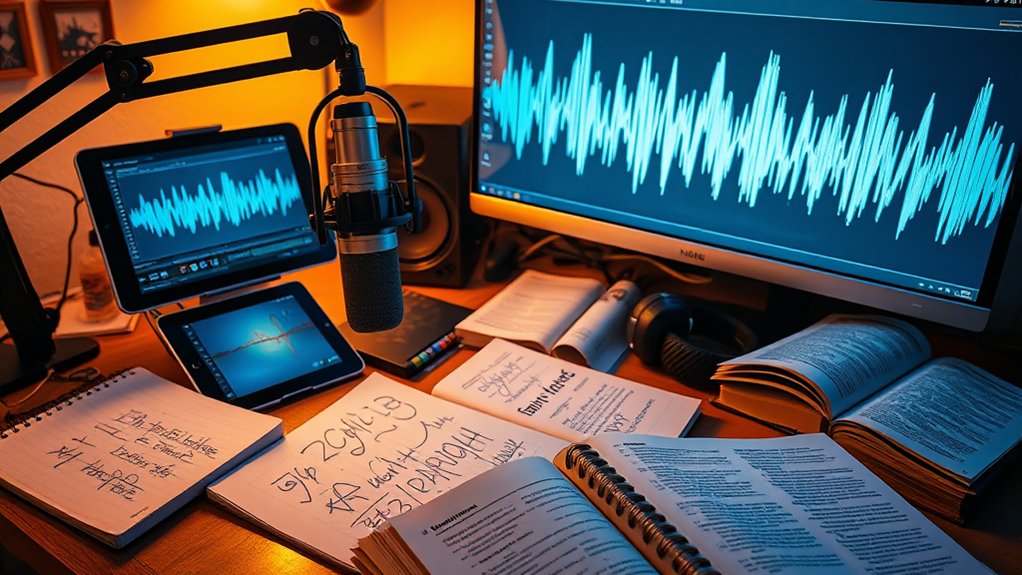
Digital advancements have revolutionized how researchers document and analyze language using IPA. You'll find that modern software can now automatically transcribe speech into IPA symbols, while high-quality recording devices capture subtle phonetic nuances that weren't detectable before.

You can use specialized apps and tools that simplify the process of entering IPA symbols, making transcription more efficient and accurate. Machine learning algorithms help you identify patterns in linguistic data, while cloud-based platforms enable real-time collaboration among researchers worldwide. When you're doing fieldwork, digital tools let you record, annotate, and analyze speech samples on-site. These technological innovations have made it possible to preserve endangered languages more effectively and create extensive databases of phonetic information that you can access instantly.
Speech Patterns and Sound Classifications
When analyzing speech patterns, you'll encounter systematic ways to classify sounds based on how they're produced in the vocal tract. You'll need to understand the relationship between articulators and the points of articulation to grasp how different sounds emerge. These classifications help you identify and categorize the distinct features of human speech.
- Place of articulation tells you where the sound is made, such as with your lips (bilabial), teeth (dental), or the back of your tongue (velar)
- Manner of articulation shows you how the airflow is manipulated – whether it's stopped, partially blocked, or allowed to flow freely
- Voicing indicates whether your vocal cords vibrate during sound production, distinguishing between voiced sounds like /b/ and voiceless ones like /p/
Research Methods in Language Study
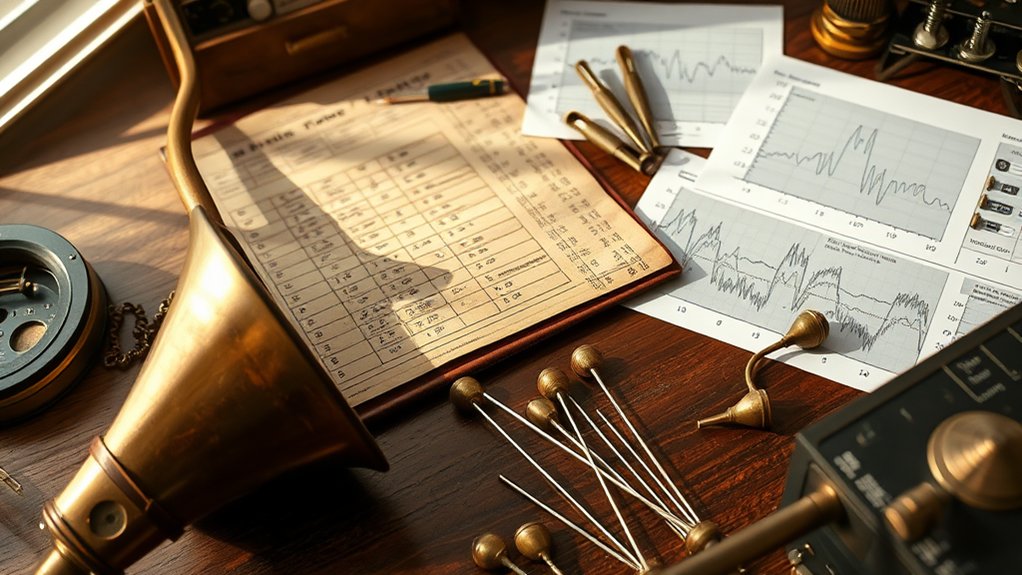
Modern language research employs diverse methodologies to uncover patterns in human communication. You'll find that researchers use both qualitative and quantitative approaches, including corpus analysis, field studies, and experimental designs. When you're conducting linguistic research, you'll need to gather data through recordings, interviews, or written samples.

You can apply computational tools to analyze large datasets of language use, helping you identify trends and variations across different populations. Field research lets you observe natural language in real-world contexts, while controlled experiments allow you to test specific hypotheses about language processing. You'll also need to take into account ethical guidelines when working with human subjects and guarantee your data collection methods are culturally sensitive. Digital technologies have expanded your ability to document and analyze language phenomena across various contexts.
Bridging Language Gaps With IPA
Since linguistic diversity presents challenges in cross-cultural communication, the International Phonetic Alphabet (IPA) serves as a standardized system to bridge these gaps. You'll find that IPA transcriptions help you understand pronunciations across languages, even when you're unfamiliar with the source language. This universal tool enables precise documentation of speech sounds, making it invaluable for language learning and research.
- You can use IPA to accurately represent sounds that don't exist in your native language, helping you master foreign pronunciations
- When you're documenting endangered languages, IPA provides a reliable method to preserve their unique phonetic features
- You'll discover that IPA's systematic approach eliminates ambiguity in pronunciation guides, making it easier to teach and learn new languages
Future Trends in Linguistic Research

Building on IPA's foundational role in linguistic analysis, emerging technological advances are reshaping the landscape of language research. You'll see AI and machine learning leading the charge in phonetic recognition, while computational linguistics continues to evolve. These tools will help you analyze speech patterns and dialectal variations with unprecedented accuracy.

As you explore future linguistic research, you'll encounter innovative applications of neural networks in language processing and real-time translation. Digital archives and big data analytics will transform how you study language evolution and variation. You'll find that mobile apps and cloud-based platforms are making IPA more accessible to researchers worldwide. The integration of augmented reality and 3D modeling will revolutionize how you visualize and understand articulatory phonetics, creating new possibilities for both research and education.
Frequently Asked Questions
Can IPA Symbols Be Effectively Used in Speech Therapy for Children?
You'll find IPA symbols helpful in speech therapy for kids, as they provide clear visual guides for correct pronunciation. They're especially useful when teaching specific sounds and phonemes your students struggle with.
How Does Musical Notation Compare to IPA Transcription Methods?
You're barking up the wrong tree if you think musical notation and IPA are twins. While both use symbols, IPA transcribes speech sounds, but musical notation captures pitch, rhythm, and melody for performers.
What Role Does IPA Play in Voice Recognition Software Development?

You'll find IPA helps train voice recognition systems by providing precise phonetic patterns. It enables software to better match spoken sounds with their standard pronunciations, improving accuracy in speech-to-text conversion.
Do Different Fonts Affect the Accuracy of IPA Symbol Representation?
You'll find that specialized IPA fonts are essential for accurate symbol display. Standard fonts often distort or misrepresent IPA characters, so you should use dedicated Unicode-compliant fonts like Charis SIL or Doulos SIL.
Can Artificial Intelligence Systems Learn to Generate Accurate IPA Transcriptions?
You'll find that AI systems can learn IPA transcriptions, but they're not perfect yet. They'll need extensive training data and linguistic rules to generate accurate results, though they're improving rapidly.
See The Next Blog Post

As you've explored the intricate world of IPA and linguistic analysis, you're now standing at the threshold of a revolutionary understanding. What you don't yet know is how this knowledge will transform your perception of human communication. Each symbol, each sound pattern you've learned isn't just a mark on paper – it's a key opening the mysteries of language that connects us all.


