


The three mountains task is Piaget and Inhelder’s test of whether young children can see a scene from another person’s position. A child looks at a model of three mountains and picks the picture a doll at another position would see. Children younger than about seven tended to choose their own view instead.
Key Takeaways
Aim
- To test whether young children can work out how a scene looks from another person’s position.
- The child shows this by choosing what a doll at another position can see.
Method
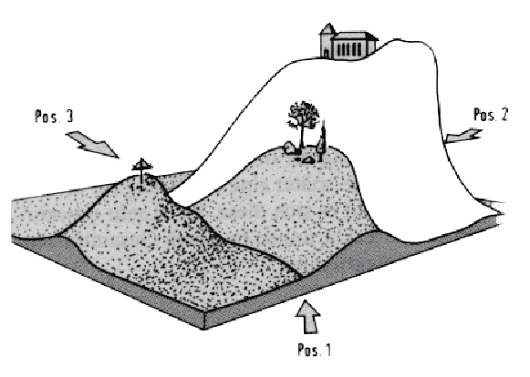
- Children were shown a three-dimensional model of three mountains. One mountain had snow on top, one a house and one a cross.
- Each child explored the model and then viewed it from one side. A doll was placed at another position.
- The child was shown pictures of the mountains from different positions and chose the one that shows what the doll sees.
- The independent variable (what the researchers compared) was the child’s age. The dependent variable (what they measured) was which picture the child chose: their own view or the doll’s.
Results
- Children younger than about seven tended to choose the picture of their own view.
- Four-year-olds almost always did. Six-year-olds showed some awareness but often chose the wrong picture.
- Older children, around seven and eight, consistently chose the doll’s view.
- Other researchers repeated the result and found the same pattern.
Conclusion
- Piaget and Inhelder concluded that young children are egocentric: they find it hard to see their own view as only one of several.
- Children become less egocentric from about seven.
Strengths
- Clear test: it asks one checkable question, which picture shows the doll’s view?
- Reproduced: other researchers found the same result.
- Started research: later researchers changed the materials or the request and compared results. This led to the hiding games (later tasks in which children hid a doll from a toy policeman) and to the idea of two kinds of perspective taking.
Limitations
- Internal validity (whether a study measures what it claims to): choosing your own view has several possible causes, such as a hard model or a request that cues the answer.
- Ecological validity (whether findings apply to everyday life): Hughes argued that the task was unusual and abstract, and children may never have seen mountains like these.
- Easier tasks show earlier success: about 90 per cent of three- and four-year-olds hid a doll from toy policemen, and Borke’s children matched a familiar scene from age three.
- Narrow task: it tests how a scene looks from another position (Level 2), not whether another person can see something (Level 1).
- Generalisability (whether findings apply to other people) and sample bias (a sample that does not represent everyone): the study does not report how many children took part.
Ethical Issues
- Informed consent: a parent should agree first. A way of dealing with it: ask a parent for permission.
- Right to stop: a child should be free to stop. A way of dealing with it: tell the child they may stop at any time.
- Harm: looking at a model and choosing pictures is low-risk.
Simply Psychology Answers
Instant answers built on 19+ years of trusted expertise.
Aim

Piaget’s theory of cognitive development says that children in the preoperational stage, the early-childhood stage, are egocentric until about seven.
Egocentrism means finding it hard to take another person’s point of view. It is a limit on thinking, not selfishness.
Simply Psychology Answers

Instant answers built on 19+ years of trusted expertise.
The mountains task tested a narrow question. Could a child take another person’s point of view “in the literal sense of being able to calculate what that person could see” (Hughes & Donaldson, 1979)?
Simply Psychology Answers
Instant answers built on 19+ years of trusted expertise.
From where they sit, can the child work out how a scene looks from a second position and show it? The aim is usually put as two questions.
- The Ability: Can a child work out how the mountains look from where the doll sits?
- The Age: At what age can children do this?
Method
Design and Variables
Piaget and Inhelder (1956) described the task in The Child’s Conception of Space, first published in French in 1948. They compared children of different ages.
The independent variable is what the researcher changes or compares. The dependent variable is what the researcher measures.
- Independent variable: the child’s age. Children of different ages were compared with each other. The doll was also placed at different positions.
- Dependent variable: which picture the child chose, scored as their own view or the doll’s view.
Participants
The study does not report how many children took part or where they came from. Its results cover children from about four to eight years old.
The Model, the Doll and the Pictures
The model showed three mountains. One had snow on top, one had a house and one had a cross. From one side of the model some of these features are visible. From another side they are hidden.
Each child explored the model first. The child then viewed it from one side. A doll was placed at another position, and its position was changed.
The child was shown pictures of the mountains from different positions. The child had to pick the doll’s view.
To choose well, the child had to work out what the doll could see from where it stood. A child who chose the picture matching their own view had not done that.
Results
The Age Pattern
Children younger than about seven tended to choose the picture showing their own view. Older children tended to choose the doll’s view. The pattern was clearest at these ages.
- Four years: children almost always chose their own view.
- Six years: children showed some awareness of the doll’s view but often chose the wrong picture.
- Seven and eight years: children consistently chose the doll’s view.
Other researchers repeated the task and found the same pattern (Aebli, 1967; Dodwell, 1963; Garner & Plant, 1972).
Simply Psychology Answers
Instant answers built on 19+ years of trusted expertise.
Conclusion
Piaget and Inhelder concluded that the children failed because of egocentrism. They wrote that the children “all really imagine that the doll’s perspective is the same as their own”.
The young child cannot decentre. That means they cannot see their own view as one of a set of views and combine them into a single system.
- Egocentrism: the failure is a limit on thinking. It is not selfishness.
- No Decentring: the child cannot hold their own view and the doll’s view in mind together.

Imagine a child who sees the cross at the front of the model. The doll sits where the house hides the cross. The child still picks the picture with the cross in front. That is the egocentric choice.
Children become less egocentric from about seven. From then on they can usually see that the doll’s view differs from their own.
Strengths
The task has five main strengths:
- Clear, Checkable Test: The task asks one question: which picture shows the doll’s view? The answer can be checked against the pictures.
- Reproduced: Other researchers repeated the task and found the same result. A finding that recurs is more reliable.
- Testable Changes: Borke, Garner and Plant, and Hughes each changed the materials or the request and compared results (Borke, 1975; Garner & Plant, 1972; Hughes, 1978).
- A Productive Dispute: The dispute over it led to the hiding games and to a distinction between two kinds of perspective taking (Flavell et al., 1981).
- Task Design: A failed task does not show an ability is absent. Results can depend on materials, response and what is asked first (Hughes & Donaldson, 1979; Hughes, 1978; Garner & Plant, 1972).
Limitations
Here is a one-line summary of the main limitations:
- Several Causes: Choosing your own view has explanations other than egocentrism.
- Familiar Scenes: Children succeeded earlier with a familiar scene and a changed response (Borke).
- Human Sense: Hiding games, which make sense to young children, were passed.
- A Narrow Task: It tests one kind of perspective taking, not all.
- The Sample: The number of children is not reported, and the work dates from the 1940s.
More Simply Psychology Answers
Instant answers built on 19+ years of trusted expertise.
Several Causes
Choosing your own view is what an egocentric child would do. It is also what a child might do who cannot manage the reversals, has not understood the task, or has been cued by the request. So the choice alone does not show which.
Hughes and Donaldson (1979) note that the task needs the child to reverse the view. Imagine the doll sits opposite the child. Then what is nearest the child is furthest from the doll.
They add that performance improves as the model is simplified (Fishbein et al., 1972; Flavell et al., 1968, as cited by Hughes & Donaldson, 1979).
Garner and Plant (1972) replicated and extended Aebli’s findings.
- Aim: To test whether the egocentrism of the three mountains experiment was more a matter of design than of children’s thought.
- Method: 255 children aged 6 to 8 were shown a display and picked out how it looked from several positions. The order of the requests was varied.
- Findings: Children asked to find their own view first made more egocentric responses than those who selected the other views first. The gap was too big to put down to chance.
- Conclusion: The authors concluded that the request had cued the responses.
A request that cues the answer is close to demand characteristics: cues that let participants guess what is wanted. That link is an argument, not a finding.
It also weakens internal validity: whether the own-view picture measures egocentrism. If the order of requests changes the answers, the picture chosen may reflect the request and not egocentrism.
Familiar Scenes
Borke (1975) asked whether young children failed because they could not take another’s view or because the mountains and the procedure were unfamiliar.
- Aim: To test whether young children fail because of the materials or because they cannot take another’s view.
- Method: Borke kept the basic design but changed the content. A farm scene with people, animals, trees, a lake and a house replaced the mountains.
- Materials: Grover, from the television programme Sesame Street, replaced the doll. There were no pictures.
- Response: After practice, the child turned a copy of the scene on a turntable to match Grover’s view.
- Findings: Children as young as three could match Grover’s view, and clearly so by four.
- Conclusion: Borke concluded that Piaget and Inhelder’s results may have been biased by the nature of the task, which was complex and unfamiliar to the children.
Borke changed the response as well as the scene. So the gain is not due to familiarity alone.
Hughes and Donaldson (1979) made a related point: the mountains task is an unusual, abstract problem. A model of mountains with snow, a house and a cross is far from anything most young children meet at home.
This is a point about ecological validity: how well findings apply to everyday life.
Human Sense
Hughes and Donaldson (1979) gave two reasons why children might fail the mountains task even if they could take another’s view. The model is complex. Or the child may not understand what to do.
They designed hiding games as an alternative to the mountains task. Three- and four-year-olds hid a boy doll from one, two or three toy policemen. In one version about 90 per cent of the children hid the doll correctly. No child consistently hid him from their own view.
The full account is in Hughes’ policeman doll study.
The authors called such tasks ones that “make human sense”, because hiding and seeking are comprehensible to a three-year-old (Hughes & Donaldson, 1979; Donaldson, 1978).
Hughes and Donaldson (1979) describe further support from Hughes (1978). Three coloured dolls faced outwards from a triangular base.
Three- and four-year-olds asked for the experimenter’s view in the standard way mostly failed. The great majority succeeded when the question followed questions about the array of dolls and the pictures.
This shows that failure can reflect not grasping the task. It does not show that the same children could pass Piaget and Inhelder’s task. Nor does it show that human sense was the cause.
A Narrow Task
A child who fails to choose the doll’s view may still know that the doll sees something different. Flavell et al. (1981) distinguished two levels of perspective taking.
- Level 1 is knowing what people can and cannot see: can the policeman see the boy?
- Level 2 is understanding that people viewing an object from different positions may describe it differently: what exactly does it look like from there? (Schurz et al., 2013).
Schurz et al. report that Level 2 emerges about two years after Level 1, at around 4 to 5 years old. This is when children begin to pass false-belief tests. These check whether a child knows another person can believe something untrue.
The hiding games ask a Level 1 question and the mountains task a Level 2 question. That would explain why young children can look competent on one and fail the other. This is an argument, not a finding of either study.
It does not fully fit the ages. Level 2 appears at around 4 to 5, yet children younger than about seven still tended to fail the mountains task. The difficulty of the task may explain the gap.
The task is also narrower than theory of mind. It tests how a scene looks from another position. It does not test what another person believes.
Baron-Cohen et al. (1985) contrast their false-belief task with perceptual tasks such as “three mountains”. Those can be solved with visuo-spatial skills alone (skills in seeing and picturing space).
The challenges suggest that Piaget and Inhelder’s broad conclusion about egocentrism goes beyond what this one task can show.
The Sample, Culture and Era
The study does not report how many children took part, so it is hard to judge whether the sample was large enough. For the same reason sample bias, a sample that does not represent everyone, cannot be judged.
The French original was published in 1948, so the children were probably from the 1940s or earlier. They may not show how children today respond.
The later studies discussed below did not test the task in other cultures. So generalisability, how far findings apply beyond the children tested, is not known.
Ethical Issues
Looking at a model and choosing pictures is low-risk. Modern standards would still expect the following.
- Informed Consent: Parents or carers should agree first, after being told what the task involves. A way of dealing with it: ask a parent for permission.
- Right to Stop: The child should be free to stop at any time. A way of dealing with it: tell each child before the task begins.
- Debriefing: Explaining the study to the child and parents afterwards. A way of dealing with it: tell them what the task was for.
- Harm: Choosing among pictures is unlikely to distress a child.
Later Research
The later studies below test the principle, not the mountains procedure itself. They support the idea that children can struggle to put their own view aside.
The own-view result has been reproduced. Its explanation has changed. It now includes the difficulty of the model, cues in the request and unclear meaning, plus a candidate mechanism: suppressing one’s own view (Frick & Baumeler, 2017).
Frick and Baumeler (2017): Stopping Your Own View
- Aim: Children can succeed at spatial perspective taking in favourable conditions but struggle when their view conflicts with another’s. The authors tested whether this reflects the need to suppress one’s own view.
- Method: 140 six-year-olds did a task that tests how well a child can stop an automatic response (an adapted Fruit Stroop task) and a children’s perspective-taking test.
- Findings: Inhibition (stopping an automatic response) and perspective taking were linked: the link was too strong to put down to chance. It held when age and other differences were allowed for.
- Conclusion: The authors concluded that inhibition contributes to individual differences in perspective taking.
One way to read this is that a child holding the doll’s view in mind while their own is in plain sight must suppress their own view. The study is correlational: it shows a link, not cause and effect. It tested six-year-olds, not the mountains task.
Surtees and Apperly (2012): The Pull Does Not Simply End
Surtees and Apperly (2012) asked children aged 6 to 10 and adults, 136 people in all, to judge another person’s perspective. Every group found it harder when the other view differed from their own. Performance improved with age. This extra difficulty did not shrink.
So the pull of one’s own view stays even as performance improves.
How Does the Task Compare with the Hiding Games?
Hughes and Donaldson designed the hiding games (Hughes’ policeman doll study) as an alternative to the mountains task. The two tasks differ on each point below.
| Three mountains task | Hiding games | |
|---|---|---|
| What the child does | Chooses the picture showing what the doll sees | Hides a boy doll from toy policemen |
| Who succeeded | Children younger than about seven tended to fail | Three- and four-year-olds, with high success |
| What it tests | How a scene looks from another position (Level 2) | Whether another can see something (Level 1) |
The last row is an argument, not a finding of either study.
More Simply Psychology Answers
Instant answers built on 19+ years of trusted expertise.
References
Aebli, H. (1967). Egocentrism (Piaget) not a phase of mental development but a “substitute solution” for an insoluble task. Paedagogica Europaea, 3, 97–103. https://doi.org/10.2307/1502314
Baron-Cohen, S., Leslie, A. M., & Frith, U. (1985). Does the autistic child have a “theory of mind”? Cognition, 21(1), 37–46. https://doi.org/10.1016/0010-0277(85)90022-8
Borke, H. (1975). Piaget’s mountains revisited: Changes in the egocentric landscape. Developmental Psychology, 11(2), 240–243. https://doi.org/10.1037/h0076459
Dodwell, P. C. (1963). Children’s understanding of spatial concepts. Canadian Journal of Psychology, 17(1), 141–161. https://doi.org/10.1037/h0083273
Donaldson, M. (1978). Children’s minds. Fontana.
Fishbein, H. D., Lewis, S., & Keiffer, K. (1972). Children’s understanding of spatial relations: Coordination of perspectives. Developmental Psychology, 7(1), 21–33. https://doi.org/10.1037/h0032858
Flavell, J. H., Botkin, P. T., Fry, C. L., Wright, J. W., & Jarvis, P. E. (1968). The development of role-taking and communication skills in children. Wiley.
Flavell, J. H., Everett, B. A., Croft, K., & Flavell, E. R. (1981). Young children’s knowledge about visual perception: Further evidence for the Level 1–Level 2 distinction. Developmental Psychology, 17(1), 99–103. https://doi.org/10.1037/0012-1649.17.1.99
Frick, A., & Baumeler, D. (2017). The relation between spatial perspective taking and inhibitory control in 6-year-old children. Psychological Research, 81(4), 730–739. https://doi.org/10.1007/s00426-016-0785-y
Garner, J., & Plant, E. (1972). On the measurement of egocentrism: A replication and extension of Aebli’s findings. British Journal of Educational Psychology, 42(1), 79–83. https://doi.org/10.1111/j.2044-8279.1972.tb00699.x
Hughes, M. (1978). Selecting pictures of another person’s view. British Journal of Educational Psychology, 48(2), 210–219. https://doi.org/10.1111/j.2044-8279.1978.tb02387.x
Hughes, M., & Donaldson, M. (1979). The use of hiding games for studying the coordination of viewpoints. Educational Review, 31(2), 133–140. https://doi.org/10.1080/0013191790310207
Piaget, J., & Inhelder, B. (1956). The child’s conception of space (F. J. Langdon & J. L. Lunzer, Trans.). Routledge & Kegan Paul. (Original work published 1948)
Schurz, M., Aichhorn, M., Martin, A., & Perner, J. (2013). Common brain areas engaged in false belief reasoning and visual perspective taking: A meta-analysis of functional brain imaging studies. Frontiers in Human Neuroscience, 7, Article 712. https://doi.org/10.3389/fnhum.2013.00712
Surtees, A. D. R., & Apperly, I. A. (2012). Egocentrism and automatic perspective taking in children and adults. Child Development, 83(2), 452–460. https://doi.org/10.1111/j.1467-8624.2011.01730.x
