


If you grew up hearing the term “Asperger’s Syndrome,” you might be confused as to why it seemingly vanished from medical conversations.
For years, the world separated people into two boxes: “Asperger’s” or “Autism.” Today, experts explain that this division was more about surface-level observations than how the brain actually works.

Understanding the shift from these separate labels to a unified “Autism Spectrum” isn’t just about changing words; it’s about recognizing the unique, spiky profile of every individual.
This guide explores why the medical community moved away from Asperger’s and how a neuroaffirming perspective helps us see the person, not the deficit.
The End of Two Boxes: Why the Labels Merged
For decades, Asperger’s was used to describe autistic people who did not have a language delay or an intellectual disability.

However, as Prof. Francesca Happé explains in her extensive research, clinicians often found it impossible to consistently tell the difference between “High-Functioning Autism” and “Asperger’s.”
The labels were often based on a child’s early development rather than their needs as an adult.
In 2013, the DSM-5 (the manual used by doctors) officially merged these categories into one: Autism Spectrum Disorder (ASD). This was done to ensure that everyone on the spectrum could access the support they need, regardless of how “verbal” or “intelligent” they appeared on the surface.
Believed Differences vs. Modern Reality
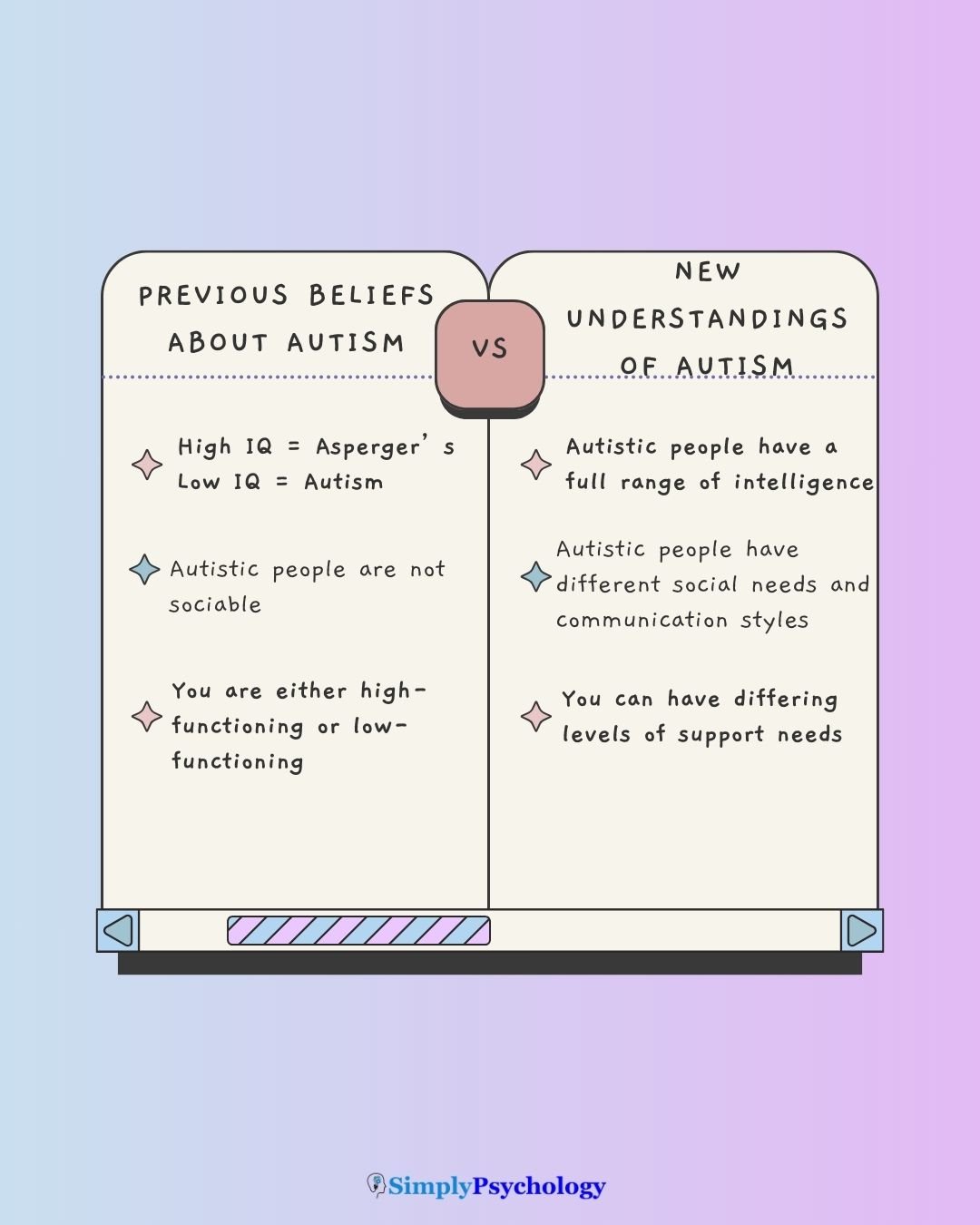
To understand where we are, we have to look at where we were. Previously, medical professionals viewed autism through a “deficit lens,” focusing only on what a person couldn’t do.
| Feature | Previous Belief (Asperger’s vs. Autism) | Modern Understanding (The Spectrum) |
| Language | Asperger’s had “normal” speech; Autism had delays. | Language is just one part of a spiky profile; it can change with age and stress. |
| Intelligence | Asperger’s required a high IQ; Autism was linked to lower IQ. | Autistic people have a full range of intelligence, just like neurotypical people. |
| Socializing | Asperger’s people “wanted” friends; Autistic people “didn’t.” | Everyone has social needs, but communication styles differ between neurotypes. |
| Functioning | You were either “High” or “Low” functioning. | Functioning labels are harmful; a person can be highly verbal but need 24/7 sensory support. |
As Dr. Megan Anna Neff suggests, these old distinctions often missed the “internalized” experience of many individuals, particularly women and girls, who were frequently misdiagnosed because they didn’t fit the narrow “Asperger’s” stereotype.
Why We Don’t Say “Asperger’s” Anymore
While you might still hear people use the term Asperger’s, it is rapidly fading from use—and for very good reasons.
Beyond the medical changes, the autistic community has largely moved away from the term. Here is why:
- A Dark History: The label is named after Hans Asperger, a pediatrician in 1940s Vienna. Modern historical research revealed that he cooperated with the Nazi regime, separating autistic children into those who were “useful” to society and those who were sent to clinics where they were killed.
- The “High-Functioning” Myth: As Dr. Neff points out, labels like “high-functioning” (often tied to Asperger’s) are deeply harmful. They dismiss the very real internal struggles, sensory overload, and burnout that these individuals face daily.
- It Divides the Community: Using a separate label creates an “us vs. them” mentality. It implies that some autistic people are “better” or “more acceptable” than others.
The “Spiky Profile” vs. The Linear Spectrum
One of the most important concepts in modern autism research is the spiky profile. Prof. Happé points out that we shouldn’t think of autism as a straight line from “mild” to “severe.” Instead, imagine a person has different “peaks” and “valleys” in their abilities.
- Peak: A person might have an incredible memory or a deep specialized interest in science.
- Valley: That same person might struggle deeply with “executive function” (like organizing a meal) or have intense sensory pain from loud noises.

By using the unified term “Autism,” we acknowledge that a person’s ability to speak fluently doesn’t mean they aren’t struggling with other invisible challenges.
Dr. Luke Beardon, a senior lecturer in autism, often emphasizes that Autism + Environment = Outcome. If the environment is supportive, the “spiky” parts of the profile don’t have to lead to distress.
Moving Toward Neuroaffirming Language
The shift away from Asperger’s is also a step toward neurodiversity-affirming care. This perspective views autism as a natural variation of the human brain, an alternative neurotype, rather than a broken version of a “normal” brain.
Dr. Neff and other experts advocate for language that respects the individual’s identity. This includes:
- Using identity-first language (e.g., “autistic person”) if that is the person’s preference.
- Focusing on support needs rather than “functioning labels.”
- Validating sensory experiences as real physical events, not “behavioral issues.”
As Steve Silberman, author of NeuroTribes, notes, reclaiming the word “Autism” helps build a broader community where everyone—regardless of their specific traits—can find belonging and shared understanding.
Conclusion: A More Accurate Future
The transition from Asperger’s to the broader Autism Spectrum reflects a deeper, more compassionate understanding of human biology.
We now know that the boxes we created in the past were too small to hold the reality of autistic lives.
By focusing on the spiky profile and environmental fit, we move away from “fixing” people and toward accommodating them.
Next Steps for Learning
If you or a loved one are navigating a new diagnosis or moving away from an old label, consider these actions:
- Audit Your Language: Start replacing “high/low functioning” with “low/high support needs” in specific areas (e.g., “I need high support with sensory environments”).
- Explore Your Spiky Profile: Map out where your strengths lie and where you encounter “friction” in your daily life.
- Connect with Autistic-Led Resources: Follow experts who share the lived experience of being autistic, such as the Neurodivergent Insights platform or community-led podcasts.
- Prioritize Sensory Safety: Recognize that sensory overwhelm is not “anxiety,” but a biological response. Adjust your environment to reduce the “too-muchness” of the world.


