



Imagine a garden, where each seed represents a unique thought, waiting to be nurtured into a flourishing plant. You might find yourself pondering how these seeds of cognition sprout, influenced by the intricate interplay of genetics, emotions, and social interactions. As you consider the stages of cognitive growth, it becomes clear that understanding this evolution can illuminate not just personal experiences but also the underlying mechanisms of disorders that disrupt this delicate balance. What insights might emerge when you explore the factors shaping your cognitive landscape?
Main Points
- Cognitive development involves understanding the world through experiences, influenced by internal mechanisms and external stimuli.
- Key milestones include sensorimotor exploration in infancy and abstract thinking in adolescence, shaping critical cognitive skills.
- Influential theories like those of Piaget and Vygotsky emphasize stages of growth and the importance of social interactions.
- Factors such as genetics, emotional health, and social interactions play crucial roles in cognitive development and learning processes.
- Lifelong learning is essential, fostering resilience and adaptability through self-reflection and curiosity across various life stages.
Overview of Cognitive Development

Cognitive development is a fascinating journey that shapes your understanding of the world. As you navigate life's experiences, your mind evolves, forging connections between thoughts, memories, and emotions. This process is deeply intertwined with your psychological landscape, influenced by both internal mechanisms and external stimuli. Understanding how cognitive disorders can impact this development is essential, as they may alter the pathways of learning and memory, affecting overall cognitive growth impairments include memory loss.
You might find yourself pondering how your perceptions and cognitive functions shift over time, revealing layers of complexity. Each thought you entertain serves as a building block, creating a rich tapestry of knowledge and insight. The interplay between your conscious and unconscious mind becomes essential; it influences how you interpret experiences and navigate relationships.

Consider the role of language in this development. It not only facilitates communication but also shapes your very thoughts. As you articulate your feelings and ideas, you're engaging in a profound act of self-discovery. This introspective journey allows you to confront your beliefs, question assumptions, and ultimately expand your cognitive horizons.
In recognizing the interplay of emotions and cognition, you begin to appreciate the holistic nature of your development. You're not just a passive observer; you're an active participant in this intricate dance of thought and feeling.
Stages of Cognitive Growth

Your journey through the stages of cognitive growth is marked by distinct phases that reveal how your thinking evolves over time. Each stage represents a unique way of interacting with the world, reflecting both your developmental milestones and the internal conflicts you navigate. As you progress, you shift from concrete, literal thinking to more abstract, complex reasoning. This change often mirrors the tensions between your immediate experiences and the broader concepts you begin to grasp. Research in cognitive psychology has shown strong links between brain function and behavior, emphasizing the significance of understanding these cognitive processes.

In the early stages, your cognitive structures are rigid, focused on tangible outcomes. However, as you mature, the fluidity of your thought processes allows for greater flexibility. You start synthesizing diverse ideas, which can lead to moments of cognitive dissonance. These moments challenge your existing beliefs, pushing you to reconcile contradictions within your understanding.
Throughout this journey, self-reflection becomes essential. By examining your thoughts and feelings, you gain insight into your cognitive patterns. This introspection not only fosters personal growth but also deepens your understanding of how you relate to others and the world around you. Embrace this evolution, for it's a fundamental aspect of becoming more conscious and aware of your cognitive landscape.
Influential Theories and Models
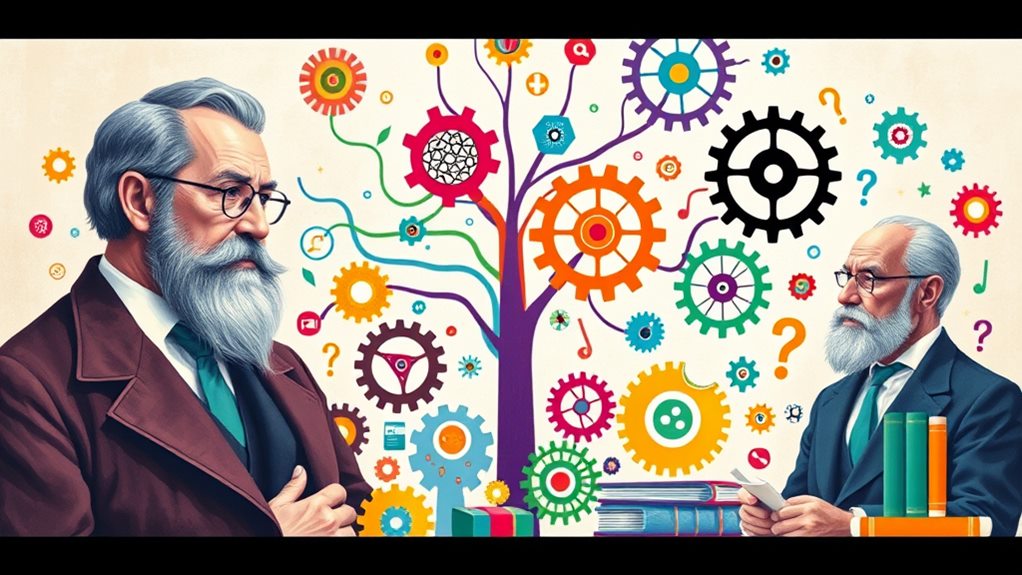
The landscape of cognitive development is shaped by several influential theories and models that provide insight into how thinking evolves across the lifespan. You might find yourself drawn to Jean Piaget's theory, which emphasizes the stages of cognitive growth, compelling you to reflect on how your own understanding has shifted through these phases. Piaget invites you to contemplate the intricate interplay between maturation and experience, urging you to explore how your environment has impacted your cognitive processes. Additionally, understanding cognitive disorders can enhance your perspective on cognitive development, as it highlights the challenges that can arise when these processes are impaired, showcasing the importance of cognitive rehabilitation in recovery and adaptation.

Then there's Lev Vygotsky's sociocultural theory, which encourages you to recognize the profound influence of social interactions and cultural context on your cognitive development. As you ponder Vygotsky's ideas, you may begin to appreciate how collaborative learning and language shape your thought patterns.
Lastly, you might resonate with the information-processing model, which likens your mind to a computer, dissecting how you encode, store, and retrieve information. This model prompts you to introspect on your cognitive strategies, fostering a deeper understanding of your learning processes. Each of these theories invites you to engage with your cognitive journey, revealing the intricate tapestry of your intellectual evolution.
Factors Affecting Cognitive Development

Amidst the myriad influences on cognitive development, both internal and external factors intertwine to shape how you think and learn. As you navigate through life, several key elements come into play, often reflecting your inner psychological landscape and external environment. Understanding these factors can provide insight into your cognitive evolution. For instance, cognitive dissonance can often lead to a reevaluation of beliefs, which in turn affects your learning processes and outcomes, highlighting the importance of cognitive conflict resolution.
- Genetics: Your inherited traits lay the groundwork for your cognitive capabilities, influencing everything from intelligence to specific learning styles.
- Emotional Health: Your emotional state can either enhance or hinder cognitive functioning. Anxiety and depression, for instance, can cloud your ability to think critically.
- Social Interactions: Engaging with peers and adults helps you develop language skills and critical thinking. These interactions often mirror your own psychological needs for connection and validation.
- Motivation: Your intrinsic drive to learn plays a pivotal role. When you're genuinely interested, your cognitive processes become more engaged, leading to deeper understanding.
Role of Environment and Experience


Environment and experience serve as powerful architects of cognitive development, shaping the landscape of your mind in profound ways. Your surroundings—both physical and social—act as a canvas where your thoughts, emotions, and perceptions are painted. Every interaction, every moment of engagement, builds neural pathways that can either strengthen or hinder your cognitive growth.
Consider how your early experiences—be it a nurturing environment filled with stimulating conversations or a chaotic atmosphere—imprint upon your psyche. Each stimulus, whether it's a kind word or a harsh criticism, carves out a piece of your cognitive framework. The interplay between your innate abilities and external influences is where the essence of who you are begins to take shape.
As you navigate the complexities of life, you're constantly synthesizing information from your surroundings, leading to deeper insights and understanding. This dynamic relationship with the environment fosters not just knowledge but also the capacity for critical thinking and emotional intelligence. Reflect on how your experiences have molded your cognitive processes, illuminating the intricate dance between nature and nurture in your journey of becoming.
Cognitive Milestones in Infancy


As you reflect on how your surroundings have influenced your cognitive development, it's important to recognize the specific milestones that occur during infancy. These milestones lay the groundwork for your future learning and understanding. During this critical period, your brain undergoes rapid changes influenced by both genetic and environmental factors.
You might notice four key cognitive milestones during this phase:
- Sensory Exploration: In the first few months, you engage with the world primarily through your senses, discovering textures, sounds, and sights.
- Object Permanence: By around 8 to 12 months, you begin to understand that objects continue to exist even when out of sight, revealing your growing awareness of the world.
- Imitation: As you approach your first birthday, you start mimicking behaviors, which indicates your ability to learn from others.
- Symbolic Thought: Near the end of infancy, you begin to use symbols, paving the way for language development and imaginative play.
These milestones reflect your cognitive evolution, shaped by interactions and experiences, influencing how you'll perceive and engage with the world later.
Adolescent Cognitive Changes

Often, during adolescence, your cognitive abilities undergo profound transformations that shape not just how you think but also how you perceive your identity and relationships. This period is marked by the emergence of abstract thinking, allowing you to explore complex ideas and contemplate your beliefs. You start questioning the world around you, seeking deeper meanings and grappling with existential dilemmas.
As you navigate these cognitive shifts, you may find yourself torn between childhood simplicity and the complexities of adult life. Your capacity for metacognition—thinking about your own thinking—grows, enabling you to reflect on your thoughts, feelings, and motivations more critically. This introspection can lead to self-discovery but might also evoke anxiety as you confront uncertainties about your future.
Moreover, your enhanced reasoning skills allow you to engage in moral and ethical debates, refining your sense of justice and empathy. You may become more aware of social dynamics and the perspectives of others, fostering a deeper understanding of relationships. Yet, this increased awareness can bring challenges, as the weight of social expectations and peer influences becomes more pronounced, prompting an ongoing exploration of who you are in a rapidly changing world.
Lifelong Learning and Adaptability


Emerging from the complexities of adolescence, the journey of cognitive development doesn't cease; instead, it morphs into a lifelong pursuit of learning and adaptability. As you navigate adulthood, your cognitive faculties are continually reshaped by experiences, insights, and the evolving world around you. This process isn't just about acquiring knowledge; it's about adapting to new contexts and challenges.
To deepen this understanding, consider these aspects of lifelong learning and adaptability:
- Self-Reflection: Regularly assess your beliefs and experiences. Self-reflection fosters awareness, allowing you to adapt your cognitive frameworks.
- Open-Mindedness: Embrace diverse perspectives. An open mind nurtures flexibility, enabling you to modify your thoughts and behaviors.
- Resilience: Cultivate the ability to recover from setbacks. Resilience in the face of challenges strengthens your cognitive agility.
- Curiosity: Maintain an inquisitive nature. A desire to learn fuels your cognitive growth and keeps your mind active.
Frequently Asked Questions
How Does Nutrition Impact Cognitive Development in Children?
When you consider how nutrition shapes a child's growth, it's fascinating to think about the deeper implications. You might notice that a well-nourished child often displays enhanced focus and emotional regulation. It's intriguing how the brain thrives on essential nutrients, fueling not just physical health but also mental clarity. As you reflect, you may realize that the choices you make today can profoundly influence their developing mind and future potential.
What Are the Signs of Cognitive Delays in Early Childhood?

You might notice a child struggling with basic skills or communication. They may have trouble following simple instructions or seem uninterested in play. If you see them avoiding eye contact or not responding to their name, it could signal a delay. Watch for difficulty in making friends or sharing toys, as these interactions often reveal emotional and social growth. Reflect on these signs, as they can guide your understanding of a child's developmental journey.
Can Cognitive Development Be Accelerated Through Specific Activities?
You might think that accelerating cognitive skills is like trying to teach a cat to fetch—nearly impossible! However, engaging in specific activities can indeed boost mental growth. Activities like puzzles, storytelling, and interactive games stimulate your mind, fostering connections and enhancing problem-solving abilities. By nurturing curiosity and creativity, you create a fertile environment for cognitive advancement. Reflect on how these interactions shape your thoughts, revealing a deeper understanding of your evolving self.
How Do Cultural Differences Influence Cognitive Development?
Cultural differences shape how you perceive the world, influencing your thought processes and emotional responses. Each culture instills unique values and practices that mold your cognitive frameworks. As you navigate social interactions, you internalize these norms, which can either expand or limit your understanding. Consider how your background influences your problem-solving and decision-making. Reflecting on these experiences helps you appreciate the complexity of thought shaped by diverse cultural contexts.
What Role Do Genetics Play in Cognitive Abilities?
Genetics certainly shape your cognitive abilities, influencing aspects like intelligence and memory. You might reflect on how certain traits run in your family, revealing a deep connection between biology and mental capacity. It's intriguing to contemplate how these genetic predispositions interact with your environment, creating a complex tapestry of thought and behavior. As you explore your own cognitive strengths and challenges, you may find that understanding this interplay offers valuable insights into your personal development.
Read The Next Blog Post –
In reflecting on your cognitive journey, it's fascinating how your experiences intertwine with internal growth, shaping your understanding of the world. Each stage of development coincides with pivotal moments that challenge and expand your thinking. As you navigate through life's complexities, consider how your environment and relationships have molded your cognitive landscape. Embracing this interplay fosters lifelong learning, allowing you to adapt and thrive. Ultimately, your mind's evolution is a tapestry woven from both personal insight and external influences.


