


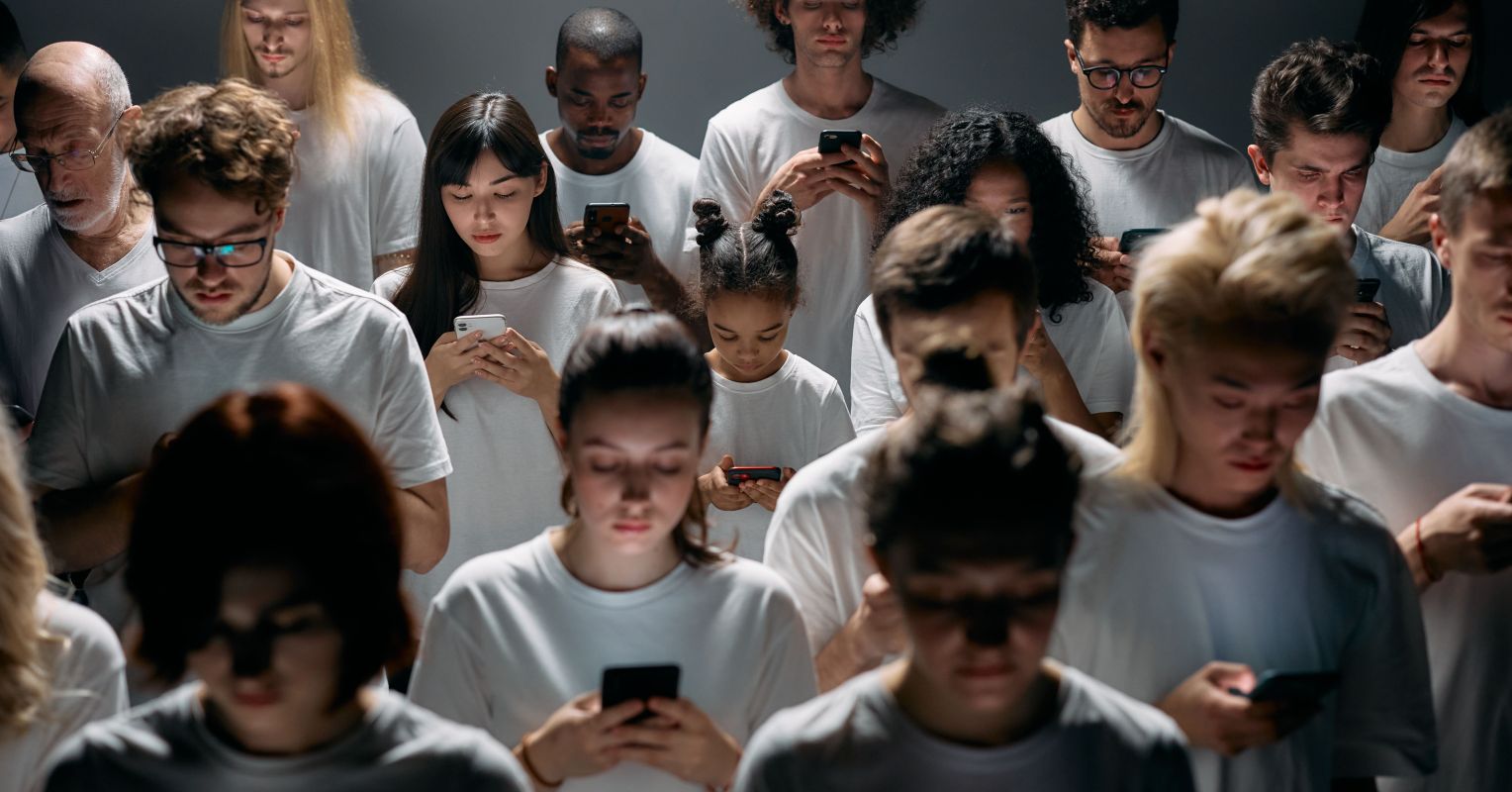
Chris Moody was a senior political correspondent with CNN for many years and is now a journalism professor at Appalachian State University in Boone, NC. He lives in a log cabin in a mountain hollow with his wife and their three-year-old son. The cabin has no cell signal. Over three years ago, they cancelled their home internet and went with a landline (intended to be a temporary measure for one summer). They write about it all in their Substack, The Opt Outers. I interviewed him about why willpower can’t compete with our devices, and what people who can’t move to the mountains can do instead.
Yael Hallak: I deleted my social media accounts six months ago. Then I came across the password to an old Instagram account, and I’m back to scrolling. I can’t move to the mountains. What can we do as a species?

Chris Moody: The tech companies know what grabs our attention, and they feed it to us (that’s how they make their money). Billions of dollars are being thrown at us, and no human will ever be able to win that battle every time, whether you’re trying to find an old password or simply want to switch your mind off.
So create what I call a Sabbath space — a room, a floor, a corner of the house, where these technologies simply can’t go in. Some people go down the route of “landlining,” where the phone is left plugged in on the kitchen counter, and you’re only allowed to use it there, standing. What would have been three hours on the couch comes down to three minutes. Think about whether you actually need Wi-Fi at all or whether a wired connection in one room would be sufficient. And make the rules when you’re sober; you don’t want to be relying on yourself when you’re drunk.
YK: Why not just go with discipline?

CM: Even if you’re not using it, the phone is still calling; it’s like the sirens calling out to Odysseus. Every moment is a decision, and decision fatigue wins. That’s why we have a scoop of ice cream at 9 p.m. and not at 9 a.m.
I drove fifteen minutes to a studio for this interview. My couch would have been far easier, but it’s worth it. When I’m finished in town, the laptop goes down, and at home I couldn’t have checked email if I’d wanted to. The people who need me have my landline. I’m not living in the 1890s, more in the 1990s.
YK: During the recent bank and flight outages, I was constantly refreshing X. Information is what makes me feel in control. My husband is always telling me to put the phone down and look out of the window.
CM: Today’s channels don’t give you any data that’s going to help. They just feed an appetite that can’t be quenched; they’re just empty calories. You can learn what you need from the Sunday New York Times once a week. A reporter on a presidential campaign needs real time. Most people don’t.
Look at the boomers, the richest generation in history, spending their days being angry online. Do they have more information? Possibly. Are they any happier? No.
YK: You teach undergrads; how are they getting on?
CM: They know the monster is coming for them and they think they’ve been had. Some of them, the ones brought up by phone-obsessed parents, are completely radicalised: “I’ll never ignore my child the way my own did.” When they see my Nokia flip phone, they go absolutely mental, and a few of them come back with “I’ve got one!” They’re just as hooked as everyone else, just as keen to get their hands on one, but they’re thinking about it very carefully. I’m hopeful.
YK: So many people want this life. What enabled you to get it?
CM: My first real job post-college was in social media (at the very beginning of it), and I saw what the algorithms did to my friends. I’m an extrovert, a golden retriever when the doorbell rings, and suddenly everyone just went off and into their screens. Mostly it’s my wife, really. She’s the one who drives it. Left to my own devices, I go with the flow.
YK: What do you do at dinners where everyone’s on their phone?
CM: At our place, it just works itself out as we don’t have phones. People come and ask for the Wi-Fi password, and I say we don’t have one; there’s a landline if you want it. They never do. We don’t have to take the rubbish we’ve been given; we can just eat the better stuff.
YK: Is there anything you’re missing? Podcasts, audiobooks?
CM: Not at all. I download the episodes in town and listen to them at home whilst doing the dishes. On Friday nights we watch a library DVD on a projector and a pull-down screen. It takes ten minutes to set it up, and that friction is important. Everything has a beginning and an end. It’s not “let’s just scroll to the next forever.” It’s: that’s all we’ve got.
Social Media Essential Reads
YK: So you just have more willpower than the rest of us?
CM: No! I have absolutely no willpower. I’m a disaster. When I’m on the road, and there’s Wi-Fi all over the place, I just go absolutely mad and end up with no idea how the time has gotten away from me. The solution is systems, really. Less friction for the good things, more for the bad. In New York, we put our phones in baskets by the door, and we had the router on a timer, which would turn it off from 8 p.m. to 8 a.m. If we’re going to rely on willpower, we’re all going to fail. We all are.
