


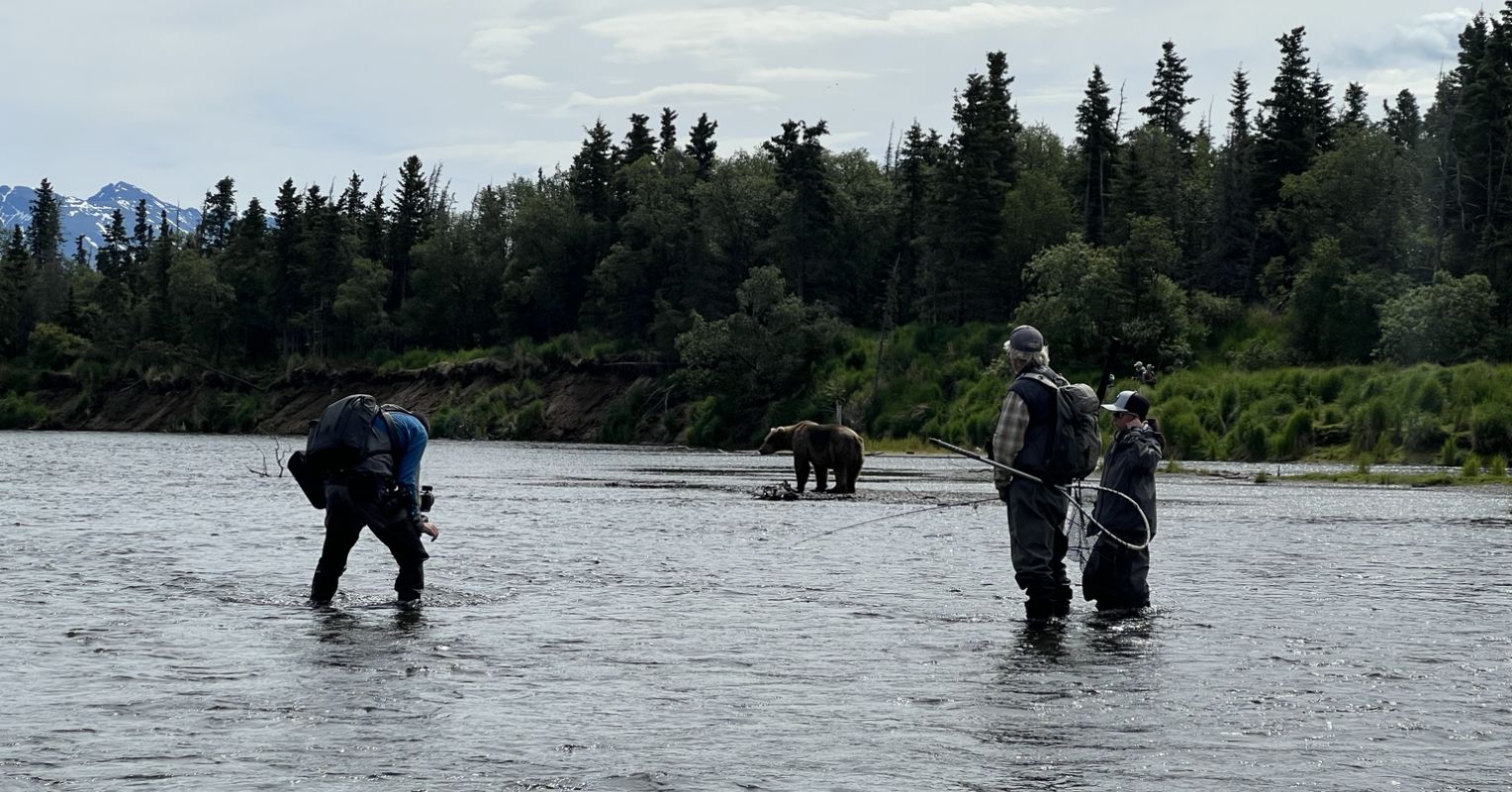
I was wading in a river in Alaska when a man beside me hooked a salmon and a brown bear began moving directly toward him. He had already done the hard part: he had hooked the fish, kept tension on the line, and begun reeling it toward him. Then the bear entered the water.
He did not try to reel faster. He did not hold his ground or calculate whether he might still be able to keep the salmon. He cut the line and walked away. The bear got the fish. He got to keep fishing. The entire decision took about four seconds.

I have thought about it ever since, because most of the things we struggle to release do not arrive with a brown bear attached to them. They unfold slowly. A project keeps consuming time without gaining traction. A job no longer fits, but still offers enough familiarity to make leaving difficult. A relationship changes, yet both people remain committed to the version of it they once believed was possible. There is no single moment that forces a decision. So we keep going, not always because continuing is the right choice, but because we have already invested so much that stopping begins to feel irresponsible.
Psychologists call one version of this escalation of commitment.
We continue investing in a decision partly because walking away would force us to confront the possibility that the time, energy, or emotion already spent will not produce what we hoped. In plain language, we keep going not necessarily because something is working, but because stopping would require us to admit that it may have stopped working some time ago.
Why the River Made the Decision Clear

It would be tempting to say the fisherman’s body made the decision before his mind could interfere, but the physiology is more complicated than that. Immediate threats mobilize the nervous system, narrow attention, and move us toward faster action. But what made his decision so clean was not simply adrenaline. It was clarity. Whatever he had already invested in catching that salmon no longer mattered. The next decision was about what continuing might cost.
The Weight We Keep Carrying
Most of us never get that kind of clarity, because nothing forces us to put the sunk cost down. We carry both calculations at once: what we have already spent, and what continuing will still cost us. Letting go can feel like declaring the earlier investment worthless, so we keep adding to it instead, hoping enough time will eventually justify the time already spent. It rarely works that way. The count just gets longer.
What We’re Actually Protecting
The people who find this hardest are usually protecting more than the outcome. If part of who you are is the person who doesn’t quit, in a relationship, a job, a friendship, a project, then stopping isn’t just a practical decision. It’s a threat to the story you tell about yourself. A few months ago I wrote about the trap of needing to keep proving yourself. This is its quieter relative: the trap of refusing to stop, long after the point has already been made.
Consider the relationship two people stay in years after it has stopped working, because ending it would mean admitting the years already spent don’t count for what they’d hoped. Or consider the job someone stays in well past the point of growth, because leaving would mean admitting the earlier choice wasn’t the one they thought it was. We tend to trust people more, including ourselves, when they can say, out loud, that something didn’t work.
The Test That Actually Works
The fisherman didn’t ask what he had already put into that fish. He asked what continuing would cost him now, with a bear ten feet away. We can ask the same question without the bear. Don’t ask: Can I still make this work? Lots of people can keep many things functioning far longer than they remain worthwhile. Ask instead: If I were deciding today, for the first time, knowing everything I know now, would I choose this? Ignore what you have already spent. It cannot be recovered by spending more.
A “no” does not mean the decision has already been made for you. It means you now have information you did not have a moment ago, and a choice to make with open eyes instead of momentum. Sometimes that choice is to leave. Sometimes real constraints, financial obligations, safety, timing, or responsibility to other people mean the right move is a slower exit, a repair attempt, or a plan instead of an immediate departure. The test does not tell you what to do next. It tells you the truth you are actually working with.
Cutting the line was not a failure of commitment. It was commitment, once the weight of what he’d already spent stopped being part of the equation.
If you were deciding today for the first time, what would you choose?
