


It happens sometimes when I am dreaming.
I catch myself thinking, “Hold on—wait a second—dogs don’t sing,” or, “I don’t work for the government,” or, “Swimming pools don’t fly.”
And in that moment, I know I am dreaming. What I thought was real dissolves like mist. It’s a projection—shimmering at the edges, ready to disappear.
But here’s the question: what if we could wake up like that in the waking world? What if we could peer at the stories we tell ourselves, the identities we wear, the solidness we ascribe to our lives, and say: Wait a second… this isn’t real either, not really.

This brings to mind khomar, a Pashto word I learned on my podcast Fifty Words for Snow from Afghani guest Sanjar Qiam describing a state of dreamy wakefulness.
Source: Sanjar Qiam/Used with Permission
The Elusive Dance of Khomar
Fifty Words for Snow is all about exploring words without direct English equivalents—those linguistic treasures that capture something nuanced, something we feel but can’t articulate. And khomar is exactly that.

According to Sanjar, khomar describes a state of dreamy wakefulness. You’re not asleep, not unconscious, but you’re not entirely here either. You’re adrift in a hazy in-between, eyes open but seeing something more ethereal. It’s a word that defies rigid definition, an experience that slips through your fingers even as you try to grasp it.
It reminds me of the Buddhist concept of maya, the illusory play of appearances that makes up our so-called reality. We’re all wandering through this life, convinced of its solidness, its permanence, its truth. But what if we’re mistaken? What if, like the dream, it’s all fleeting—shimmering, soft, unreal?
The Beauty of Being Half-Awake
Sanjar shared how khomar can also be a gentle rebuke. Imagine someone zoning out, lost in their thoughts, untethered from the present moment. You might say, “You’re so khomar today,” to nudge them back to reality. But here’s the twist: khomar isn’t just a state of distraction. It’s also a state of magic.
In one of Afghanistan’s most beloved folk songs, khomori sterge—“dreamy eyes”—are praised as a lover’s most enchanting quality. These are the eyes that see the world not as it is but as it could be, softened by longing, lit with imagination.
And doesn’t that describe so much of our own lives? We drift, we dream, we imagine. And in those moments, we’re suspended between what’s real and what’s possible, hovering in that mystical khomar state.
Source: Sanjar Qiam/used with permission
The Hard Spell of Waking Up
But let’s not get too comfortable in this haze. The dream, while beautiful, can trap us. It’s easy to stumble through life half-asleep, wrapped in stories about who we are, what we own, and what we need.
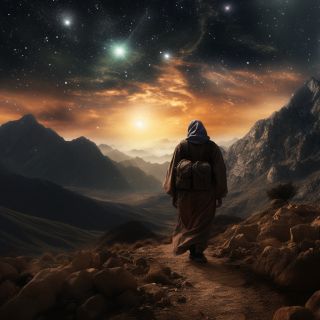
The gift of khomar isn’t just its dreamy quality—it’s the invitation to wake up. To see through the illusions we cling to, to let the sharp bell of awareness shatter the hard spell of separation. What if we could look at ourselves and say, Hold on… this “me” isn’t real. This “you” isn’t permanent. What if we could awaken, not just from our dreams but from our waking illusions?
A Rebellion Against Perceived Reality

Source: Sanjar Qiam/used with permission
For me, khomar is a reminder to rebel—not against the world, but against my own delusions. To see life not as a rigid, unyielding structure but as a shimmering, fleeting dream. It’s a call to question everything: Am I awake? Am I dreaming? What is happening here?
So the next time you find yourself lost in thought, consider khomar. Let it be a reminder to gently awaken to where you are, to see the shimmer of reality’s edges, and to find beauty in the fleeting nature of it all.
Because sometimes, waking up in the waking world is the most vivid dream of all.
Source: Sanjar Qiam/used with permission
