


Internalized ableism occurs when an autistic individual absorbs and accepts negative stereotypes, stigmatizing attitudes, and deficit-based narratives perpetuated by a neurotypical society.
This psychological phenomenon transforms societal prejudice into personal self-reproach. Autistic individuals regularly internalize these structural biases instead of recognizing that their daily challenges stem from an inaccessible environment.


Consequently, natural autistic traits are viewed as personal failings, defects, or character flaws rather than valid biological differences.
Origins Of Internalised Ableism
Societal systems continuously inflict minority stress on neurodivergent individuals, laying the groundwork for internalized stigma.
Minority stress refers to the chronic, high-level stress experienced by stigmatized minority groups due to their marginalized social status.

According to expert Dr. Amy Pearson, this process forces the integration of dehumanizing societal attitudes directly into the autistic self-concept.
Development occurs over extended periods through specific structural pipelines:
- Repeated Rejection and Stigma: Chronic exposure to social rejection, bullying, and overt discrimination erodes self-worth.
- Childhood Experiences and Therapies: Early interventions often demand the suppression of natural behaviors like stimming. Stimming, or self-stimulatory behavior, involves repetitive physical movements or sounds used for emotional regulation. When behavioral therapies teach children to repress these habits to appear “normal,” individuals internalize a deep-seated belief that they are inherently wrong.
- Lack of Contextual Knowledge: Young people frequently encounter deficit-based messaging without learning about neurodiversity or systemic barriers. Neurodiversity defines neurological differences as natural, normal variations of the human genome. Lacking this conceptual framework, youth cannot recognize their negative experiences as systemic discrimination, which inevitably triggers intense self-blame.
The Multifaceted Impact on Autistic Well-Being
Internalized narratives function as a form of social oppression that directly damages emotional well-being, personal agency, and self-confidence.
This psychological burden manifests across multiple domains of an individual’s life, creating severe barriers to mental health and autonomy.
Psycho-Emotional Disablism and Mental Health
Deep-seated shame develops regarding any characteristics that deviate from neuro-normative expectations.
Neuro-normative standards dictate the socially constructed ideals of typical neurological functioning and behavior. This internalized stigma causes lifelong anxiety, depression, trauma, and lowered self-esteem.
Disempowerment and Silence
Internalized ableism severely disempowers autistic individuals, forcing them to doubt the validity of their own lived experiences.
Self-advocacy becomes hindered because individuals feel unworthy of accommodations. Furthermore, this systemic self-doubt makes people far less likely to seek professional help or necessary support.
Forced Masking and Identity Erosion
Shame drives autistic individuals to engage in masking, which is the exhausting, conscious suppression of autistic traits to mimic neurotypical behavior.
Masking aims to avoid social rejection, but it simultaneously leaves the underlying stigma completely unchallenged.
Conversely, individuals experiencing lower levels of internalized stigma find it much easier to safely disclose their neurodivergent identity to others.
Specific Manifestations of Internalized Ableism
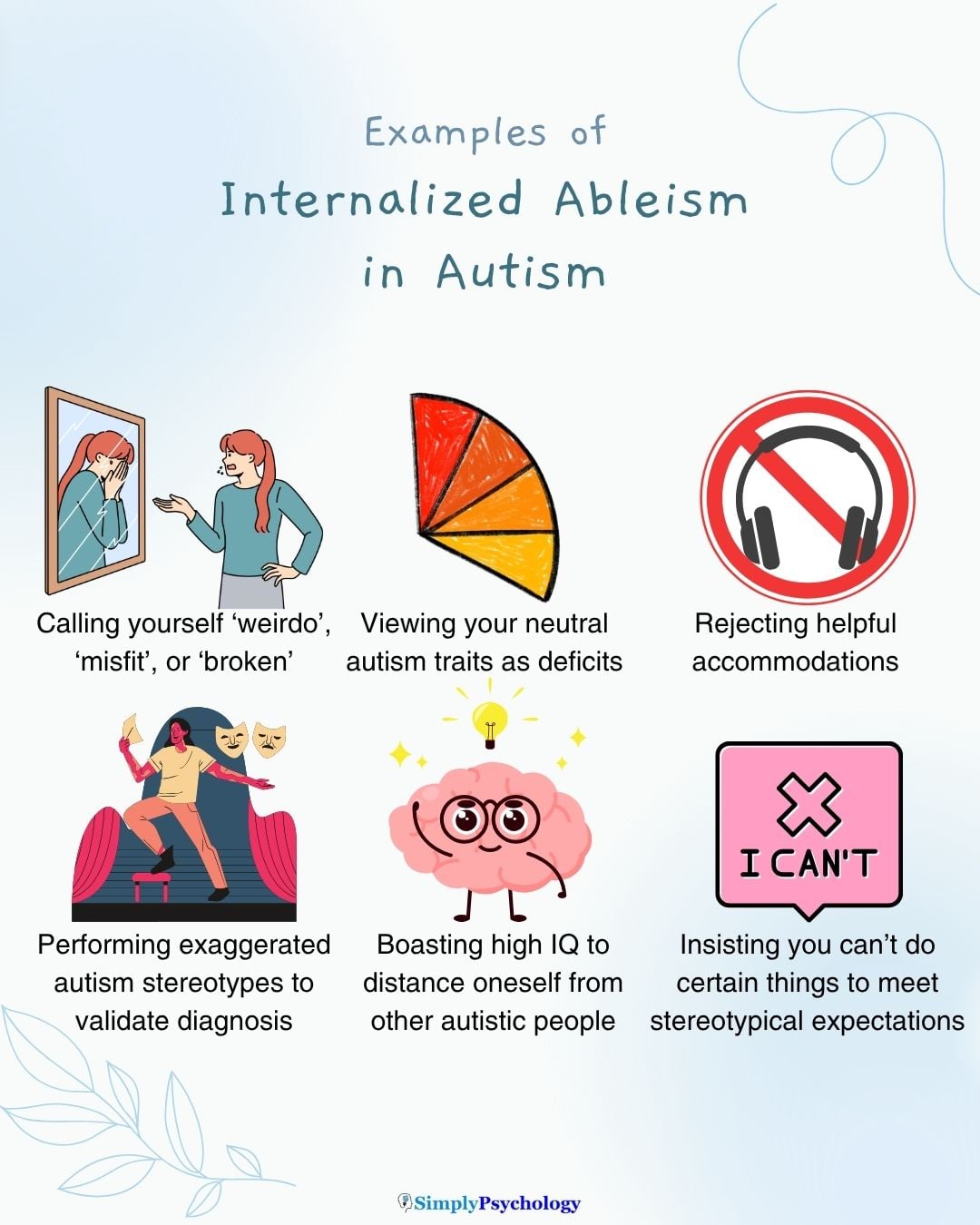
Internalized stigma alters how individuals talk about themselves, perceive their traits, and navigate interpersonal relationships. The list below illustrates specific examples of how internalized ableism shows up in autistic people:
- Adopting Stigmatising Language: Individuals may describe themselves using derogatory terms like “weird,” “misfit,” “defective,” or “freak”.
- Viewing Neutral Traits as Problematic: Autistic people may view benign traits such as intense attention to detail or repetitive behaviors as pathological.
- Engaging in “Aspie Supremacy”: Individuals may attempt to distance themselves from what society views as a spoiled identity. They may hyper-focus on high intelligence or academic success to separate themselves from other autistic people, reinforcing the harmful idea that compliance and productivity dictate human worth.
- Denying Personal Accommodations: Autistic adults might reject helpful modifications, viewing tools like noise-canceling headphones, flexible hours, or external assistance as unearned luxuries rather than actual necessities.
- Experiencing Severe Imposter Syndrome: Individuals suffer from intense diagnostic doubt, constantly fearing they are faking their struggles. Alternatively, they may strictly force themselves to perform rigid, exaggerated autism stereotypes to validate their diagnosis.
- Harsh Comparative Tailspins: Individuals judge themselves against neurotypical standards for tasks like sitting still or maintaining a standard 9-to-5 job. When they struggle, they mentally punish themselves as failures.
Vulnerability to Interpersonal Abuse
Internalizing a lesser social status significantly may increase an autistic person’s vulnerability to interpersonal violence, polyvictimisation, and domestic abuse.
Polyvictimisation refers to the experience of enduring multiple distinct types of victimization over a lifespan. Pearson’s research into intimate partner violence reveals that internalizing negative societal attitudes disrupts an individual’s safety mechanics.
First, individuals normalize mistreatment because they experience dehumanizing treatment from an early age.
Many victim-survivors report feeling that they inherently deserved to be treated poorly simply because they were autistic. Because poor treatment is normalized, identifying manipulative or abusive behavior in partners becomes incredibly difficult.
Second, chronic stigmatization causes individuals to view themselves through a self-objectifying lens. They perceive themselves as malleable objects whose primary purpose is to satisfy the expectations of others, eroding personal boundaries.
Finally, this boundary erosion triggers a trauma response known as fawning, which involves utilizing extreme people-pleasing behavior to avoid conflict and secure safety.

Autistic individuals adopt heightened compliance, hoping total submission will prevent further harm. Nefarious individuals frequently exploit this intense politeness, trapping the victim in cycles of violence.
Shame then creates a final barrier, preventing victims from disclosing the abuse due to fears of being disbelieved.
Deconstructing Internalized Ableism
Dismantling internalized negative narratives is a conscious, active process of unlearning neurotypical expectations and building a positive self-concept.
Autistic individuals and their support systems can utilize several clear, strategic pathways to actively counter internalized stigma, as outlined below:
Reframing Experiences Through Cognitive Reappraisal
Individuals must actively shift away from a deficit-based medical model toward identity-affirming frameworks like the neurodiversity paradigm.
Cognitive reappraisal involves reframing personal distress compassionately as a rational response to a hostile, inaccessible environment rather than a personal failure.
Recognizing systemic faults reduces self-blame, transforming deviations from neuro-normative standards into a valid identity.
Connecting with the Autistic Community
Engaging with other autistic people, often called neurokin, provides a powerful buffer against minority stress.
Community connectedness builds collective self-esteem, which is the pride and positive value derived from one’s social group identity.
Shared spaces allow individuals to normalize their lives, replacing self-stigma with the realization that they are normal autistic individuals rather than abnormal neurotypical people.
Self-Education and Language Reclamation
Learning about the psychological and scientific context of autistic traits, such as executive functioning differences or sensory overload, removes personal blame. This self-education replaces hypercritical self-views with self-validation.
Furthermore, adopting neurodiversity-affirming language reduces stigma. Moving away from pathologizing terms toward identity-first language (e.g., “autistic person”) positions autism as an inherent, valued part of identity.
Cultivating Authenticity and Affirming Support
Practicing daily self-compassion combats the shame spirals associated with social rejection or perceived mistakes.
Individuals must consciously unlearn rigid societal standards, allow themselves to safely unmask, and honor natural traits like stimming to regulate emotions.
Additionally, seeking out professionals who utilize a neurodiversity-affirming framework reinforces positive identity.
These specialists prioritize quality of life, autonomy, and environmental accommodations over forced compliance with neurotypical norms.
References
Botha, M., & Frost, D. M. (2020). Extending the minority stress model to understand mental health problems experienced by the autistic population. Society and mental health, 10(1), 20-34. https://doi.org/10.1177/2156869318804297
Pearson, A., Rose, K., & Rees, J. (2023). ‘I felt like I deserved it because I was autistic’: Understanding the impact of interpersonal victimisation in the lives of autistic people. Autism, 27(2), 500-511. https://doi.org/10.1177/13623613221104546
Pearson, A. (2025). Autism, interpersonal violence, and hate crime. In The Routledge Handbook of Disability, Crime, and Justice (pp. 500-519). Routledge.
