


This post is part 2 in a series. Click here for part one.
Narcissism can be thought of as either healthy or pathological. In healthy or “normal” narcissism, writes Jungian analyst Mario Jacoby (1991), we have “realistic ambitions and an adequate sense of self-esteem. . . . We are all in continual need for recognition, of having our existence and our worth acknowledged by others.” But in neurotic or pathological narcissism, these needs and qualities are amplified and distorted as the tragic consequence of having not been met by others in the past.
The Story of Little Briar Rose (Sleeping Beauty)

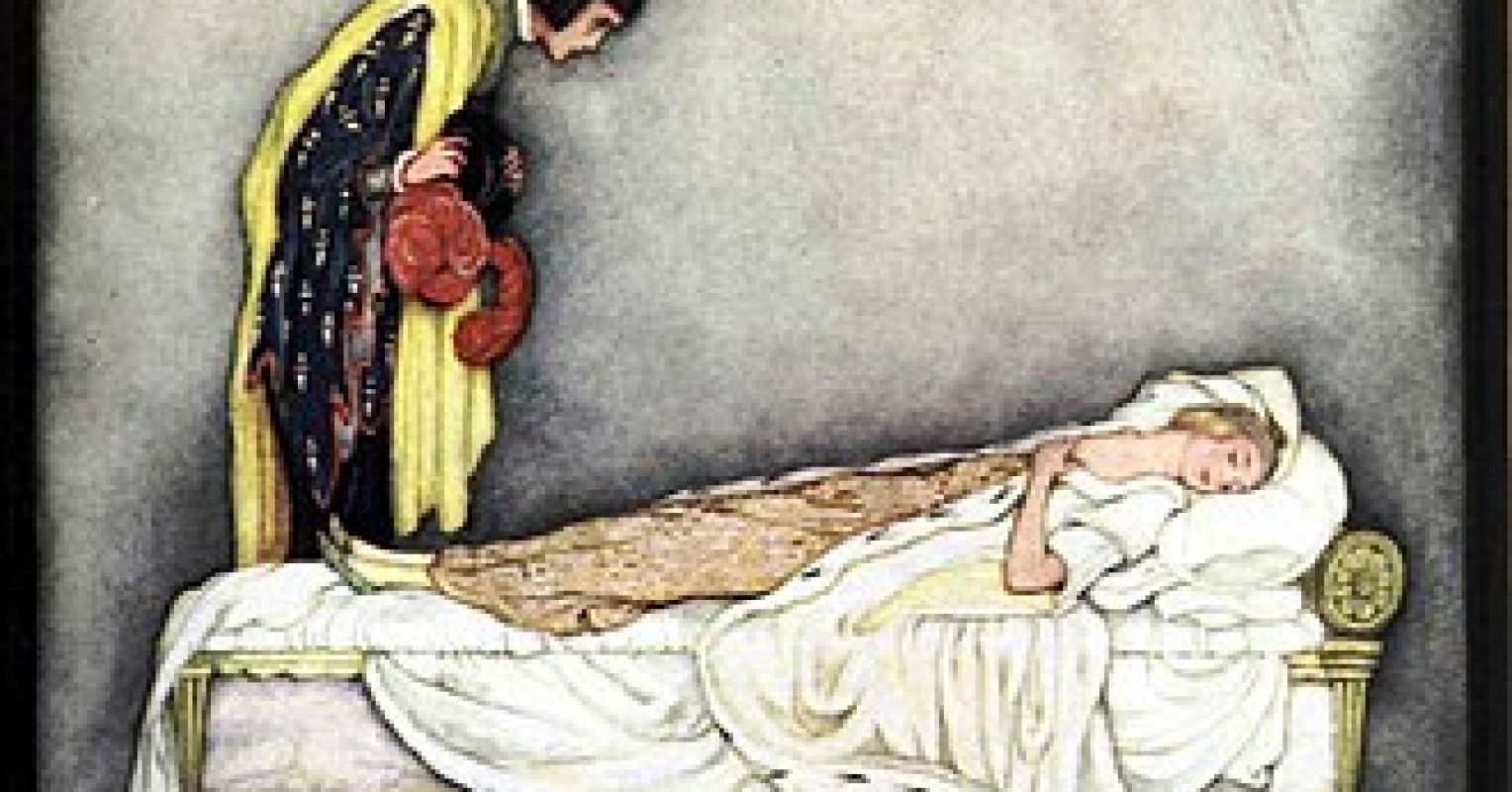
Another myth depicting the bitter, vengeful, negative quality of neurotic narcissism is the Grimm’s fairy tale “Little Briar Rose,” better known to some as “Sleeping Beauty.” In that story, Briar Rose is placed under an evil spell by a narcissistically offended and furious witch who declares that at the age of 15, the girl will fall into a century-long sleep from which no one will be able to awaken her. When, on her 15th birthday, the princess accidentally pricks her finger with a sewing needle as the witch predicted, the terrible prophecy is fulfilled, and she succumbs to a coma-like slumber. All life and vitality around her is also curtailed, except that around her castle, a thick hedge of stiletto-like thorns grows, swallowing the entire structure and rendering it totally inaccessible.
As the legend of this bewitched sleeping beauty spreads across the land, suitors from far and wide make valiant efforts to penetrate the thorny briar protecting the princess, only to be fatally impaled upon it. The grotesque image of these luckless suitors skewered on deadly thorns and suffering an agonizing fate bespeaks the poignant experience of every man or woman who has tried in vain to get closer to a narcissistically prickly person. Such Briar Rose-types (both female and male) are still so unconsciously enraged and bitter about prior rejections, disappointments, and narcissistic injuries that they are simply not psychologically prepared or ready for any real relatedness or true emotional intimacy, despite what they may consciously believe or say. Sex, of course, may be another matter entirely. But sexuality is not necessarily intimacy.
Prickly defense mechanisms serve to protect the insecure, vulnerable, emotionally wounded individual, in much the same way literal thorns protect a rose’s delicate petals or the succulent bitter-sweetness of the blackberry. We may successfully fend off (i.e., offend) those persons by whom we fear someday potentially being hurt emotionally. But, in so doing, we imprison ourselves within protective thorny castles of our own creation, condemning ourselves to lives of alienation, isolation, and painful loneliness. These metaphorical thorns consist of defensive symptoms or signs such as hostility, animosity, negativity, cynicism, mockery, judgmentalism, contempt, hypersensitivity, sarcasm, distrust, etc. It is a lonely, self-imposed life sentence of solitary confinement that, for some, feels like an unbreakable curse, spell, or uncanny run of bad luck in their love life. But is it truly some external kind of bewitchment or voodoo at work here, or might the problem be emanating from within the person themselves? Could he or she be unwittingly or unconsciously sabotaging any potentialities for real relationship for fear of being hurt, rejected, or abandoned again? Neurosis is, in effect, like some powerful evil spell or curse cast by someone or something in the person’s past and continuing to negatively influence the present and future. Unconsciousness of this neurosis, its causes, and its negative effects, can be likened to the princess’s protracted state of profound sleep. For psychotherapy, the challenge resides in how to help the bedeviled patient break this insidious spell and free themselves from its evil power.

This key question of psychological “readiness” is as central to the story of Briar Rose as it is to the thorny relations between women and men. It takes real courage to create intimate relationships, since we all have our share of protective prickliness through which to navigate. Like much in life, it’s all about timing. We can see both the terrific courage and impeccable timing required to overcome these barriers to intimacy in the happy—well, fairy-tale ending—of the story: A brave, valiant, and persistent young prince, undaunted by the grisly lot of her numerous, now dead would-be suitors, decides, against all wise counsel to the contrary, to seek the hand of the sleeping princess as his bride. Ready to courageously risk life and limb, surmounting the perilous spiny hedge, the hero instead suddenly finds magnificent flowers in its place, which, magically parting for him, provide easy access to the castle—and the beautiful sleeping princess. As fate or luck would have it, for both the hero and princess, the 100-year spell ends at precisely the moment he arrives on the scene. As with so many other things in life, timing is everything. When the gallant hero gently kisses the waiting lips of the still somnolent princess, she is at long last ready to waken and return to life. And to love. Intimacy and love, in the deepest sense of permitting another person access into the self-constructed and well-defended fortress surrounding one’s heart, always involve a choice, a fundamental, fateful decision to fully live, to love, to risk, to feel, and to care deeply about another.
