


Social influence is the way other people affect what we think, feel and do. In AQA GCSE Psychology (8182), it is Section A of Paper 2, worth 25 of the 100 marks. The topic covers conformity, obedience, helping in an emergency and the behaviour of crowds.
Key Takeaways
Conformity
- Conformity is changing your behaviour or opinion because of real or imagined pressure from a majority, which is a larger group that agrees.
- Social factors, which are about the situation, raise conformity: a bigger majority, answering in front of others (not anonymously) and a harder task.
- Dispositional factors, which are about the person, matter too: personality and expertise, which means special knowledge or skill. An expert conforms less.
- In Asch’s study, male US students judged line lengths after confederates (secret helpers) gave wrong answers. They gave the group’s wrong answer 36.8 per cent of the time.
Obedience
- Obedience is following an authority figure’s orders. Milgram’s Agency theory explains it: we obey when we act for the authority figure, so we feel less responsible.
- A uniform or a close authority raises obedience, and a close victim lowers it. Cultures differ in how far they value obedience.
- Adorno, a psychologist, said some people have an authoritarian personality: obedient to those above, looking down on those below, and thinking in black and white, often after harsh parenting.
Prosocial Behaviour
- Bystander behaviour is what a person does when they see someone needing help. Bystander intervention means actually helping.
- Social factors: with more people present, each feels less responsible. A high cost of helping, such as effort, time or risk, lowers helping.
- Dispositional factors: we help people we see as similar to us. Expertise, such as first aid skills, makes helping more likely.
- In Piliavin’s subway field experiment (a real-life setting), a walking-stick victim was helped within 70 seconds in 95 per cent of incidents, a drunk one in 50 per cent.
Crowd and Collective Behaviour
- Collective behaviour is the actions people carry out when they are part of a group. It can be prosocial (helpful) or antisocial (harmful).
- Social loafing is making less effort in a group than alone. Deindividuation is losing your sense of who you are in a crowd, so you feel less responsible.
- Culture matters too. Groups that put the group first, called collectivist cultures, tend to show less social loafing.
- Personality, such as worrying what others think, and morality, your sense of right and wrong, affect whether a person joins in with a crowd.
Exam Skills
- For a study or theory, give the aim, method, results and conclusion. Then evaluate it, which means give strengths and limitations linked to that study or theory, not to studies in general.
Simply Psychology Answers
Instant answers built on 19+ years of trusted expertise.
Conformity

Have you ever done something because your friends were doing it? That is conformity. It means changing your behaviour or opinion because of real or imagined pressure from a group.
The group that applies the pressure is called the majority, so the specification talks about majority influence. Read more about conformity.
Simply Psychology Answers

Instant answers built on 19+ years of trusted expertise.
Psychologists name two kinds of factor that change how much people conform. You must be able to tell them apart.
Simply Psychology Answers
Instant answers built on 19+ years of trusted expertise.
Social factors are about the situation or the people around you. Dispositional factors are about the person, such as their personality or skills.
Social and Dispositional Factors Affecting Conformity to Majority Influence
In the exam you get marks for identifying a factor and explaining how it changes conformity. A definition alone earns nothing, so add an example that says which way the factor pushes.
Social Factor: Group Size
Group size is the number of people in the majority. In the exam, a bigger majority led to more conformity. In one question, groups of 4 or 5 showed the most conformity.
A bigger majority makes it harder to stand out. Disagreeing with one other person is easy. Disagreeing with several people feels much harder.
Social Factor: Anonymity
Anonymity means nobody knows who gave the answer. Answering privately lowers conformity, because nobody can disapprove of you.
In one early study, people gave their judgements either face to face or in private, by pressing a button behind a screen. The private group showed much less social influence (Deutsch & Gerard, 1955).
Social Factor: Task Difficulty
The harder the task, the less sure you are of your own answer. So you are more likely to follow other people.
In the exam you get marks for an example. A complex maths problem leads to more conformity than working out 2 + 2.
In later experiments, Asch made the lines more alike. This made the task harder, and conformity rose (Asch, 1956).
Dispositional Factor: Personality
Dispositional factors are personal characteristics that may affect a person’s behaviour or choices. Not everyone in the same group conforms, so something about the person must matter. The specification names two: personality and expertise.
Simply Psychology Answers
Instant answers built on 19+ years of trusted expertise.
Personality is the set of characteristics that make you who you are. It differs from person to person. In the exam, you need not name a trait.
Locus of control is one example that the specification does not name. People with an internal locus of control believe they control their own lives.

A survey of 516 Ethiopian secondary school students found that this went with less conformity (Gebresilase et al., 2026). A survey shows a link, not a cause. Read more about locus of control.
Dispositional Factor: Expertise
Expertise means special knowledge or skill. A person with expertise in a task trusts their own answer, so they are less likely to conform on it.
In the exam you get marks for an example. A mathematician is less likely to conform on a maths problem than someone with no maths knowledge. The reason is confidence in their own answer.
Asch’s Study of Conformity
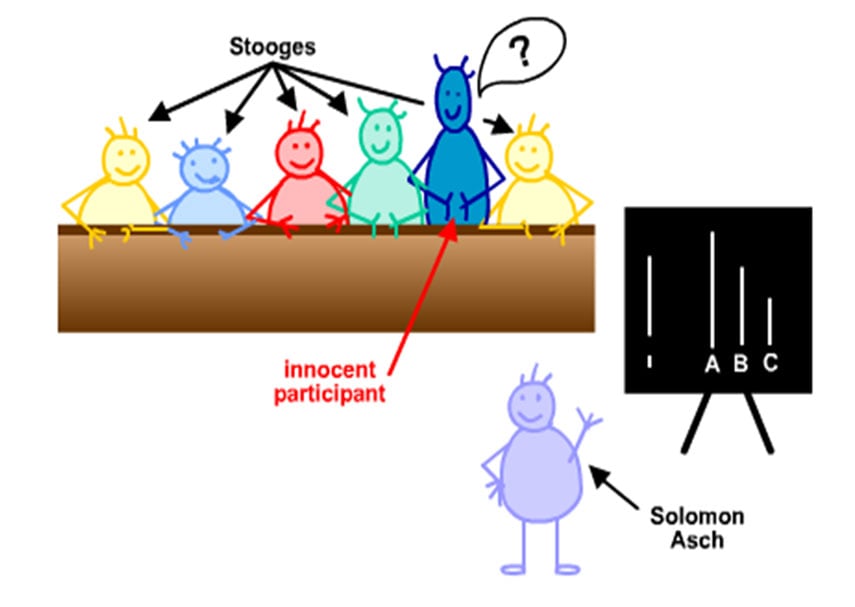
Solomon Asch was an American psychologist (Asch, 1955). He wanted to test conformity with a task that had an obvious right answer, so that any wrong answers had to come from group pressure.
Read more about Asch’s conformity experiments.
- Aim: To see whether people would go along with a group’s wrong answer when the correct answer was obvious.
- Method: This was a laboratory experiment, which means a controlled but artificial setting. The participants were male college students in the USA. They were put into groups of 7 to 9 people.
- The Confederates: Only one person in each group was a real participant. The others were confederates, which means secret helpers who follow the researcher’s plan. The real participant did not know.
- The Trials: There were 18 turns, called trials. Each trial showed a set of lines: a target line and three comparison lines.
- The Task: One at a time, each person said which line matched the target.
- Answering Last: The real participant always answered after hearing many wrong answers.
- The Wrong Answers: On 12 of the 18 trials, the confederates had been told to give the same wrong answer.
- Variables: Asch changed the number of confederates. The independent variable, which the researcher changes, was group size. The dependent variable, which is measured, was the number of participants who conformed.
- Variations: In the exam, group size, task difficulty, anonymity and expertise are all variations of Asch’s study. They are ways of investigating conformity.
- Results: On 36.8 per cent of trials, the participants gave the same wrong answer as the confederates.
- Conformed at Least Once: 76 per cent of participants conformed at least once.
- Never Conformed: Only 24 per cent gave the correct answer every time.
- Conclusion: When people feel pressure to fit in with a group, they will conform and change their behaviour.
Strengths of Asch’s Study
- Control: In a laboratory, the researcher controls extraneous variables, which are other things that could change the results. So we can be surer that group pressure caused the wrong answers.
- Standardised Procedure: This means every group gets the same instructions. It makes the study easy to repeat, so other researchers can test whether the findings are reliable.
- Replication: Other researchers have repeated the line task in many countries. A review compared 133 line-judgement studies from 17 countries (Bond & Smith, 1996).
- Group Size: Asch could change the number of confederates. This showed that group size affects conformity.
Limitations of Asch’s Study
- Ecological Validity: This means how well findings fit real life. Judging lines among strangers is not an everyday task, so people may not have behaved as they normally would.
- Demand Characteristics: These are clues that tell participants they are in a study. Participants knew they were in a study, so this may have changed their behaviour.
- Trivial Task: The task was not important, and a wrong answer cost nothing. People may conform less when the consequences matter.
- Sample Bias: All the participants were male students from the USA. So the findings may apply only to a small section of the population.
- Culture: A culture is the unwritten rules that a group of people share. Asch’s study was done in an individualistic culture, where people put themselves first.
- Collectivist Cultures: Conformity is higher in collectivist cultures, where people put the group first (Bond & Smith, 1996). So the findings may not apply to every culture.
- Time: The 1950s was a time of high conformity in America. In an exact replication in 1980, only one participant conformed (Perrin & Spencer, 1980).
- Child of Its Time: So the result may belong to that period only. The exam calls this a “child of its time”.
Ethics of Asch’s Study
A past exam asked whether Asch’s study would be considered ethical now. The British Psychological Society (BPS) sets the ethical guidelines for psychologists in the UK. Four points earned marks.
- Informed Consent: Participants thought they were taking part in a vision test. So they did not know what they were agreeing to. Today they would need to be told everything.
- Deception: This means misleading participants, who did not know the others were confederates. The study needed it. Today, a debrief afterwards would explain the whole study, including the deception.
- Protection From Harm: Being the only one to disagree may have felt very uncomfortable. But everyday life has this pressure too, so the risk may be no greater than everyday life.
- Right to Withdraw: Participants should know they can leave at any point and can take their results back, before, during and after the study.
Examiners found that many students wrote about deception and confederates but did not link this to the lack of informed consent. Some also thought harm meant only physical harm.
A past exam also asked students to justify deception in conformity studies. Two ideas earned marks:
- If participants knew the pressure was not real, it would have less effect. The findings would be less valid, which means they would not measure real conformity.
- Participants who know the aim of the study might help the researcher or work against them.
“The results would not be accurate” earns no mark.
Obedience
Obedience means following the orders of someone in authority. Authority is the right, or the apparent right, to give orders. Obedience is not the same as conformity. In conformity nobody gives an order. In obedience somebody does. Read more about obedience.
Milgram’s Agency Theory of Social Factors: Agency, Authority, Culture and Proximity
Stanley Milgram was an American psychologist. He wanted to know why ordinary people obey orders, even orders that harm others.

In his electric shock study, described below, ordinary men were told to give shocks to a “learner”. His Agency theory looks at social factors, which means the situation and not the person.
Read more about Milgram’s obedience experiment.
Agency and the Theory
In the exam you get marks for these points (Milgram, 1974).
- Agentic State: We are more likely to obey when we believe we are acting for an authority figure. This is the agentic state.
- Responsibility: We believe the authority figure takes responsibility for what we do. So we no longer feel responsible.
- Autonomous State: In an autonomous state we act on our own and feel responsible for what we do.
- Agentic Shift: When someone we see as an authority gives an order, we move from the autonomous state to the agentic state. This move is the agentic shift.
The specification names four social factors that affect obedience. Agency is the first. Agency is the awareness that you are in control of your actions, and so responsible for them. The less agency you feel, the more likely you are to obey.
Authority
The more authority people see in the person giving the orders, the more they obey. Symbols of authority, such as a uniform, raise obedience.
In a past exam, obedience was higher when the actor wore a uniform. The credited reason was that a uniform suggests the person has legitimate authority, which means the right to give orders. A lab coat and a scientific laboratory were also credited.
Location matters too. In the exam, obedience was lower when orders came in a less believable place, such as a run-down office building, than in a laboratory.
A field study takes place in a real-life setting. Bickman did one in Brooklyn. Pedestrians obeyed a man dressed as a guard more than a man dressed as a civilian (Bickman, 1974). Read more about Bickman’s uniform study.
A past exam asked students to evaluate a field study of obedience in which an actor wore a uniform. Credited points were deception, no informed consent and high ecological validity from the natural setting. These fit Bickman’s study too.
Culture
Culture is the unwritten rules that a group of people with the same customs, beliefs and behaviours share. Some groups value obedience more highly than others.
In one study, 62.5 per cent of Jordanian students went to the end of the shock scale (Shanab & Yahya, 1978). That is close to the 65 per cent in Milgram’s own study, so high obedience was not only American.
But studies in different countries are hard to compare, so it is hard to say which culture obeys most.
Proximity
Proximity means how near or far something is. It works in two ways.
- Authority Close: We are more likely to obey someone who gives orders right next to us than someone who gives them from a distance, such as by telephone. Orders by telephone lower obedience.
- Victim Close: We are less likely to obey an order to hurt someone who is right next to us than someone far away.
A past exam credited hearing the victim but not seeing them as an example of proximity. The victim is further away, so obedience is higher.
Milgram suggested that being close to the victim raises “moral strain”, which increases our sense of personal responsibility. In the exam, an answer about social factors gets no marks for dispositional factors such as personality.
Milgram’s Study
The specification names the theory, not the study. In the exam, Milgram’s electric shock study counts as evidence for the theory.
- Aim: To see how far ordinary people would obey an order to hurt another person.
- Method: This was a laboratory experiment at Yale University in the USA. Forty men, aged 20 to 50, answered an advert (Milgram, 1963).
- The Task: Each man played the “teacher”. He gave a “learner” an electric shock for every wrong answer on a memory task. The shocks rose in steps to 450 volts.
- The Learner: The learner was a confederate who was not really shocked.
- The Orders: An experimenter in a grey lab coat said “The experiment requires that you continue” if the teacher hesitated.
- Results: Every participant went to at least 300 volts. 65 per cent went all the way to 450 volts. Many showed extreme tension.
- Conclusion: Obedience to authority was far stronger than people expected, even though the experimenter had no power to punish.
Answers that only describe the method and results of this study earn nothing for the theory. The conclusion can earn marks.
Evaluating Milgram’s Agency Theory
Strengths of Milgram’s Agency Theory
- Real-World Support: The theory helps explain how ordinary people obeyed orders to harm others, for example the Nazi guards in concentration camps in the Second World War.
- Research Support: In Milgram’s electric shock study, 65 per cent of participants obeyed to the end when an authority figure gave the orders. This fits the idea that people hand over responsibility.
- Testable Factors: Milgram changed one factor at a time. Orders given by telephone lowered obedience, and so did putting the learner in the same room. Obedience changed with the situation.
Limitations of Milgram’s Agency Theory
- Not Everyone Obeyed: Only 65 per cent went to the end. The theory does not fully explain why the others did not obey. Some people may be more likely to enter the agentic state.
- Social Factors Only: The theory looks only at the situation. Other psychologists, such as Adorno, think dispositional factors like personality are very important.
In the exam, evaluating Milgram’s study without saying how it affects the theory earns nothing.
Dispositional Factors Affecting Obedience: Adorno’s Theory of the Authoritarian Personality
Milgram’s theory explains obedience through the situation. But not everyone in his study obeyed. Dispositional factors, which are about the person, may help to explain why.
Theodor Adorno, a psychologist, and his colleagues proposed that some people have a personality that makes them more likely to obey. Read more about the authoritarian personality. In the exam you get marks for these points.
- Authoritarian Personality: Some people have a personality that makes them more likely to be obedient. Adorno called this the Authoritarian Personality.
- Obedient to Those Above: A person who is very obedient to people in authority, or of higher status, is likely to have this personality.
- Looking Down: These people look down on people they see as having lower status.
- Black and White Thinking: They see things as completely right or completely wrong, with nothing in between.
- The F-Scale: Adorno based his theory on research using a questionnaire called the F-scale, which measures how authoritarian a person is.
- Upbringing: He concluded that people who had a harsh upbringing, with critical or strict parenting, were more likely to develop this personality (Adorno et al., 1950).
Examiners found that many students wrote about Milgram’s agency theory or study instead. Others only described and evaluated the F-scale. Write about the personality.
Strengths of Adorno’s Theory
- Individual Differences: It explains why people in the same situation behave differently, which Milgram’s theory does not fully explain.
- Large Sample: The research used a questionnaire with over 2,000 American people, so it rests on a lot of data.
Limitations of Adorno’s Theory
- Response Bias: This means answering the same way whatever the question. Answering “agree” to every F-scale question gives the authoritarian answer. So the findings may not be valid (Bass, 1955).
- Correlation, Not Cause: A correlation is a link between two things. Adorno found a link between personality type and obedience. He has not proved that the personality causes obedience.
- Milgram’s Participants: Some of Milgram’s most obedient participants did not have the strict upbringing that Adorno’s theory predicts.
- Other Factors: Researchers have found that people with lower levels of education are more obedient. So personality alone is not enough, and other dispositional factors matter.
A fair conclusion is that Milgram explained obedience through the situation and Adorno through the person. Each explains something that the other does not.
Prosocial Behaviour
Prosocial behaviour is behaviour that helps other people, such as helping, comforting and sharing. This topic looks at bystander behaviour, which is what a person does when they see someone needing help. Bystander intervention means actually helping. Read more about the bystander effect.
Bystander Behaviour: Social and Dispositional Factors Affecting Bystander Intervention
Social factors are about the situation. Dispositional factors are about the person. The specification names two of each for bystanders. In the exam, bystander apathy means bystanders not helping.
More Simply Psychology Answers
Instant answers built on 19+ years of trusted expertise.
Social Factor: Presence of Others
The more people who see an emergency, the less likely it is that any one of them will help. Each person thinks somebody else will act. So each feels less responsible.
This is diffusion of responsibility. It means responsibility is spread out.
In an early experiment, people sat in separate rooms and heard a person having a seizure over an intercom. Of those who thought they were alone with the victim, 85 per cent reported it before the seizure ended.
Of those who thought four others were listening, 31 per cent did (Darley & Latané, 1968).
Social Factor: Cost of Helping
Helping can cost effort, time or safety. People weigh the cost of helping against the rewards, such as thanks. When the cost is high, helping is less likely.
In the exam you get marks for an example that says which way the cost pushes. Missing an exam to stop and help makes helping less likely.
A past exam also credited a bystander who was nervous around people who had been drinking. For her, the cost of helping was too high.
Dispositional Factor: Similarity to Victim
We are more likely to help someone we see as similar to us. In one study, people were more likely to help when the victim seemed to belong to their own group (Levine et al., 2005).
Dispositional Factor: Expertise
Expertise means skills that help in an emergency, such as first aid. People with these skills know what to do, so they are more likely to help.
People without the skills may hold back. In a past exam, a bystander with no first aid training did not help. A bystander who thinks someone else is better able to help may also hold back.
Piliavin’s Subway Study
Piliavin, Rodin and Piliavin carried out a famous field study on a New York subway train (Piliavin et al., 1969). Read more about Piliavin’s subway study.

- Aim: To investigate the effect that a victim’s appearance has on helping behaviour.
- Method: A field experiment is an experiment in a real-life setting. This one took place on a subway train in New York City. Passengers did not know they were in a study.
- The Staged Collapse: On many journeys, an actor pretended to collapse in a train carriage. His appearance changed. On some journeys he seemed drunk. On others he seemed sober and carried a walking stick.
- Variables: The independent variable, which the researcher changes, was the victim’s appearance. The dependent variable, which is measured, was how often and how quickly he was helped. Observers on the train recorded this.
- Results: When the victim carried a walking stick, he was helped within 70 seconds in 95 per cent of the incidents.
- The Drunk Victim: When he seemed drunk, he was helped only 50 per cent of the time.
- Conclusion: A person’s appearance affects whether they get help and how quickly help is given.
Strengths of Piliavin’s Study
- Ecological Validity: The setting was a real subway train, and the passengers were doing what they did every day. So the results can be applied to bystander behaviour in real life.
- No Demand Characteristics: Passengers did not know they were in a study. So they were not given clues about its aim, and they acted as they usually would.
- Real-Life Task: Deciding whether to help someone is a task that people may face in real life. This adds to how natural the behaviour was.
Limitations of Piliavin’s Study
- Control: A field experiment has little control of extraneous variables. The carriage, the time and the passengers’ moods all varied.
- Cause and Effect: So the victim’s appearance may not have been the only thing affecting helping.
- Ethics: The passengers could not give consent. They were not debriefed, and nobody asked their permission to use their results. They also did not know they could withdraw. This makes the ethics questionable.
- Generalisability: This means how far findings apply to other people. Most passengers were probably New Yorkers. People in other places, especially in collectivist cultures, may behave differently.
A Variation of Piliavin’s Study
A past exam described a variation of this study, with a victim who had a large facial scar. Two explanations earned marks for why people helped him less. The scar may have made people feel less similar to the victim. It may also have raised the cost of helping.
Crowd and Collective Behaviour
Prosocial and Antisocial Behaviour in Crowds
Collective behaviour is the actions people carry out when they are part of a group. It does not mean that everyone in the group does the same thing. Examiners report that this is a common mistake.
Collective behaviour can be prosocial, which means helpful or peaceful. It can also be antisocial, which means harmful or disruptive, such as rioting or aggression.
The specification names three social factors and two dispositional factors that affect collective behaviour.
Social Factor: Social Loafing
Social loafing is making less effort when working with others than when working alone. A definition needs both halves. Read more about social loafing.
Students shouted and clapped as loudly as possible, alone or in groups. Each person made less noise as the group grew bigger (Latané et al., 1979).
In a past exam, a teacher prevented social loafing by making sure her students knew she could tell who had done what.
Social Factor: Deindividuation
Deindividuation is losing your sense of who you are in a crowd. People become so immersed in the group that they lose their sense of individuality and self-awareness. So they feel less responsible for their actions. Read more about deindividuation.
In a past exam, a student called Liam was not sure why he had joined in a fight. The credited explanation was that he had lost his sense of self-awareness.
Women in hooded lab coats were treated as a group. They gave about twice as much electric shock to another woman as women in their own clothes and name badges (Zimbardo, 1969).
But people dressed as nurses gave less shock, although they were just as anonymous as Zimbardo’s hooded group (Johnson & Downing, 1979). So the meaning of the clothes matters too.
Social Factor: Culture
The social norms of a culture affect collective behaviour. Collectivist cultures put the group first. Individualist cultures put the individual first.
American managers made less effort when working in a group, but managers from China did not. Their collectivist culture may lead them to work for the group (Earley, 1989). So findings from Western studies cannot be assumed to hold everywhere.
Dispositional Factors: Personality and Morality
Dispositional factors are about the person. A past exam described two friends, Liam and Lukas, in a fight. Liam joined in. Lukas walked away. The exam credited two dispositional factors.
- Personality: Liam may have gone along with the crowd because he worried about what others thought. He did not see that he had a choice.
- Morality: This is your sense of right and wrong. Lukas had a strong belief that violence is wrong. This helped him to walk away.
Research Methods in Social Influence Questions
Paper 2 tests research methods inside every topic. Social influence questions use experiments, ethics and data.
Laboratory and Field Experiments
- Laboratory Experiment: Asch’s study is the example. Strengths are high control and a standardised procedure that is easy to repeat. Weaknesses are artificial tasks and participants who know they are in a study.
- Field Experiment: Piliavin’s study is the example. Strengths are natural behaviour and no demand characteristics. Weaknesses are little control, and passengers who could not consent or withdraw.
- Cost: Field experiments are not cheaper. Examiners report that this is a common wrong claim.
- Use the Study: A 9-mark question asked students to outline both methods and use one published experiment. Naming alone is not using the study: without it, AO3 is capped at 1 mark.
Designing an Experiment
A 6-mark question asked students to design an experiment on anonymity and conformity. The marks went to the independent variable with two conditions, a dependent variable, a standardised procedure with its benefit, and the expected results for both conditions.
A standardised procedure treats every participant the same. That means the same instructions, the same place, and the same briefing and debrief. It limits extraneous variables, shows cause and effect, can be repeated, and makes findings more reliable.
Imagine one group answers questions aloud in front of others, and another group answers in private. You would expect less conformity in the private group. This is an illustration, not a finding.
A 3-mark question asked how to study social loafing. Marks went for a named sampling method, such as opportunity sampling, which means choosing people who are available. They also went for one task feature, such as clapping alone or in a group.
Ethics and Ways of Dealing With Them
- Ethics: Give an issue and a way of dealing with it, and make sure they match. Issues credited include respect, competence, responsibility, integrity, informed consent and deception. See informed consent.
- Matching Ways: For consent, explain what they will take part in and ask if they are happy. For deception, tell participants as soon as possible.
- More Ways: For confidentiality, use a number and not a name. For consent with under-16s, also ask their parents.
- Debrief: Explain what they took part in, why, and how the results will be used.
Independent Groups and Hypotheses
- Independent Groups: Different people do each condition. Participant variables, which are differences between the people such as mood, lower validity and reliability.
- Order Effects: Independent groups have none, so there is no boredom or practice from doing one condition first. Participants also find it harder to work out the aim. Address both reliability and validity.
- Null Hypothesis: This predicts no difference between two conditions. Read more about variables.
- Worked Example: “There will be no difference in the answers given by participants in a group of 3 and in a group of 8.”
- Measurable Variable: The dependent variable must be measurable. “Answers given” is. “Level of conformity” is too vague to earn full marks.
Correlations and Field Experiments
- Correlations: A strength is that they study a link without changing anything. A weakness is that they cannot show cause and effect. A scatter diagram title needs the word “relationship” and both variables.
- Design a Field Experiment: To study personality and anti-social behaviour, people could witness littering in a real setting. The dependent variable is whether, or how quickly, they speak up.
Reading Data, Conclusions and Graphs
- Reading Data: In the exam, answer from the numbers in the question.
- Example Data: In one question, 34 per cent conformed in a group of 3 and 83 per cent in a group of 8. So conformity rose with group size.
- Conclusions: Say what the results show about conformity and use both groups’ results. “Larger group, more wrong answers” earns nothing. Groups of 4 or 5 showing most conformity earned 2 marks.
- Graphs: A histogram has touching bars. Its title names both variables, such as “total wrong answers” and group size, not “conformity”.
- Sums: Simplify a ratio. Round 37.5 to 38 for two significant figures, which means counting two digits from the first non-zero digit.
How the Exam Asks About Social Influence
Social influence is worth 25 marks, and Paper 2 is worth 100 in all. AO1 is knowledge, AO2 is applying it and AO3 is evaluation. The split changes each year. Applying a factor or theory to a scenario is often the biggest single skill.
Command Words
- What is meant by: Give a short, accurate meaning that covers every word of the term. For collective behaviour, define “behaviour” too.
- Identify or name: Give one answer. No explanation is needed.
- Outline: Give the main points. Naming a factor is not an outline.
- Describe a study: Give the method, results and conclusion. Some students write A, M, R and C in the margin to remember the aim, method, results and conclusion.
- Use an example to describe: The example must say which way the factor pushes.
- Briefly evaluate: Give strengths and limitations of the thing named, each with a reason.
- Describe and evaluate: Give both. A long description with one line of evaluation cannot reach the top level.
- Discuss: Weigh both sides, then reach a conclusion, as in whether Asch’s study would be ethical now.
Social Factors and Dispositional Factors Compared
Examiners often found that students named two factors of the same kind when one of each was asked. Use this table to check your answer.
| Topic | Social factors | Dispositional factors |
|---|---|---|
| Conformity | Group size, anonymity, task difficulty | Personality, expertise |
| Obedience | Agency, authority, culture, proximity | Authoritarian personality |
| Bystanders | Presence of others, cost of helping | Similarity to victim, expertise |
| Crowds | Social loafing, deindividuation, culture | Personality, morality |
For bystanders, the exam also accepted personality and morality as dispositional factors, and culture and proximity as social factors.
What Examiners Look For
- Answer the Command Word: Some students gave more than one factor when asked for one. Others only named a factor.
- Evaluate the Theory: For Milgram’s Agency theory, evaluating the study without saying how it affects the theory earns nothing. For Adorno, many students wrote about agency theory or Milgram’s study instead.
- Evaluate the Method When Asked: On Asch, a common error was evaluating Asch’s study instead of the laboratory method.
- Link to the Study: Naming Piliavin is not enough. A point must fit that study, not any field experiment.
- Use the Stem: Do not copy comments from the question. Link them to the term you are defining.
- Define Every Word: Social loafing answers often missed the comparison with working alone.
- Obedience Examples: “The researcher gave the orders” is obedience, not an example of authority or proximity. For a scenario, use authority and proximity, not only the agentic state.
- Name Each Variation Once: A lab coat and everyday clothes are one variation, so they earn one mark, not two.
- Use Identified Factors: A “common sense” answer about why a bystander did not help earns less than a named factor.
- Scar Question: “Medical expertise” does not explain why the victim with a scar was not helped.
- Balance Your Time: In a question with three skills, such as 3 marks each for AO1, AO2 and AO3, write about each one. Too much description can lose evaluation marks.
- Adorno: “It excuses people who do terrible things” earns no mark. Do not just describe and evaluate the F-scale.
- Harm: Many students read harm as only physical. It includes feeling very uncomfortable.
Marking Notes for the Studies and Theories
- Asch, 9 Marks: One question gave 3 marks for description, 3 for applying a conversation and 3 for evaluating the laboratory method. Another gave 4 for description and 5 for evaluation.
- Asch, 3 Marks: Link each point to Asch. A generic point about any laboratory study can earn only a limited mark.
- Asch Ethics, 6 Marks: 3 marks for knowing the BPS guidelines and 3 for evaluating. Under 2 per cent of students gained all 6.
- Piliavin, 9 Marks: 4 marks for the aim, method, results and conclusion, and 5 for evaluation.
- Milgram’s Theory, 9 and 3 Marks: Describe the agentic state, responsibility and the agentic shift. Method and results alone earn nothing.
- Adorno, 6 and 3 Marks: Describe the personality, then give the evaluation points. A study with no link to the theory stays in the Basic level.
- Levels: Long answers are marked in three bands: Basic (1 to 3), Clear (4 to 6) and Detailed (7 to 9). There is no fixed number of marks per point.
Practice Question 1: Describe Asch’s Study and Evaluate the Research Method (9 Marks)
These model answers are examples, not the exam board’s own wording.
Model answer: Asch wanted to see whether people would conform to a group’s wrong answer when the right answer was obvious. His participants were male college students in the USA.
Each group had one real participant. The others were confederates who gave the same wrong answer on 12 of the 18 trials.
On 36.8 per cent of trials the participant gave the same wrong answer. 76 per cent conformed at least once and 24 per cent never did. Asch concluded that when people feel pressure to fit in, they conform.
The method was a laboratory experiment. This gives high control of extraneous variables, so we can be surer group pressure caused the result. The procedure was standardised, so other researchers can repeat it.
But the task of comparing lines is artificial. It is nothing like an everyday task. Participants also knew they were in a study, so they may not have behaved normally. This lowers the ecological validity.
- Marking Note: Describe the method, results and conclusion. Then evaluate the laboratory method, not the sample.
Practice Question 2: Milgram’s Agency Theory and a Scenario (6 Marks)
Imagine a new employee, Sam. A manager in a smart suit tells him to throw away some important files. Sam does it. Later he says, “I just did what I was told. It was not my decision.”
How can Milgram’s Agency theory explain Sam’s behaviour? [6 marks]
Model answer: Milgram said we obey more when we are in an agentic state. This means we believe we are acting for an authority figure.
We then feel the authority is responsible, so we do not feel responsible ourselves.
Sam has made an agentic shift. He moved from acting on his own to acting for the manager. He says “it was not my decision”, which shows he feels the manager is responsible. He probably saw the manager’s suit as a sign of authority.
Sam threw away important files, which may have been harmful. He left the decision to the manager. This is a sign of an agentic state.
- Marking Note: Marks go for the theory, for links to Sam and for explaining his behaviour. Do not copy the stem.
Practice Question 3: Factors Affecting a Bystander (4 Marks)
Imagine Zara sees a man fall over in a busy shopping centre. Fifty people walk past. Zara has just finished a first aid course. A bystander, Ben, says he did not help because the man looked drunk and he was afraid.
Identify one social factor and one dispositional factor. Explain how each affects bystander intervention. [4 marks]
Model answer: One social factor is the presence of others. With fifty people around, each person feels less responsible, so helping is less likely. Another social factor is the cost of helping. Ben was afraid of a drunk man, so the cost of helping was too high.
One dispositional factor is expertise. Zara has first aid skills, so she knows what to do, and helping is more likely.
- Marking Note: Name one of each kind and link each to the scenario. Two factors of the same kind lose marks.
Practice Question 4: Would Asch’s Study Be Ethical Now? (6 Marks)
Discuss whether or not Asch’s study of conformity would be considered ethical now. Use the BPS guidelines. [6 marks]
Model answer: The BPS says participants should give informed consent. Asch’s participants thought they were taking part in a vision test, so they did not know what they were agreeing to. This is not ethical.
The guidelines say to avoid deception. Participants did not know the others were confederates. But the study could not be done without deception. If participants are debriefed afterwards, it could be ethical.
The guidelines say to protect participants from harm. Being the only one to disagree may have been uncomfortable. But everyday life has this pressure, so the risk may be no greater than normal.
Participants should also know they can withdraw themselves and their results at any point. Overall, the study would need changes, but it might be accepted.
- Marking Note: Link each guideline to Asch and reach a conclusion. Do not confuse Asch with Milgram.
More Simply Psychology Answers
Instant answers built on 19+ years of trusted expertise.
References
Adorno, T. W., Frenkel-Brunswik, E., Levinson, D. J., & Sanford, R. N. (1950). The authoritarian personality. Harper & Brothers.
Asch, S. E. (1955). Opinions and social pressure. Scientific American, 193(5), 31–35.
Asch, S. E. (1956). Studies of independence and conformity: I. A minority of one against a unanimous majority. Psychological Monographs: General and Applied, 70(9), 1–70. https://doi.org/10.1037/h0093718
Bass, B. M. (1955). Authoritarianism or acquiescence? Journal of Abnormal and Social Psychology, 51(3), 616–623. https://doi.org/10.1037/h0042890
Bickman, L. (1974). The social power of a uniform. Journal of Applied Social Psychology, 4(1), 47–61. https://doi.org/10.1111/j.1559-1816.1974.tb02599.x
Bond, R., & Smith, P. B. (1996). Culture and conformity: A meta-analysis of studies using Asch’s (1952b, 1956) line judgment task. Psychological Bulletin, 119(1), 111–137. https://doi.org/10.1037/0033-2909.119.1.111
Darley, J. M., & Latané, B. (1968). Bystander intervention in emergencies: Diffusion of responsibility. Journal of Personality and Social Psychology, 8(4, Pt.1), 377–383. https://doi.org/10.1037/h0025589
Deutsch, M., & Gerard, H. B. (1955). A study of normative and informational social influences upon individual judgment. Journal of Abnormal and Social Psychology, 51(3), 629–636.
Earley, P. C. (1989). Social loafing and collectivism: A comparison of the United States and the People’s Republic of China. Administrative Science Quarterly, 34(4), 565–581. https://doi.org/10.2307/2393567
Gebresilase, B. M., Zhang, C., Elka, Z. Z., Biramo, Y. B., Taddese, E. T., & Han, K. (2026). Locus of control and conformity among adolescents: the mediating role of assertiveness. Frontiers in Psychology, 17, 1704912. https://doi.org/10.3389/fpsyg.2026.1704912
Johnson, R. D., & Downing, L. E. (1979). Deindividuation and valence of cues: Effects on prosocial and antisocial behaviour. Journal of Personality and Social Psychology, 37(9), 1532–1538. https://doi.org/10.1037/0022-3514.37.9.1532
Latané, B., Williams, K., & Harkins, S. (1979). Many hands make light the work: The causes and consequences of social loafing. Journal of Personality and Social Psychology, 37(6), 822–832. https://doi.org/10.1037/0022-3514.37.6.822
Levine, M., Prosser, A., Evans, D., & Reicher, S. (2005). Identity and emergency intervention: How social group membership and inclusiveness of group boundaries shape helping behavior. Personality and Social Psychology Bulletin, 31(4), 443–453. https://doi.org/10.1177/0146167204271651
Milgram, S. (1963). Behavioral study of obedience. The Journal of Abnormal and Social Psychology, 67(4), 371–378. https://doi.org/10.1037/h0040525
Milgram, S. (1974). Obedience to authority: An experimental view. Harper & Row.
Perrin, S., & Spencer, C. (1980). The Asch effect: A child of its time? Bulletin of the British Psychological Society, 32, 405–406.
Piliavin, I. M., Rodin, J., & Piliavin, J. A. (1969). Good Samaritanism: An underground phenomenon? Journal of Personality and Social Psychology, 13(4), 289–299. https://doi.org/10.1037/h0028433
Shanab, M. E., & Yahya, K. A. (1978). A cross-cultural study of obedience. Bulletin of the Psychonomic Society, 11(4), 267–269. https://doi.org/10.3758/BF03336827
Zimbardo, P. G. (1969). The human choice: Individuation, reason, and order versus deindividuation, impulse, and chaos. In W. J. Arnold & D. Levine (Eds.), Nebraska symposium on motivation, 1969 (Vol. 17, pp. 237–307). University of Nebraska Press.
