


This post is part one of a series.
Recently, I have had an increase in the number of students, teachers, and professional brass students who have written to ask me about a hesitation in commencing to sound a note on their instrument. Many of them have referred to this phenomenon as “musical stuttering” or the Valsalva Maneuver. The term Valsalva Maneuver refers to a breathing technique used to lower blood pressure, and seems to have been adopted by brass players to talk about a number of different issues concerning the blocking of the airway when playing the first notes of a phrase. Some common descriptions are that the issue either concerns the throat or the tongue, stopping the airflow when a musician is playing alone, not when counted in, or conducted by another person. Because this phenomenon only takes place when the musician does not establish a tempo in their mind before playing, it has become regarded as a psychological issue. In my experience, the phenomenon is a result of the activation of involuntary muscle constrictions that come about in response to a sense of fear or perceived threat of not being able to sound a note. The very preoccupation with the fear of not being able to commence the tone elicits the muscular contraction that has become a habitual response to fear of loss of control or danger.

In teaching music students and coaching professional musicians, I have come to base much of my approach on analyzing how and where the musician holds tensions in their body. From the results of my experience in observing psychotherapy patients and musicians, I have become very sensitive to observing where an individual habitually holds tension in their body and how this relates to their overall personality structure and musical performance. Commonly, a rigid or authoritarian character type who admires the discipline and precision of military or marching music will hold their bodies in a rigid and military-like way. A musician who takes a more laissez-faire, or laid-back, style of music often presents in body language that reflects this style. I have found that a person’s body language is typically congruent with their attitudes and beliefs. This is also observed in the congruency between musical genre, personality structure, style of playing, and body language. I would like to share the theoretical background, observations from teaching, and some practical techniques that I use to help musicians achieve a natural and free experience in music making.
The idea that we habitually hold tensions in specific areas of our body is known as body armoring and was developed by the depth psychologist Wilhelm Reich. In his 1933 text, Character Analysis, Reich describes how, from infancy on, we develop unique concentrations of muscle tension that become physically visible and serve as a constricted defense from perceived threats to autonomy and safety. This body armoring, which can be observed in how a person holds themselves and through their body language, is the foundation of what becomes a person’s experience of themselves in the world, what Reich referred to as character armor. Character armor is the distinct way a person comes to interact with the environment as experienced through their psychological defenses for preserving a sense of an autonomous and volitional self. In other words, our experience of who we are is based on habitually formed tensions within the body that become the sources of how we come to interact with our environment, others, and with our sense of a consistent selfhood.
One of Reich’s students, Fritz Perls, developed these ideas of analyzing body and character armoring into a practical psychotherapeutic technique known as Gestalt psychotherapy. Contemporary Gestalt psychotherapy provides us with a number of methods that are effective in helping musicians become aware of their habitual body armoring, how this shapes one’s sense of self and experience with the environment, and how to undo maladaptive habituations of both physical and emotional selfhood. The goal is to increase a sense of autonomy and volition in one’s experience of making music.

In addition to Gestalt psychotherapeutic techniques, I have found that Alexander Technique bodywork (body mapping) is a perfect complement to the processes of raising awareness and a sense of autonomy in the performing artist.
I have found that Gestalt psychotherapy, combined with Alexander Technique body work, has been beneficial in helping musicians to overcome issues including performance anxiety, musical tics such as musical stuttering or stammering (sometimes called the Vasalva Maneuver in wind playing), and physical ailments including muscle cramping, pinched nerves, and headaches. The following is a sample case study that will illustrate how I have worked with a musician to overcome issues that have affected their music-making experience.
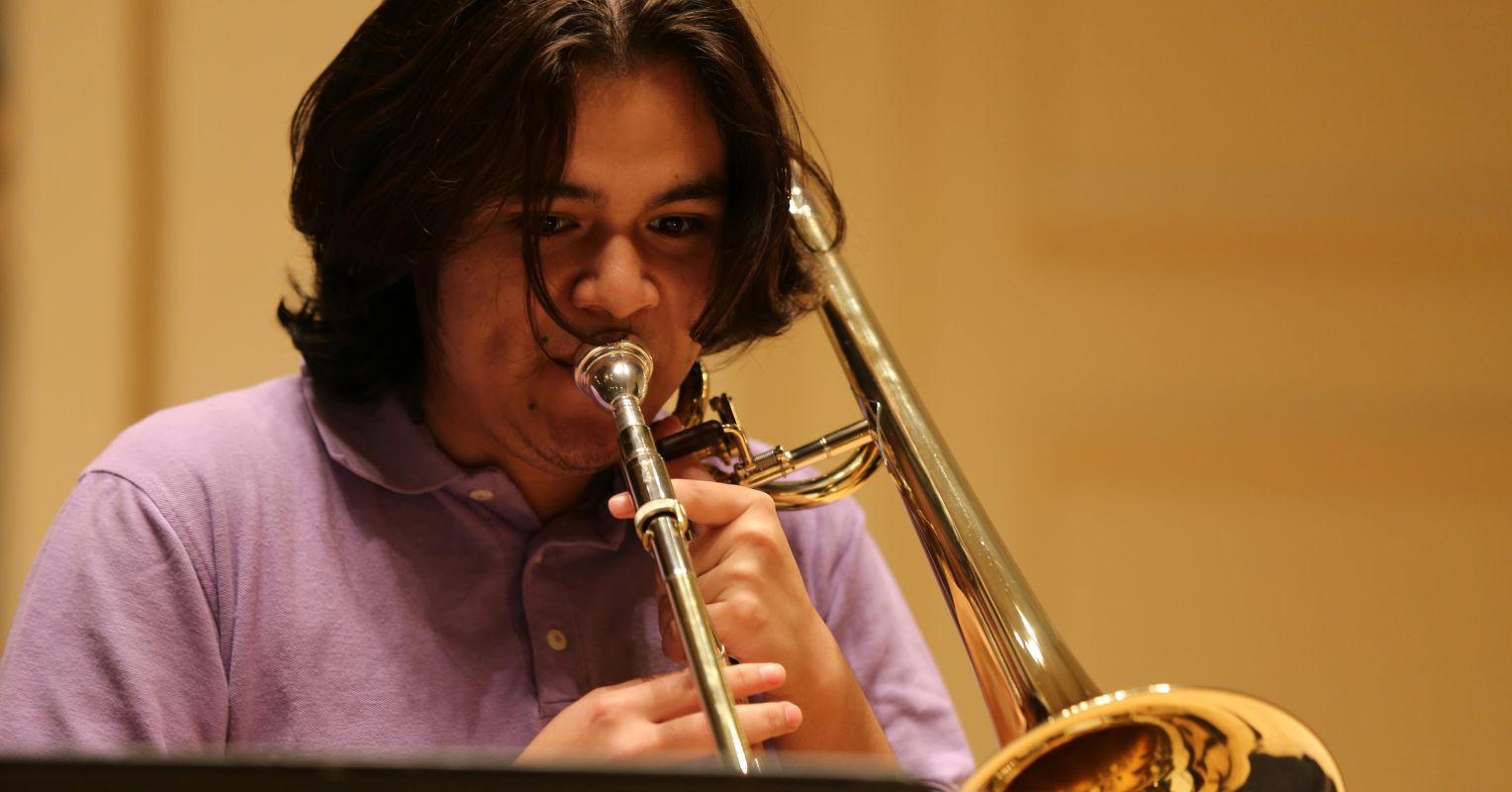
An adolescent trombonist named Jane came to me, describing an intermittent inability to commence sounding a note while playing alone. The issue first presented during her weekly lessons with her regular teacher, and later appeared while taking auditions for college. Jane described how she would begin to initiate a tone, and her throat would close and “lock” in a constriction that prevented free airflow. I asked her to recall the earliest time she could recall having the issue take place. As she described this first experience, I paid close attention not only to what she was saying, but to how she was saying it. I also kept an awareness of what her body language was communicating in relation to her words. As Jane began telling me of her earliest awareness of her inability to commence a note, I noted that her face became flushed and her breathing became heavier. The emotional experience of anxiety was manifesting in her body as she described the experience. She told me that the first time she experienced the inability to play was during a lesson with her regular teacher. The teacher had asked her to play an etude that she had been working on for several weeks. I asked Jane not only to recall the story but to tell me as if it were happening now. This is a Gestalt technique in which contact with the experience is enhanced by speaking of it in the present tense, rather than linguistically distancing oneself from the experience by using the past tense. As Jane described her experience, I brought to her attention certain physical changes that I observed. I asked Jane what she was experiencing emotionally when I saw her face turn red. I asked her to be aware of the fact that she repeatedly touched her chest with her hand, as if to protect herself, while she described a sense of being critically judged by her teacher. I asked Jane to “be aware of what is happening now” as her words became shaky and weak while describing her sense of inadequacy in the eyes of her teacher.
In addition to verbally bringing a student’s body language to their attention, An effective method used in the Alexander Technique is to touch the musician’s body while they play, to bring attention to areas of the body where they have habitual tension, and to broaden their awareness to areas of their body that are blocked out of awareness. It is important to explain this technique to the student beforehand and ask their permission for you to touch them.
