


Autistic individuals may find it harder to initiate and sustain romantic relationships compared to non-autistic individuals.
Often, this disparity stems from difficulties in interpreting social cues, expressing emotions, and managing sensory sensitivities, which are common characteristics of autism.

However, these challenges do not negate the capacity for autistic individuals to experience fulfilling and meaningful relationships.

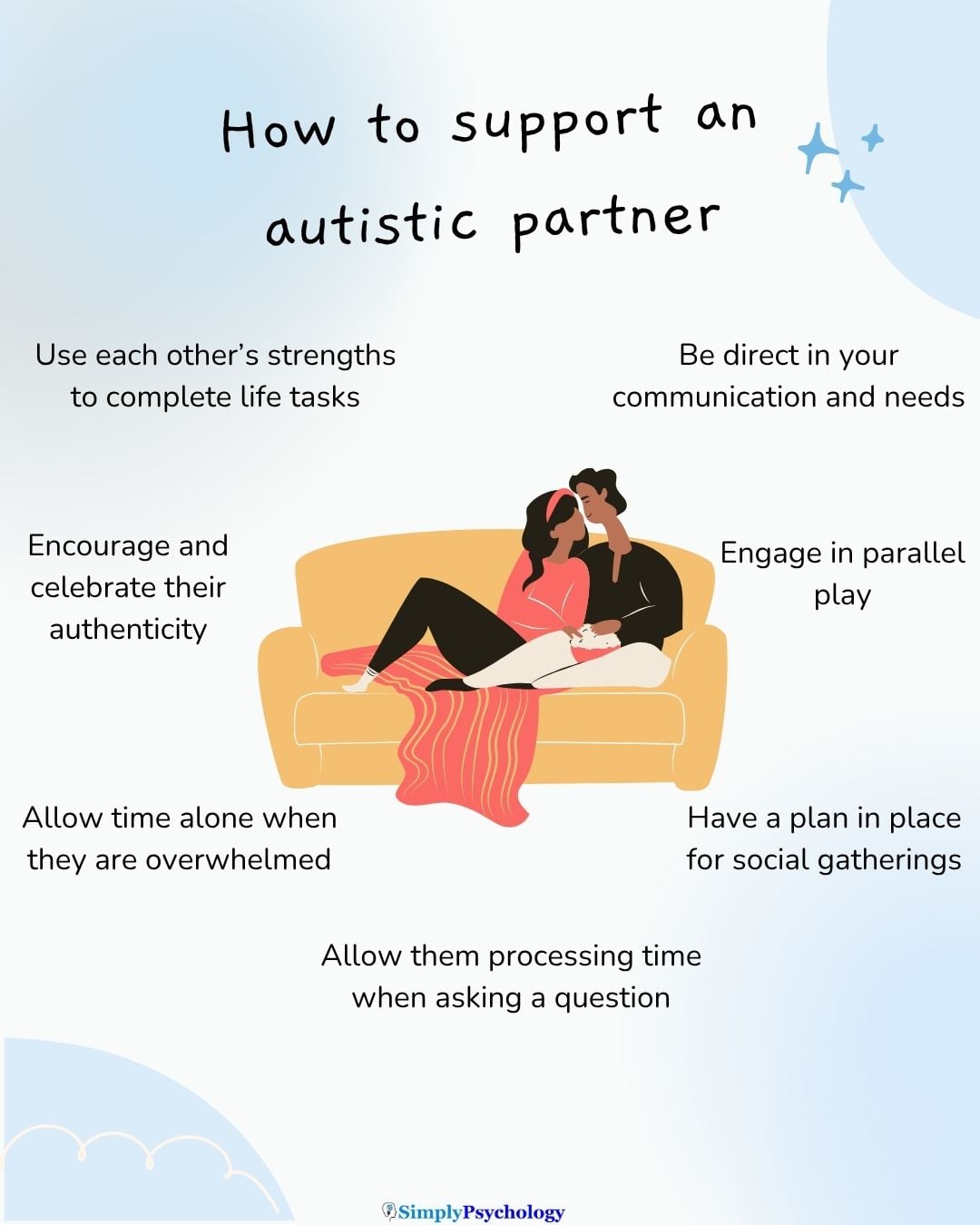
Below are 9 tips aimed to help support an autistic partner:
1. Be understanding of their traits
The first step to supporting an autistic partner is to read up on autism and understand your partner’s unique traits.

You may show understanding by:
- Understanding that their straightforward honesty is probably not intended to be hurtful
- Recognizing that they may have different ways in which they express love and empathy toward you
- Communicating about schedules and plans and discussing any changes in advance to minimize potential anxiety
- Not expecting them to show a particular type of reaction to gifts and gestures
- Recognizing their need to ‘decompress’ after social events
While it’s essential to be understanding and accommodating of your autistic partner’s unique needs, it’s equally important for you to prioritize your own well-being and ensure that your needs are also being met in the relationship.
A healthy relationship involves mutual support, open communication, and a balance of give and take from both partners.
2. Recognize and respond to your partner’s cues
As you come to understand your autistic partner better, you can become more skilled at recognizing when they are experiencing discomfort, overwhelm, or stress.
Discuss with your partner what would help them best when they are having a tough time. With this knowledge, you can respond in a way that you know will help them.
For example, your partner may appreciate time alone to engage in their special interest or be wrapped in a blanket with their favorite hot drink in times of stress.
Renee shares with her husband when she notices his cues, “So I know when you start rubbing your hair in a certain way or when you start moving your legs or your body in a certain way, or when you start using echolalia more or when you start singing more, then I know that things are starting to overwhelm you.”
3. Encourage them to be themselves without judgment
It can be common for autistic individuals to camouflage (or mask) their autistic traits, even sometimes around their romantic partner. Masking can be exhausting and result in burnout, so it is important that you foster a safe environment for them to be authentic.
To help encourage authenticity, you can:
- Explicitly tell your partner that you love and accept them for who they are
- Show interest in understanding your partner’s perspective and experiences, even when they differ from your own
- Encourage them to discuss and engage in their special interests
- Share your own experiences to encourage openness and deeper connections
Peter, who has an autistic wife, explains that the best thing to help his partner unmask is to be patient:
“I think it’s just come with time. I don’t know if there’s anything in particular other than just be patient. And she’s had the time to open up and get to know me before she revealed a bit more of what she’s like.”
4. Be direct in your communication
If you know that your autistic partner has difficulty with understanding subtle social cues or suggestions, practice being more direct in what you are saying.
For example, instead of saying, “There is a lot to prep for this meal” (as a hint that you would like your partner to help), say, “Can we please prepare this meal together?” or “Let’s prepare dinner now.”
Similarly, it can be helpful to be clear about how you are feeling. For example, if you are feeling stressed or upset, communicate this in a way your autistic partner will understand so that they can better offer you support.
This direct approach can help avoid misunderstandings that could cause friction in your relationship.
5. Allow them processing time
To allow your autistic partner processing time and patience, it’s crucial to understand that they may need more time to absorb information, respond to questions, or adapt to changes.
To help with processing time, you can:
- Give your partner space to think before expecting a response
- Not rush them to make decisions
- Break down complex topics into smaller parts
Louis accommodates his autistic girlfriend Meg’s processing needs by waiting a few seconds after asking a question, giving her space to respond without pressure.
When Meg is focused on a task, Louis asks his question and waits patiently for her to finish before expecting an answer. This creates a supportive environment that respects Meg’s unique needs.
6. Navigate social gatherings together

How you navigate social situations can depend on your partner’s social needs as well as your own.
- If you enjoy social events but your autistic partner does not, you could instead attend these with a friend
- Meet up with one or two people at a time with your partner if they get overwhelmed by big gatherings
- Have a secret hand signal or code word that your autistic partner can use when they are reaching their social limit
- Allow your partner alone time after social situations so they can recharge
Peter explains the ways in which he is supportive of his wife at social events:
“I try to make sure that she’s not left on her own too much with people that she doesn’t know or that she’s not comfortable with… Sometimes if I have a story that I think is relevant … then I might pass it to her just to try and encourage her to involve herself a little bit more because I know it can be hard for her to jump in.”
7. Be mindful of sensory sensitivities
To be mindful of your autistic partner’s sensory sensitivities, it’s important to learn about their specific triggers and needs.
This may involve discussing which sensory inputs (like certain sounds, lights, textures, or smells) cause discomfort or distress.
You can then work to create a sensory-friendly environment at home, advocate for accommodations in social settings, and be understanding when sensory overload occurs. This might mean adjusting lighting, noise levels, or clothing choices, as well as being flexible with plans if a situation becomes overwhelming.
By openly communicating, respecting sensory needs, and finding creative solutions together, you can foster a supportive and comfortable relationship for both of you.
8. Find a shared interest to focus on
Having a shared interest can be a powerful bonding tool for autistic and non-autistic partners. It provides a common ground where you can both connect, communicate, and enjoy quality time together.
You might find that you can share enjoyment in your partner’s special interest. For them, this can be a great source of joy and intimacy to deepen your connection.
Otherwise, you could work together to find a new interest that you both can experience for the first time together and commit to, for example:
- A physical activity such as rock climbing, sword fighting, or running
- Creative activities such as painting figurines, pottery, photography, or learning a musical instrument
- Intellectual pursuits like studying a new language, exploring a period of history, or diving into a science topic
- Games and puzzles such as chess, escape rooms, or cooperative board games
- Collecting items like stamps, coins, or memorabilia related to a shared interest
- Volunteering for a cause you both care about, such as animal welfare or environmental conservation
- Culinary adventures, including cooking classes, trying new cuisines, or exploring food history
The key is to find something that ignites passion and enthusiasm in both partners, providing an engaging focus for quality time and bonding.
9. Utilize each other’s strengths
By valuing and leveraging each other’s natural talents, together you can create a strong, balanced partnership that benefits from their diverse ways of thinking and being.
For example, your autistic partner can put their strong research and analytical skills to use by planning out the ideal romantic vacation, while you could arrange transportation and handle the communication aspects of traveling.
Your partner’s attention to detail and thorough planning can ensure a well-organized, efficient trip, while your interpersonal skills can help navigate any unexpected challenges that may arise during your journey.
By recognizing and trusting in each other’s unique abilities, you can complement one another and create a fulfilling, enjoyable experience.
Tips For The Autistic Partner
As an autistic partner, you appreciate the support and understanding your partner offers you. However, it is equally important to also put in the work yourself to ensure you are being supported in the way that is best for you, as well as making sure you are supporting your partner.
Below are some tips for navigating romantic relationships as an autistic person:
- Express appreciation: Verbalize your gratitude for your partner’s efforts, even if your facial expressions don’t always show it.
- Be transparent about masking: Let your partner know when you’re camouflaging your autistic traits and that you need to feel safe to be yourself around them.
- Communicate about sensory sensitivities: Reassure your partner that your sensory sensitivities are not personal and explain how they affect you.
- Be honest about social needs: Discuss your capacity and desire for socializing, and work together to find a compromise that suits both of you.
- Seek clarity when needed: Don’t hesitate to ask your partner for clarification if you misunderstand something.
- Show interest in your partner’s perspective: Ask inquisitive questions to better understand their point of view.
- Maintain independence: While it’s important to rely on your partner for support, don’t depend on them for everything.
- Offer support: Ask your partner how you can best support them and their needs.
- Find ways to accommodate spontaneity: If your partner enjoys spontaneity, work together to find ways to incorporate it without causing you stress.
- Be upfront about needing solitude: Communicate your need for alone time to recharge after social situations, and explain that it’s not a rejection of your partner.
- Discuss your honesty: Explain that your honesty is a sign of respect and that you’re not trying to be hurtful.
- Communicate difficulties with discussing feelings: Let your partner know if you struggle with talking about your emotions due to alexithymia or difficulty with self-reflection.
- Explain how change affects you: Be open about your difficulty with change and discuss how your partner can support you through transitions.
- Share how your brain processes information: Help your partner understand that misinterpreting social cues is not about a lack of caring but a difference in how your brain works.
