


Our memories form the foundation of our continuing sense of self. Our understanding of who we are is built up from a lifetime of experiences stored in our brain. Loss of that information about who you are, where you’re from, and how you got to be where you are can be profoundly disturbing, trapping you in time and space. This makes memory loss, amnesia, prime fodder for writers looking for something mysterious and spooky to happen to their characters. As a result, the general public sometimes “memorizes” faulty information about memory and memory loss, leading to some strongly ingrained myths about both.
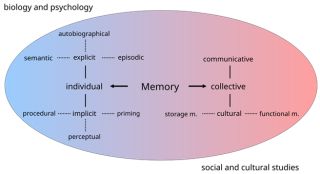
Models of Memory

Source: Predatorix, CC BY-SA 4.0 via Wikimedia Commons
What is memory? The most popular classification scheme is to break memory apart into those that can be described using language and those that cannot. So-called declarative memory or explicit memory is memory that can be described using language—you can “declare” a declarative memory, like telling a friend how to make your mom’s famous sugar cookies. We make Episodic declarative memories out of the events and experiences in our lives, and Semantic declarative memories from the facts, concepts, and ideas we acquire. Autobiographical memory, or memory for events in your own life and what they mean to you personally, is a subtype of episodic memory.
On the other hand, some memories are difficult, if not impossible to describe with language. These are called non-declarative memory (or implicit memory or sometimes procedural memory). Your memory for how to do things like ride a bicycle or hit a backhand is non-declarative, implicit memory, for things that are hard to describe using language. You may have noticed that in some cases talking about non-declarative memory can interfere with performing the action itself. Try consciously explaining to someone, using language, how to skip. I can almost guarantee you’ll stumble. Non-declarative memory is not normally available to our consciousness, which is likely why we can’t easily talk about it.

Memories are created and stored in our brains, so it isn’t surprising that traumatic brain injury, or TBI, can cause memory loss. In particular, damage to regions of the brain directly associated with the creation of memory, like the frontal lobes and the hippocampus, is associated with amnesia. Other forms of amnesia do not have an obvious organic cause. Instead, they are caused by psychological trauma or sometimes by mental disorder.
And some forms of amnesia, like transient global amnesia, or TGA, don’t have a recognizable cause at all. TGA is the rare (estimates are five to 11 per 100,000 people), sudden, and abrupt loss of memory for recent events (called retrograde amnesia) and difficulty in creating new memories (anterograde amnesia), both thankfully temporary (Yi, Sherzai, Ani, et al., 2019). Typically, the episode of amnesia lasts only a few hours (on average six to eight hours) in people over the age of 50. TGA may also be more common in females, although there is some debate about the role of gender (Sander, Bartsch, Connolly, et al., 2023). In addition, studies show that “Between 12 and 27% of affected individuals suffer at least one additional TGA subsequently, which is perceived as dramatic by both patients and relatives despite the benign nature of the syndrome” (Sander, Bartsch, Connolly, et al., 2023).
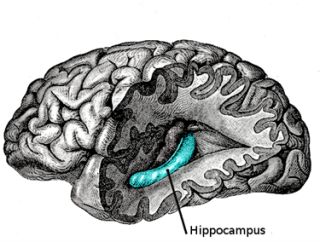
Diagram showing the location of the hippocampus, beneath the temporal lobe
Source: Henry Vandyke Carter, Public domain, via Wikimedia Commons
Researchers are still investigating possible causes of TGA, but no single, definitive cause has been identified. It is not associated with TBI, nor with specific psychological trauma. A small number of sufferers show a lesion in the hippocampus. However, research has also shown that even when there is a hippocampal lesion, that lesion does not appear to last. Comparison of brain scans from those with a lesion and those without show no differences four to six months later. In addition, experiencing an episode of TGA does not seem to affect the risk of later memory loss or any dementia-related symptoms, nor is the overall risk of stroke affected (Enzinger, Thimary, et al., 2008). There is some evidence that a history of migraine headaches is associated with an increased risk of TGA, although the role that migraines might play in this risk is still being studied (Yi, et al., 2019).
TGA is also a good example of one of the most commonly held misperceptions about amnesia in general, and that is that amnesia always includes the loss of all types of memory—your sense of yourself and who you are (autobiographical memory) as well as declarative and non-declarative memory. This is not the case. In fact, amnesia of any form is very rare. Loss of a sense of personal identity, in any form of amnesia, TGA included, is rarer still. This may be evidence for different storage systems for different kinds of memory in the brain.
Problems like TGA are of interest to memory researchers because they are so unusual, and because TGA memory problems happen spontaneously, are not associated with specific brain lesions, and are temporary. And, unlike amnesia associated with dementia and TBI, most of the research on TGA does not point to a cerebrovascular cause of TGA. Perhaps an understanding of TGA might lead to a better understanding of memory and memory loss in everyone.
