


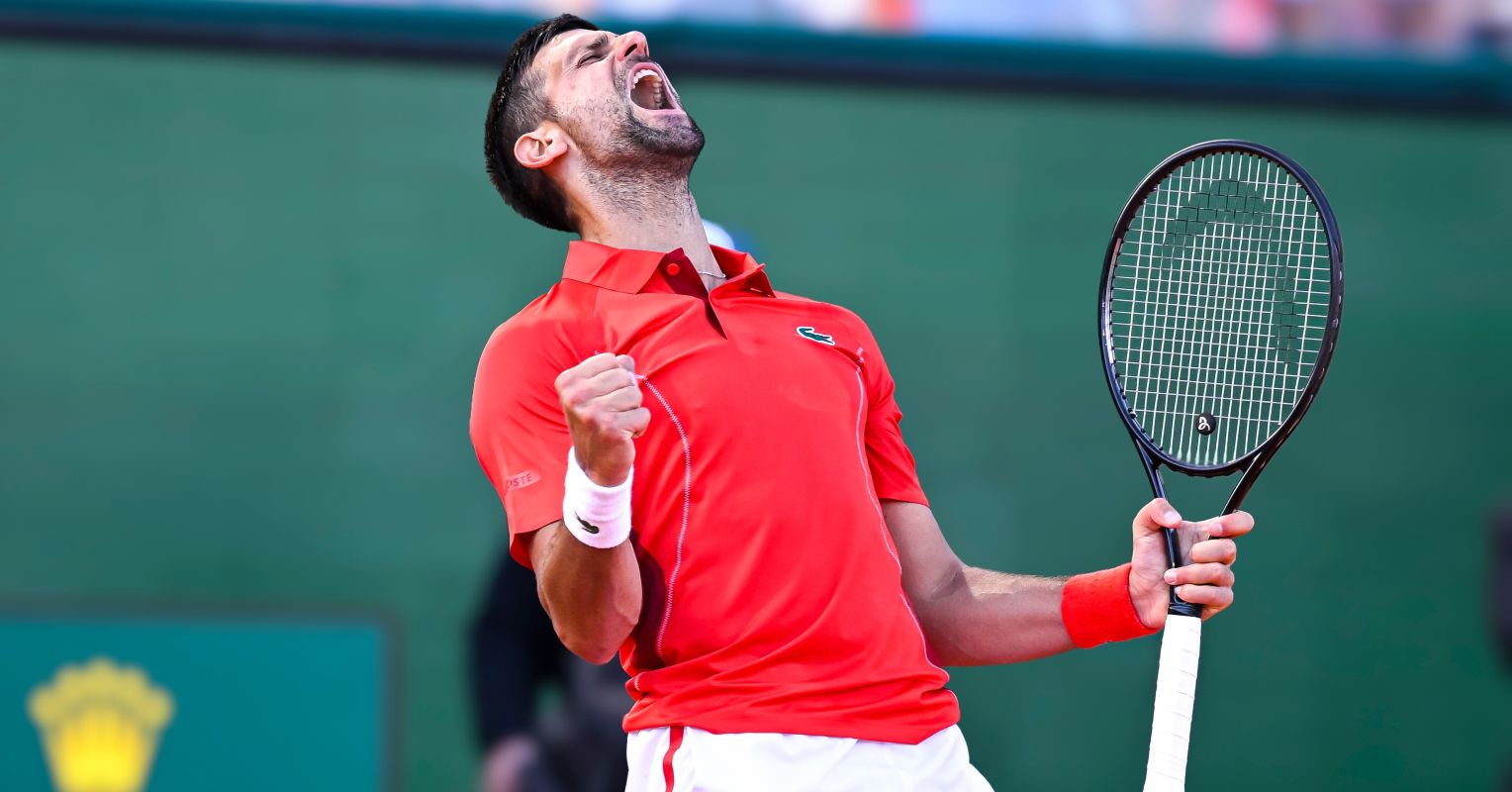
In a recent interview with Jay Shetty, when asked if he feels like he’s achieved everything he set out to as a tennis player, Novak Djokovic replied, “Yes, and more than that, and at the same time, I still want to do more.” He talked about a big part of that coming from “a good place”—from a place of purpose, inspiration, love for the sport, and a passion to make people happy when they watch him play.
He then continued, “But when it comes from maybe I would say not necessarily a bad place, but less of a good place,” he’s identified a second source of motivation for his continued pursuit of greatness in his “feeling of not being enough.” He added, “And that goes back to my very, very beginning of my life and my relationship particularly with my father, and not being, not doing, enough, not being good enough. I get emotional about that… because it is still deep inside of me and it’s kind of the battle that I also go through often.”
A Physiological Imprint

This story within Novak’s head reveals not just a cognitive belief but a physiological imprint. From a Polyvagal lens, his nervous system was shaped to anticipate threat, and for very good reason. His early experiences biased his nervous system toward detecting danger. Although this bias fueled his relentless drive to become what many consider the greatest of all time in men’s professional tennis, it also prevents him from feeling fully satisfied with what he has accomplished. It keeps him locked into patterns of protection, still “wanting to do more” and unable to rest in the felt sense of being enough just as he is.
Later in their conversation, Novak admitted, “I don’t see myself fully satisfied because I have that part of me which is like, you know, I think I can still do more. But the other side of me is like, of course I am fully happy and I’m proud and in a way I can’t wait one day to reflect on everything, but while I am still in my active career, I don’t have time.”
By staying mobilized and active in the professional game and all the training, preparation, and daily practice it requires, Novak doesn’t have time to allow himself to reflect and to meet himself truly where he is. He isn’t able to simply be Novak, the human—the wounded boy that had to win at tennis to protect his mom, dad, and two brothers. He carried a heavy burden where tennis wasn’t just a game, and winning wasn’t just ambition. For him, it was survival. In his own words: “Like I have to succeed, it’s basically a matter of existence, a survival of my family, so I think it started there and then over the years it has obviously transformed or evolved into a different kind of form.”
Inadequacy as a Path to Success?

Jay Shetty reflected, “Anyone who goes off to do something successful externally, all of us, everyone was channeling some sort of internal inadequacy or an internal feeling of not being enough, as you said. How do you live with it, because it’s there, but not letting it be your guiding light?”
Novak’s story makes clear how this feeling took root as he grew into a champion. “One of the most impactful moments of my upbringing and my childhood is when he [my father] brought 10 Deutsch marks and he said, ‘This is all we got for our family of five…’ That’s where it hit me. It was like, okay, now I have to take the means in my hands as a 12-year-old body in whatever way I can… not having success is not an option.”
He describes his father borrowing money at predatory interest rates to get him to tournaments, in the hopes of landing sponsorship, and the weight that placed on him. “Of course, my father is always my hero for that, and my champion, but you know, feeling not enough because of that stress and what things he was going through, and then it was hard because he was giving me also a hard time if I wouldn’t play well… it’s like, you need to win no matter what. He wasn’t telling me that in words, but that’s how it felt, and that felt like that for years.”
The Spoken and Unspoken Messages
Here, Novak is articulating a fundamental truth often echoed by Stephen W. Porges, Ph.D., the developer of Polyvagal Theory, that it’s not what we say, but how we say it, which includes our facial expressions, tone of voice, and body language. These spoken and unspoken cues translate beneath conscious awareness to transfer a state without words. His father’s physiology was shaping Novak’s, even without directly saying that success was not an option.
As Novak describes the dramatic risks his father was taking to both promote his future tennis career and provide the financial resources so desperately needed by the family, his father was certainly experiencing and expressing his own fears, worries, and concerns through his voice, face, and body to the young Novak. That constant immersion in his father’s fear and urgency carved a lasting autonomic imprint. Novak’s nervous system learned to equate winning with survival, and anything less with danger and uncertainty.
This is the imprint Djokovic still carries: a body tuned to fight for survival, driven by the fear of not doing enough and not being enough. And he’s not alone. The deeper question is: How does he live with it now, and is there a way to soften its grip? That’s where we’ll turn in Part 2.
