


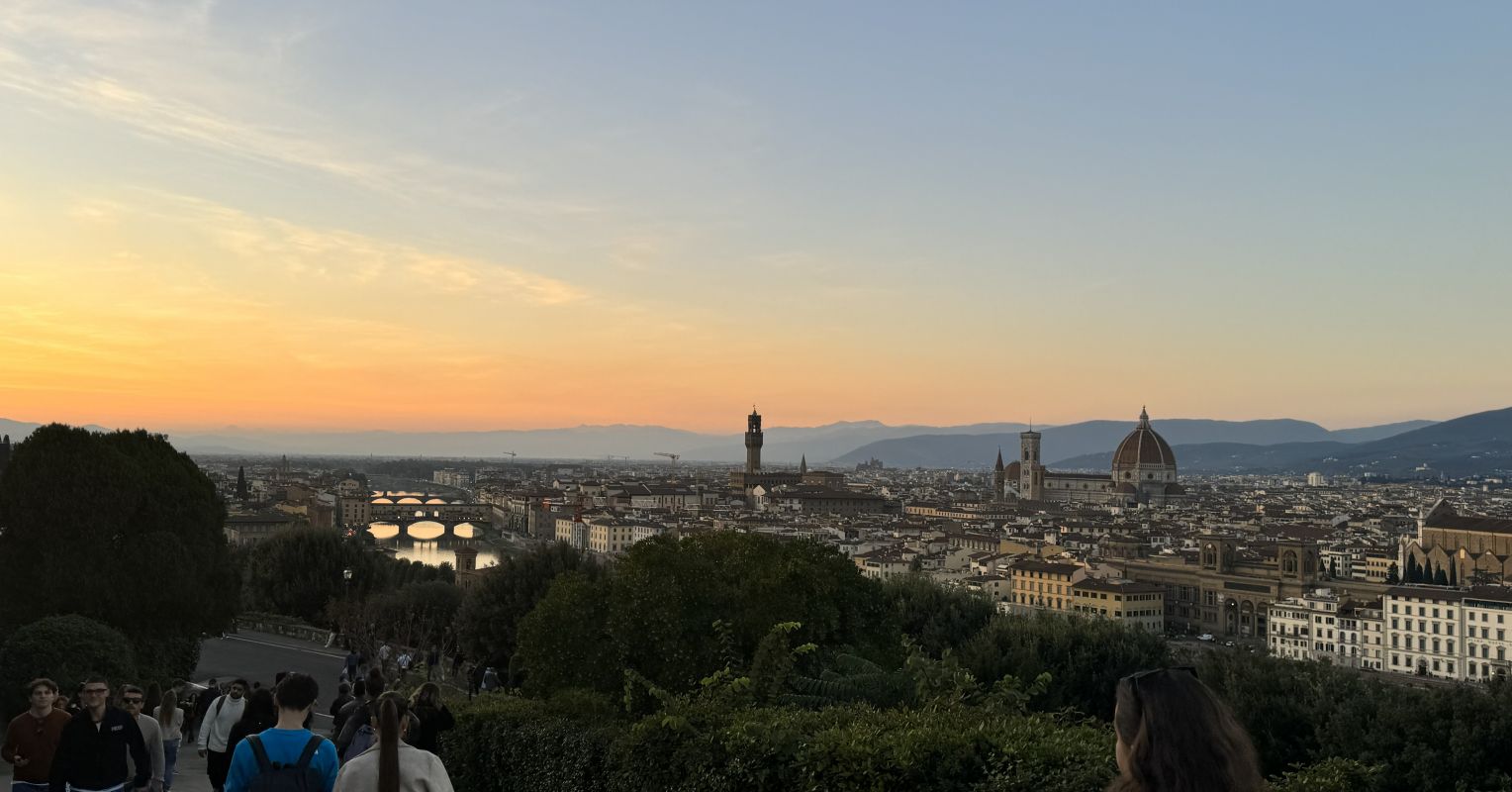
A couple of years ago, I had the opportunity to visit Florence, Italy—a city steeped in history and beauty—in the fall. I was there for a meeting, but one evening, I decided to venture out alone, climbing up to Piazzale Michelangelo to watch the sunset. I had imagined something quiet and contemplative: sitting still, observing, letting the city unfold below me.
That was not what I encountered.

The hill offered a breathtaking panoramic view of Florence: the Duomo rising above red rooftops and low-rise buildings, the Arno River winding through the city, Ponte Vecchio catching the fading light, and the surrounding Tuscan hills stretching into the distance. It was also packed with like-minded tourists, all hoping to catch the sunset. Vendors lined the path, well aware that this spot drew crowds. Instead of solitude, I found myself negotiating space, edging closer to the railing, politely competing for a better view.
It was worth the effort. As the sky shifted from blue to gold, then red and purple, the city below seemed to glow. When the sun began to set, I instinctively pulled out my phone and took a few photos.
I wasn’t alone. Hundreds of people around me did the same. Almost in unison, phones and cameras rose into the air, all trying to capture the same fleeting moment, not just the sunset, but ourselves standing there together, compressed in space, witnessing it. It was a bit of an overwhelming scene when thinking that this probably repeats day after day, with countless sunsets on millions of phones.
Why do we do this?

Logically, we know that images of sunsets, especially a Florence sunset, are everywhere. They exist in far better resolution online, in guidebooks, and on postcards. And yet, when something strikes us as beautiful or meaningful, we feel an almost irresistible urge to take our own picture.
The key, I think, lies in personalization and in how the brain assigns importance.
Our brains are constantly filtering the world, deciding what deserves attention and what can be ignored. Moments that feel emotionally charged or personally meaningful are tagged as salient. Taking a picture may be one way we mark such moments as worth keeping. The photograph becomes a bridge between our subjective inner experience and the objective outer world—physical proof, to ourselves and to others, that we were there, that the moment happened to us.
But photographs do something more.
As part of my New Year’s routine, I’ve been trying to clean out my phone and reduce my digital clutter. In my material life, I’ve become something of a minimalist, but I find it much harder to let go of digital photos. As I scroll through them, long after the details have faded, a single image can bring back a feeling I thought I had lost—the emotional texture of a moment.
From a neuroscience perspective, memory is not a fixed recording. It is reconstructive. Each time we remember, we rebuild the experience, often with the help of cues. A photograph serves as such a cue, anchoring memory and reactivating emotional associations. We intuitively know that looking at old photos can surprise us: a forgotten detail, an unexpected feeling, a sudden emotional resonance. We are wired to enjoy these moments of surprise; they momentarily refresh our sense of self and the past.
Perhaps knowing this, we keep records. A photograph reassures us that our inner experience once intersected with the world in a tangible way, and that it may one day return to us in ways we cannot fully predict. It helps cement the narrative of our past—often an edited one—filling in details we might otherwise lose.
Today, advances in technology and social media allow us to showcase much of our lives through images and videos. Much has been written about the “curated” online persona versus a supposed “true” inner self, as if such a clean division really exists.
Here, the philosopher Jean-Paul Sartre offers a useful perspective. He argued that we are free precisely because there is a gap between the in-itself (our bodies, histories, and circumstances) and the for-itself (our aspirations, values, and self-conceptions). We are never fully identical to who we imagine ourselves to be, and that is a feature, not a bug.
Our images, especially curated ones, live in that gap.
From a cognitive standpoint, this makes sense. The brain is constantly generating models of the self—who we have been, who we are, and who we might become. Even idealized or imperfect images express something essential: what we attend to, what we value, and what we are drawn toward. In this light, documenting our lives through photos and videos is not merely an act of vanity or distraction. It is part of how we construct identity over time.
Taking a picture of a sunset, then, is not just about the sunset. It is about asserting a relationship between the self and the world—about briefly closing the distance between subjective experience and objective reality.
This year, I would encourage you not only to snap a picture when you feel compelled to, but to pause for a moment and reflect:
What was so compelling? What made this moment stand out?
Natural beauty?
Something that simply melts you with happiness and joy?
Companionship that you treasure?
Information that you didn’t want to forget? Perhaps an aspiration?

What you feel compelled to preserve in your digital space may offer a clue to what your brain—and your deeper self—has decided truly matters.
