


When thinking about why play is so crucial to our balanced social, physical, and mental development, so key to our sense of belonging and reciprocity and fun, it pays to begin at the beginning, and then follow along.
Tuning Up, Tuning In
Play first stirs in the mutual, musical back-and-forth cooing of mother and infant. This proto-play practices attunement. Before we learn to talk, we learn to chortle and gurgle and babble and hum along. Psychoanalyst Erik Erikson noted that this pleasurable and surprising dialog “negotiates the first interpersonal encounters, the light of the eyes, the features of the face, and the sound of the name [as they each] become essential ingredients of a first recognition by the primal other.” Even as infants, we learn to play along.
Minding the Other Mind

Just before toddlerhood, we reach a second milestone of understanding and empathy after having begun to differentiate ourselves from those others who inhabit a realm outside our own sensations and perceptions. As if our young selves were budding logicians, developmental psychologists colorfully call our routine and remarkable breakthrough a “theory of mind.” Playing a simple game reveals this profound new discovery. Wave at an 8- or 9-month-old. When she returns your greeting with wiggled fingers (usually mimicking in reverse), she has begun to understand hello and goodbye
Singing Along
Somewhere before we turn 2 years old, we begin to discover that we can sing. As it happens, we may be recapitulating our species’ history, individually. Tonally rich and rhythmically complex sounds persist in the ancient, tuneful, tribal “click languages” that so vex English speakers. These vocalizations may be a distant relic. Over its long, evolutionary childhood, humankind may well have learned to sing and whistle and imitate sharp nature sounds even before we could talk.
At first, for us, the simplest songs are naturally the catchiest. The melodic nursery rhyme “Baa Baa Black Sheep,” for example, works even before the singer knows what a sheep is or that a sheep can bleat. But the playful human musical intelligence gains steam and complexity as, over time, we play with melody, rhythm, tone, pitch, timbre, sequence, harmony, and musical form.

Adults have been singing playful rounds together for at least 800 years, re-entering the melodic line after an interval. Kindergarteners are now often trained to sing rounds. But the game is not so easy as it requires both collaboration and competition as they learn to master a melody and then to hold on to it as other voices challenge, in sequence. When singing “Row, Row, Row, Your Boat,” timing, as mutual understanding, is everything. Harmony is the surprise and the reward.
Playing With Words
Songwriters are among the cleverest word-players. Lorenz Hart’s lyrics for the song “Mountain Greenery,” for example, rhyme “keener re(ception),” “scenery,” and “beanery.” Poets call this trick “enjambment” (French for “sliding over”) that keeps listeners on the edge, waiting an extra beat or two for a rhyming punchline.
Play always begins in anticipation, keenest in wordplay. Limericks tease us in real time with almost-predictable, multisyllabic rhymes. Consider Edward Lear: “There was an old man from Thermopylae/Who never did anything properly!” As for the unattributable and foreseeable limerick of the “There-was-an-old-man-from-Nantucket” variety, you are welcome to fill in the blank.
Naughty limericks, a specialty in English, don’t have much success crossing national linguistic boundaries. But here’s an exception. The physicist and mathematician John von Neumann amused his fellow savants with this irreverent French verse: “Il y un jeune homme de Dijon/Qui croyant pas a la religion./Il a dit:”Quant a moi/ Je m’en fous t’tous les trois:/ Le Père, et le Fils, et le Pigeon.”
Other rhymes call for action, participation, and catching the beat. “Eeentsey Weentsey Spider” is one; “Hickory Dickery Dock” is another. “Baby Shark” also rings true in a simple tempo. Similarly, jump rope rhymes keep the rhythm going: “Out ran the doctor/Out ran the nurse/Out ran the lady/With the alligator purse!”
Playing With Movement
The paleoanthropologist Louis Leakey observed how schoolboys, straining at penmanship, often stuck out their tongues to the side. He theorized an evolutionary and developmental connection between human speech and human dexterity—two of our species’ claims to fame. He also believed that social play is communication, a way of securing trust. When curious children wandered into his dig-sites at Olduvai, he would sometimes strike up with them a game of cat’s cradle, a kind of puzzle played with colorful string wound around his fingers. Play was the only language they shared.
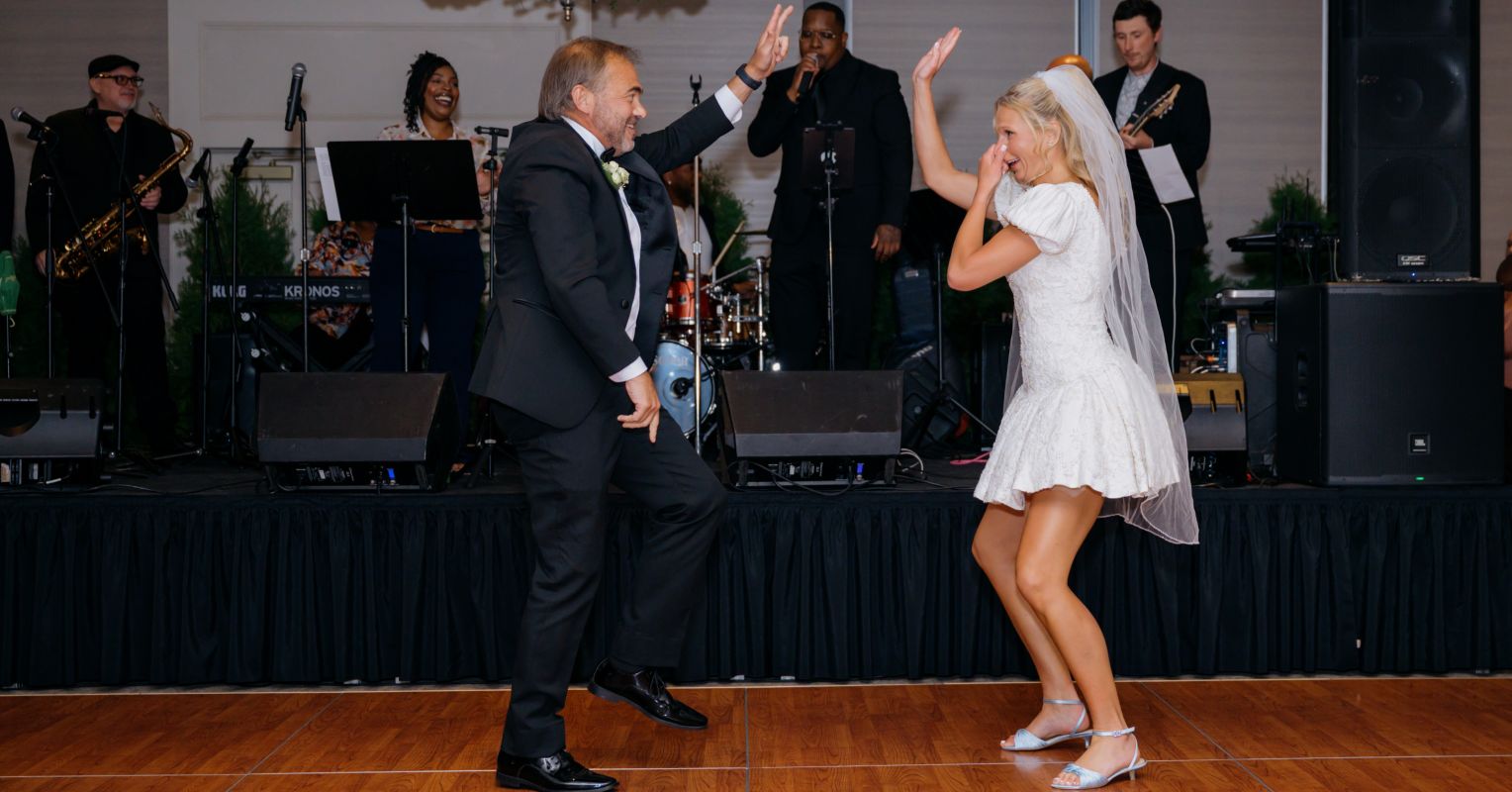
More plainly, we humans play with dance as we move alone and together. Dance recruits our feet and our brains and our friends. Some dances are formal and elegant, like a pas de deux or a minuet. Some call for athleticism and competition, like Celtic step dancing or breakdancing. Some are trendy, creative, and inviting.
Here is a list of dance crazes that absorbed millions over the years. Call to mind the Hully Gully? The Mashed Potato, The Frug, and The Twist? (You date yourself, boomer.) Or The Loco-motion, The Hustle, or the Moon-Walk?
Recently: twerking, a roguish pelvic move hailed for bolstering women’s community, liberation, and empowerment. Twerking arose in New Orleans but now attracts the routine ire of chaperones at high school dances nationwide. Play is mischief.
Clapping songs recruit the hands and call for a partner. Even the simplest, like “Pat-a-Cake” and “Miss Mary Mack,” require instruction and practice. Professional dance companies now sometimes perform versions of “Hambone,” which evokes the elaborate African “juba dance.” This body-percussive slap, clap, and stomping game is arranged in a circle. Play is understanding.
Pump Up the Jam, Pump It Up!
The shy will linger at the fringe in the gymnasium, pressing up against the bleachers, finding no smooth escape. When the band strikes up “I Wanna Dance With Somebody” at the wedding reception, some won’t be dragged onto the dance floor. But when a conga line erupts at parties, irresistibly, even the reluctant will play along.
Here is a final venerable choreography: “The Chicken Dance.” Visualize the elbow-flapping mime. Recall the oom-pah-pah. Sorry for loading you up with the eyeworm and earworm. But the routine calls for a reminder. Play, while profound and instructive and bolstering across a lifetime, may well be defiantly and helpfully silly in the moment.
