


While non-autistic friends and family members can have good intentions when talking about autism, it is important to navigate these conversations with an understanding of how certain phrases can inadvertently cause harm.
The language we use can either validate someone’s lived experience or can be invalidating, which can unintended consequences of contributing to societal stigma or further “masking” and isolation for autistic loved ones.


Below are some phrases that will feel all too common for autistic people, how these may impact the individual, and what can be said instead.
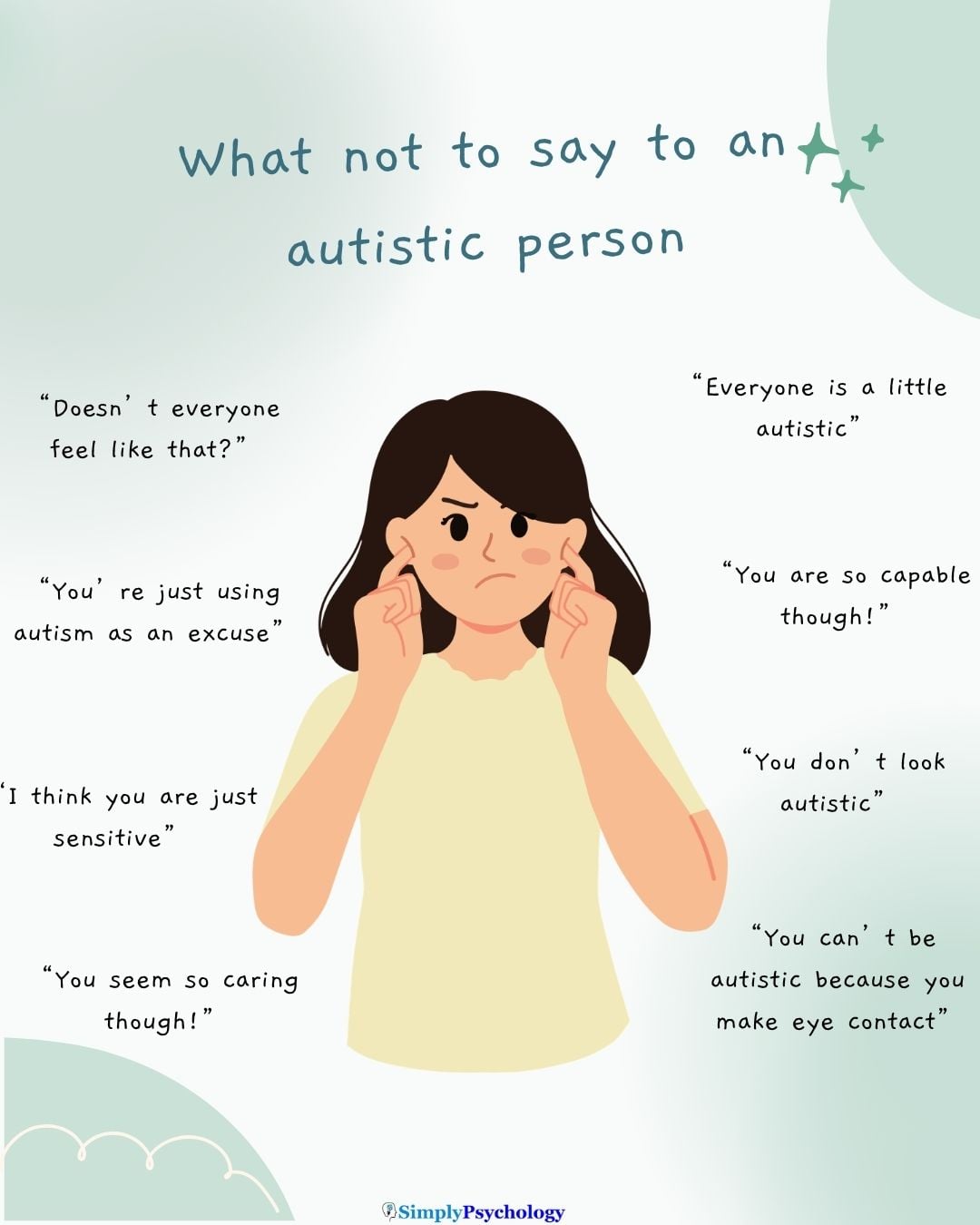
“Everyone’s a little bit autistic.”
This phrase is often intended as a way to find common ground, but to an autistic person, it feels incredibly demoralizing.
It minimizes a lifetime of genuine struggle, confusion, and the exhausting effort required to navigate a world built for neurotypical people.

By suggesting that everyone shares these traits, you effectively erase the specific challenges that define the autistic experience.
This can lead to wider issues where autistic individuals feel their needs for support or workplace adjustments are being dismissed as “dramatic” or unnecessary.
What to say instead: “I appreciate you sharing that with me. Can you tell me more about your unique experience and how being autistic looks for you?”
“You must be very high-functioning.”
Functioning labels, whether “high” or “low”, are increasingly viewed as inaccurate and harmful.
When someone is labeled “high-functioning,” their daily struggles and support needs are often ignored or invalidated because they appear “normal” on the surface. Conversely, labeling someone “low-functioning” denies their agency and potential.
These labels fail to capture how an autistic person’s abilities can fluctuate depending on their environment, energy levels, or sensory input.
What to say instead: “What kind of support or accommodations do you find most helpful in your daily life?”
“But you don’t look autistic.”
This comment is deeply patronizing because it relies on outdated, narrow stereotypes, often the image of a non-verbal child.
It dismisses the reality of autistic adults who drive, have careers, or raise families, suggesting that autism has a specific “look.”
For many, this feels like their identity is being erased based on a surface-level assessment. It forces people to choose between proving their diagnosis or continuing to mask their true selves to fit your expectations.
What to say instead: “Thank you for trusting me with that. I’m learning more about how diverse the autistic community is.”
“You can’t be autistic because you make eye contact.”
Starting a sentence with “You can’t be autistic because…” is a form of gaslighting.
Many autistic people have spent years training themselves to perform social cues, like faking eye contact by looking at someone’s nose, just to avoid social friction.
Using these learned survival strategies as evidence to deny their neurodivergence is exhausting and invalidating.
It ignores the internal cost of “fitting in” and creates a hostile environment where the individual feels they must constantly justify their existence.
What to say instead: “I’m interested to hear about your perspective. What are some things about being autistic that people might not notice from the outside?”
“Doesn’t everyone feel like that?”
Usually said in response to sensory overload, this phrase creates a false equivalence between mild annoyance and neurological distress.
While a non-autistic person might find a loud room distracting, for an autistic person, that same noise can be physically painful, invading their entire thought process and triggering a “fight or flight” response.

Comparing these two experiences undermines the extreme distress caused by hypersensitivity and can make an individual feel ashamed for having a biological reaction they cannot control.
What to say instead: “That sounds like it’s really overwhelming for you. Is there anything I can do to help make this environment more comfortable?”
“You’re just using autism as an excuse.”
There is a vital distinction between an “excuse” and a “reason.” When an autistic person explains that a meltdown or a social misunderstanding was due to their neurodivergence, they are providing context for their behavior, not shirking responsibility.
Labeling these explanations as excuses fuels internalized ableism and makes people afraid to ask for the help they need. It creates a culture of blame rather than one of accommodation and understanding.
What to say instead: “I hear you. Let’s figure out how we can handle this differently next time or what adjustments we can make.”
“Look at me when I’m talking to you.”
Forcing eye contact is physically and emotionally uncomfortable for many autistic individuals.
For some, the intensity of eye contact makes it impossible to actually process what the other person is saying.
Demanding it is an assertion of power that ignores the person’s sensory needs. This is particularly damaging in professional or medical settings, where the focus should be on communication and safety rather than forced social conformity.
What to say instead: “Feel free to look wherever you’re most comfortable while we talk; I’m listening.”
“I know someone with autism, so I know all about it.”
This assumption is rooted in the “if you’ve met one autistic person, you’ve met one autistic person” fallacy.
Autism is a broad spectrum, and it presents uniquely in every individual. Assuming expertise based on a single acquaintance is dismissive of the person currently in front of you.
It shuts down the opportunity to learn about their specific strengths, interests, and challenges, replacing a real human connection with a preconceived template.
What to say instead: “I’ve known other autistic people, but I know everyone is different. I’d love to hear about your own interests and experiences.”
The Cumulative Impact: Beyond Hurt Feelings
The consequences of using the phrases mentioned above extend far beyond a momentary social awkwardness; they contribute to a pervasive cycle of invalidatiton, stigmatization, and gaslighting.
When society consistently dismisses or questions an autistic person’s diagnosis through comments like “You’re just jumping on the bandwagon” or “You don’t look autistic” it forces that individual to choose between a “double life” of exhausting masking or facing outright disbelief.
This constant pressure to suppress one’s authentic self to make neurotypical people comfortable is not just tiring; it is a significant driver of mental health struggles and low self-esteem within the community.
Furthermore, these comments often reinforce offensive stereotypes and systemic ableism. By relying on narrow views of what autism “should” be, people inadvertently “other” autistic individuals, treating them as if they are broken or diseased.
This manifests in harmful ways, such as:
- Pathologizing Behavior: Describing autism as a “deadly disease” or suggesting that an autistic child needs physical discipline rather than support.
- Victim-Blaming: Weaponizing an autistic person’s social differences to suggest they “misinterpreted” abuse or harassment, effectively silencing them in vulnerable situations.
- Limiting Potential: Using functioning labels to either deny a person support (high-functioning) or deny them opportunity (low-functioning).
Ultimately, when we police an autistic person’s language, ignore their sensory distress as “dramatics,” or encourage them to “pretend to be normal,” we are reinforcing a societal stigma that suggests neurodivergence is something to be hidden or “fixed.”
True inclusion starts with moving away from these harmful templates and moving toward a model of curiosity, respect, and genuine accommodation.
