


In 1780, while serving as a diplomat in Paris, John Adams wrote to his wife, Abigail:
“I must study Politicks and War that my sons may have liberty to study Mathematics and Philosophy.”

Adams then imagined his sons studying commerce and agriculture so that future generations could pursue painting, poetry, music, and the liberal arts.
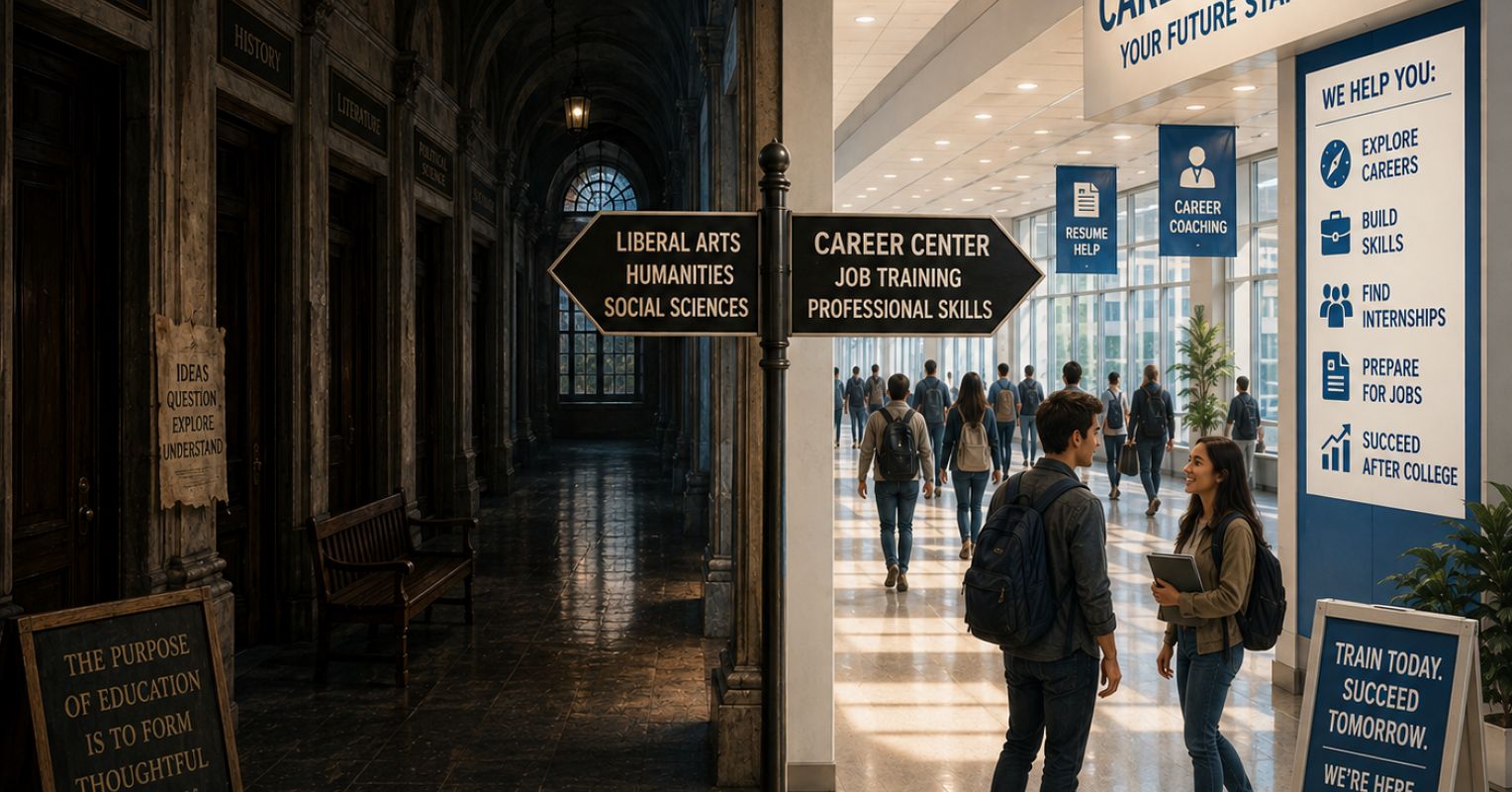
The premise seems quaint today. Yet Adams captured something essential: Education can serve purposes beyond earning a living. As a society grows more prosperous, it can devote resources not merely to producing workers, but to forming citizens—people who inherit a civilization, develop their aesthetic and spiritual sensibilities, and participate meaningfully in public life.
That idea is under serious strain. In a prior post, I examined how current incentives are lowering academic standards and threatening to hollow out the market value of the college degree. Here I focus on a deeper problem: the eroding civic value of higher education.
The Dual Purposes of College Education

A college education serves two functions. Its signaling function verifies that a student has the competence, knowledge, and grit employers value. Its civic function transmits a society’s cultural and intellectual inheritance, cultivating a student’s capacity to think independently and participate in democratic life. Thinkers from John Dewey and W.E.B. Du Bois to Robert Maynard Hutchins have long emphasized this civic function.
The civic function is often dismissed, however, as hopelessly impractical. “What are you going to do with that?” students hear when they consider such “imprudent” majors as sociology, history, music, literature, or the arts. Adams hoped later generations would have the freedom to gravitate toward the liberal arts. Today, we see the opposite. Humanities and liberal-arts majors have declined sharply for more than a decade, while parents reasonably worry whether their children’s studies will furnish a livelihood.
But we must pause to address pressing questions: Should the transmission of our cultural inheritance be tied tightly to the demands of the labor market? What happens if the labor market itself needs fewer and fewer workers?
That second question is not far-fetched.
Challenges to the Civic Function of Higher Education
Consider Bill Gates’ recent essay warning that AI could transform the labor market faster than any previous technology, disrupting law, medicine, customer service, software, and manufacturing within a decade. In an interview with The New York Times, he suggested that technology leaders are privately far more concerned about AI’s employment effects than they admit in public.
A recent post by Andrew Yang, author and 2020 Democratic presidential candidate, highlights the danger to the education sector:
“Heard about a small college in the Midwest that has lost 50% of its enrollment in the last 10 years. Hundreds of colleges are going to close in the next decade, and it’s going to be devastating for many communities.” (X, August 30, 2026)
Yang’s warning is not an isolated data point. Colleges today face a convergence of threats unlike anything in memory: declining numbers of college-age students, enormous student debt, declining academic preparation and mental health concerns, plummeting public trust, and a polarized political climate that views higher ed as a target.
Education Essential Reads
Consider the long game. If Gates and Yang are right—if advanced AI and automation steadily reduce the economy’s need for people—does the deep, cultivating work of the university (the slow formation of judgment, sensibility, historical memory, and civic capacity) become a luxury good available only to the children of the wealthy?
Federal Policy and the Shift Toward Workforce Alignment
The pressures facing higher education appear so intractable that many college leaders are leaning harder into workforce alignment—and so is the federal government. The Trump administration’s “Do No Harm” earnings standard requires undergraduate programs to demonstrate that their graduates out-earn the typical worker with only a high school diploma. Programs that fail stand to lose eligibility for federal student loans. Under Secretary of Education Nicholas Kent put the logic plainly: Taxpayers should not subsidize programs that do not leave graduates financially better off.
I recently attended a higher-education panel of college leaders, researchers, and policy experts whose job is to keep their institutions solvent. Their message was clear: Patchwork solutions are no longer adequate; major structural changes are imperative. Colleges must “demonstrate their value in real time” through “workforce alignment” and “vocational partnerships,” and accept a “vanishing line between higher education and the workplace.” “Flexibility” and “certificates” are preferred over “too slow” traditional degrees. Institutions must eliminate “underperforming” (low-enrolled) programs and “invite employers to tell us what we’re doing well and what we’re not.”
I cite these phrases not to critique the speakers. They are struggling to keep their institutions afloat against severe headwinds. But if we are to protect higher education’s civic function, hard questions must be raised before such pronouncements become irreversible policy.
Why Public Commitment to Civic Education Matters
The forces reshaping higher education are real, and no single actor—college leaders, policymakers, or parents—can be blamed for responding to them. Still, a society gets the university it is willing to pay for. If we tether higher education entirely to the labor market’s shrinking demands, we risk cutting generations of students off from the intellectual, humanistic, and spiritual substance that the liberal arts and humanities convey. That does not bode well for democratic life or for the habits of mind a complex society requires—especially amid rising global temperatures, declining social trust, and exploding public and private debt.
John Dewey understood the deeper work. Education, he wrote, “is continually shaping the individual’s powers, saturating his consciousness, forming his habits, training his ideas, and arousing his feelings and emotions.” Protecting that work—before the last humanities department closes its doors—is an urgent task now facing American higher education.
Market incentives alone will not suffice; only a deliberate public commitment can. That is why my colleagues and I have called for a renewed national commitment to public financing of higher education—one that would let institutions sustain the humanities and civic education without having to justify every program in the language of employability.
Yes, that proposal looks quixotic. But so does expecting a society lacking civic education to cooperate on the severe social problems ahead.
