


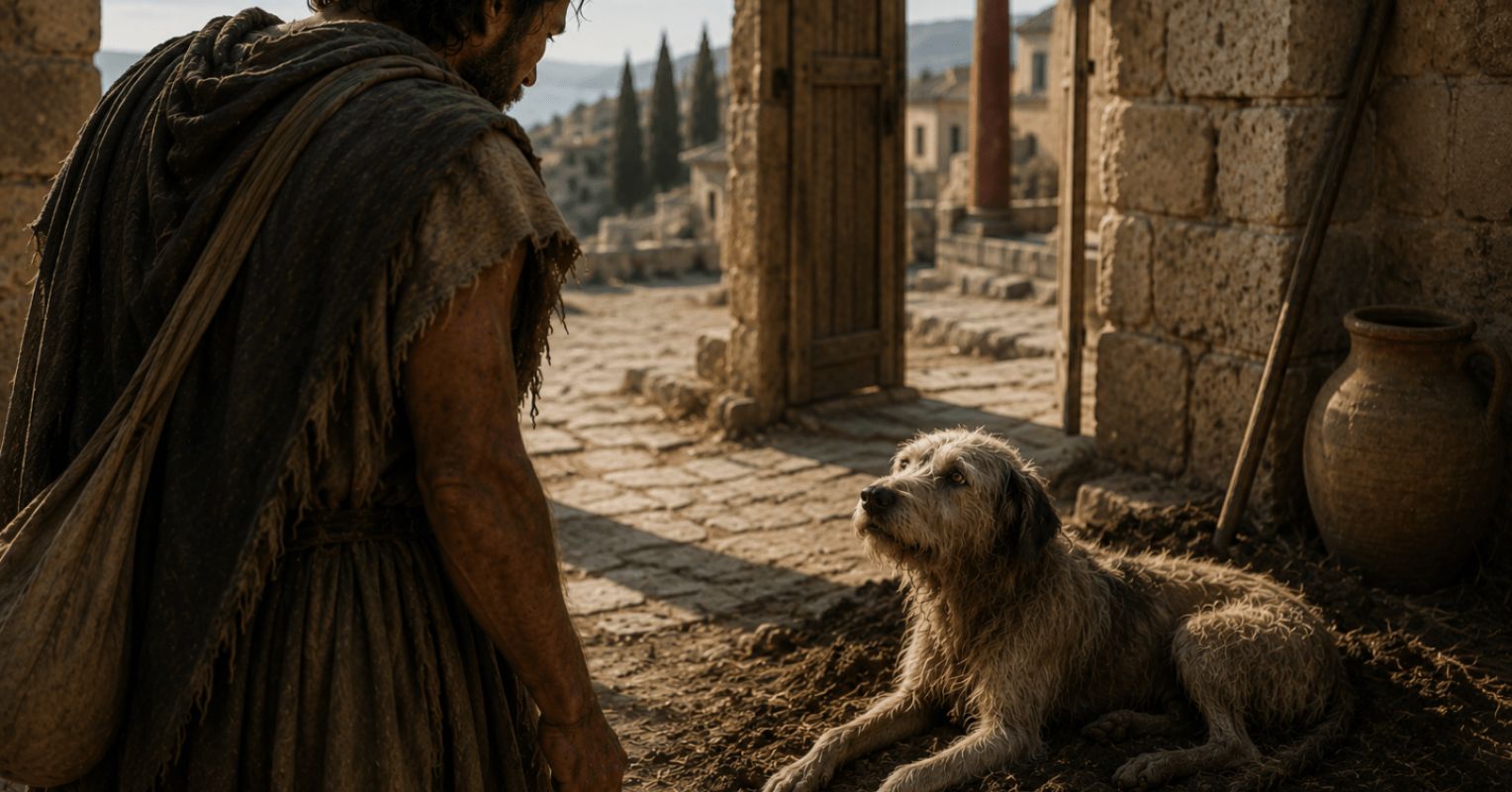
The reunion of Odysseus and Argos occupies barely 40 lines, yet it is one of the most moving episodes in Homer’s Odyssey.
After 20 years away, Odysseus returns to Ithaca disguised as a beggar. Outside the palace lies his old hunting dog, Argos, blind, flea-ridden, and abandoned on a dung heap. Recognising his master, the dog lifts his head, gives a final wag of his tail—and dies.

Christopher Nolan greatly expanded Argos’ role in his film adaptation, showing the dog ageing under the neglect and abuse of the suitors. Many cinemagoers, myself included, found the brief reunion between dog and master to be the film’s most moving scene. Nolan has said that Argos was one of the elements that drew him to the project, even describing the epic as the “ultimate dog movie.”
The Greek Dog
Why does this scene move us so deeply? There are many reasons. But one of the deepest is that Argos fulfils one of our most fundamental human longings: the longing to be recognised. Long before we seek fame or deeds, we seek to be known. Friends delight in being understood without explanation. Lovers hope to be recognised beneath the depredations of time. One of the quietest forms of suffering is not to be hated, but to be overlooked—to become as if invisible.
That is why being ghosted can be so painful. It is not merely rejection, but the withdrawal of recognition: the feeling that someone who once knew you now behaves as though you no longer existed. Argos does the opposite.

After 20 years of disguises and transformations, Argos alone recognises the man who once gave his name as “Nobody.” The old dog sees beyond age and suffering—and Athena’s best work—to the man he has always known. Odysseus weeps for the dog, but he weeps also for himself. For 20 years, he has been all things to all men. Then, for one fleeting moment, someone recognises the one man beneath all the disguises.
The Indian Dog
Homer was not alone in seeing something profound in a dog’s fidelity. The Mahabharata, along with the Ramayana, is one of India’s two great epics. At the end of the Mahabharata, after the great war has been fought and every earthly hope has been shattered, the five Pandava brothers journey to Mount Meru, followed only by a stray dog. One by one, they fall on the ascent, leaving only the eldest, King Yudhisthira, to arrive at the gates of heaven.
The god Indra invites Yudhisthira into heaven, but refuses to admit the dog. Yudhisthira turns away, explaining that he cannot bring himself to abandon his faithful companion. At this, the dog reveals himself as none other than Dharma (cosmic order, duty, right way of living), and Yudhisthira is reunited with his brothers in Heaven.
Like Argos, the dog embodies something much greater than himself. By remaining faithful to faithfulness, Yudhisthira proves himself worthy of Heaven and saves his clan.
One Lesson
The two stories mirror one another. In Homer, it is the dog who remains faithful to a man. In the Mahabharata, it is just as much the man. Yet both honour the same virtue. Homer and the authors of the Mahabharata independently arrived at the same intuition, namely, that the fidelity of a dog is not merely an animal instinct. It is a revelation.
The irony, certainly in Homer, is that Argos remembers better than we do—better even than Penelope. Anyone who has ever ghosted, or been ghosted, may find themselves asking: Are we better than dogs?
Neel Burton is author of The Meaning of Myth.
