


“I remember being at a dinner party a while back and there was an abstract painting on the wall. I kind of liked it. Whatever you’re supposed to get from art, it was happening. And the host of the party came up to me and he said, “A machine painted that.” And I was impressed with the technology, but whatever I was feeling about that painting was gone.” — Aaron Sorkin, New York Times, September 27, 2026
In a 1969 lecture published under the title “What Is an Author?”, French philosopher Michel Foucault rhetorically asked if we should include Nietzsche’s laundry list in his body of work to help interpret some of his masterpieces. The question for us is: Should an artist’s verbal or written articulations about their motivation and intention be considered when viewing an artwork?
I believe that firsthand knowledge of the artist’s motivations and intentions adds to the experience of an artwork, and that is why The Other Art Fair is my favorite art fair: because there is something somewhat rogue about standing in front of an artwork with the artist herself, hearing directly from her about her motivations and intentions as well as the process and technique, rather than making an interpretation from our own isolated perspective. Access to the artist changes the experience of the work entirely, and I find that it makes the viewing far richer than it would otherwise be. It also means that the art fair rewards precisely the kind of woman who has something to say and refuses to stay quietly behind her own canvas.

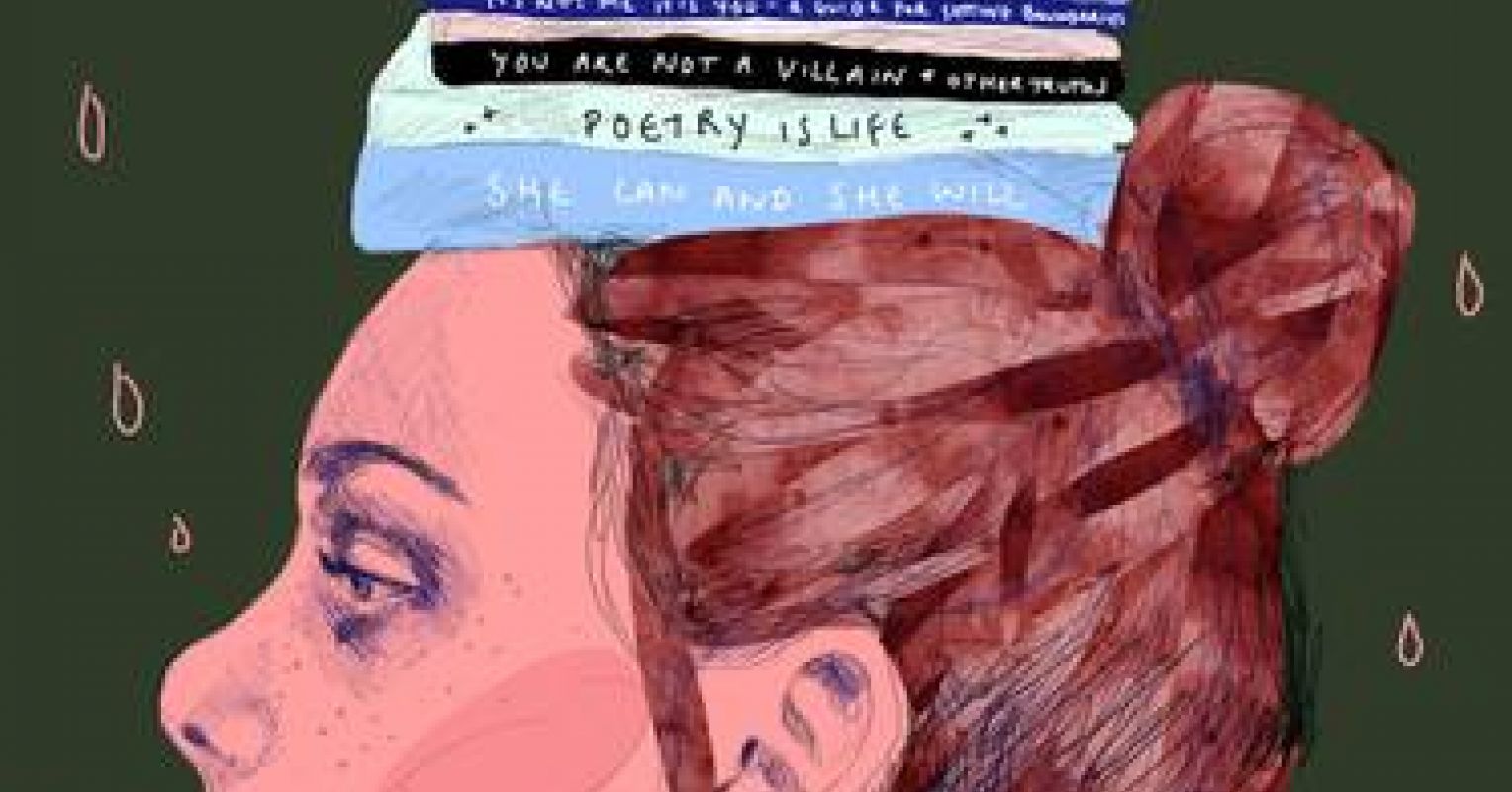
Touring The Other Art Fair this weekend, I first spoke with Hannah Gilson about her painting “Knowledge” that depicts the books she wants her daughter to read; however, these are books that do not exist (yet). Hannah explained to me that the traditional literary canon, the books most of us were assigned in high school and college, no longer serves everyone (which is why the literary canon that I studied at university in the 1980s is now often referred to as that of “Dead White Males”). And although similar existential, psychological, and moral questions persist today, it is time to allow new voices to wrestle with these themes regarding what it means to be human. I found something wonderfully irreverent about “Knowledge,” learning that a mother preferred to imagine enlightening titles than hand her daughter antiquated knowledge.
Next I spoke with Halle Ross about “Trust, but Verify,” and she told me that the painting “was created as a reminder to trust in the larger unfolding of life and the possibility that things work out, even when the path forward is unclear. The work reflects the balance between surrender and discernment, trusting the process while remaining engaged with the reality in front of us.” I loved Halle’s explication and thought it was representative of how I suggest patients approach life: that we need to show up authentically and with discernment but without prejudice. We shouldn’t try to figure out everything in advance and instead try to endure uncertainty, which is often quite difficult.
Lastly, I spoke with Isabel Maddahi about her painting “The Big One,” and she told me, “For a few months, I found myself blocked. I knew what I was feeling, but I struggled to put it into words. It was always, ‘It’s this, but not quite that.’ One day I went home and simply started painting, without a plan or expectation, and let what I was feeling internally take shape on the canvas.”

This reminded me of what makes art therapeutic, namely that it offers a non-verbal language for emotions and overwhelming sensations that may be beyond words. Isabel’s rebelliousness is against language itself, against the pressure to arrive at a tidy and contained verbal account of her interior life. I found something quietly radical in Isabel’s decision to let this canvas speak “The Big One.”
Speaking with each of these women turbo-charged my sense of wonder regarding how artistic expression is therapeutic. The opportunity to stand shoulder to shoulder with the actual creators and ask them about their motivations and intentions gave me new insights into what they hope viewers will feel.
Interpreting a painting is similar to a therapist interpreting a patient’s behaviors and beliefs, piecing a puzzle together, trying to determine what caused the artist to express herself in this manner. Art can show us what is in our blind spots the same way that therapists can—“To hold, as ‘twere, the mirror up to nature,” as Shakespeare wrote.
The type of inside access to artists that The Other Art Fair facilitates is thrilling. I found Hannah’s distrust of the traditional literary canon to be justified; I found Halle’s account of trusting an unclear path while maintaining discernment to be courageous; and I found Isabel’s expressing her emotions through colors and forms instead of words to be edifying.
To respond to Foucault, I’m not sure that I need to know anything about the artists’ laundry lists, but having their thoughts about motivation and intention freely offered while standing in front of their work is very inspiring.
