


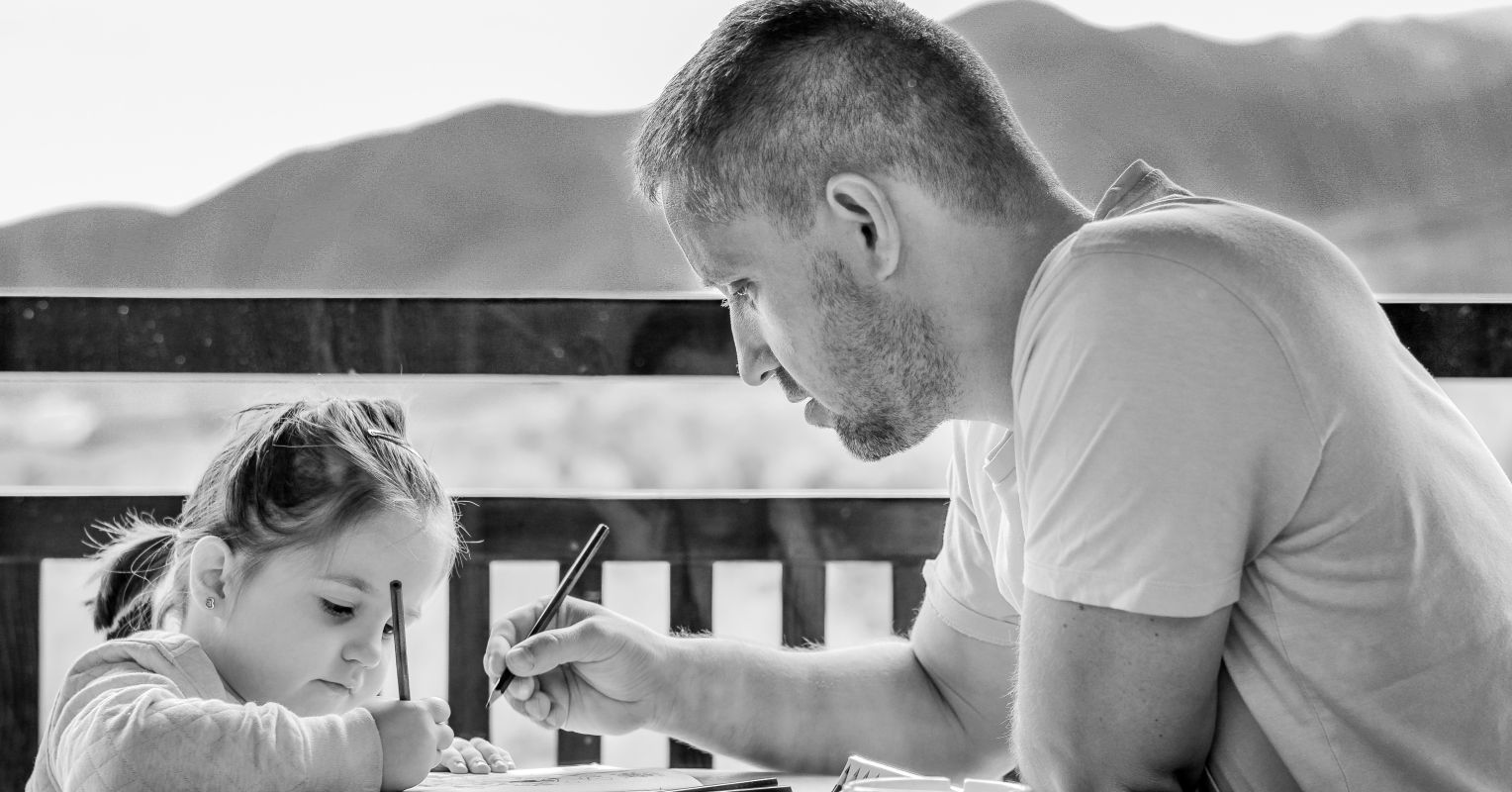
One of my fondest memories of my father is the night he taught me how to write my name.
I was little, sitting at a Fisher-Price table with a new arts-and-crafts set, drawing with crayons. My mother had gone to bed. I think my father had gone in to check on her or say good night, leaving me sitting at the little table by myself.

When he came back out, I proudly showed him what I had written on my paper: “Look, I wrote my name!” I remember exclaiming proudly. I had written the letters “K.T.” on a paper with pink crayon.
“KT.” A little girl’s phonetic attempt at spelling my actual name, “Kaytee.”
“Let me show you how to spell it,” I remember him saying with a smile. It was just him and me, late at night. It was probably much earlier than I remember, but in my mind it was dark and late, long past when a little girl should have been awake, making it extra exciting. The world was ours. He took a crayon and wrote: K-A-Y-T-E-E across a clean, crisp piece of white craft paper. It was like a new world had opened. That was the night I learned how to write (and spell!) my name.

At least, that’s how I remember it. I’m in the first year of my 40s now, remembering something that happened when I was a very young child. I know memory doesn’t work like a video recording. Details fade. Our minds fill in spaces. Maybe it wasn’t a pink crayon; maybe it was green. Maybe some of the details happened differently than I remember them. Sometimes I even wonder if the whole thing was a dream, or a story I somehow created for myself over the years.
But I don’t think so. And, if I’m being truthful, I don’t really want to know. Because it is one of my fondest memories of my father.
I often say that it would be easier, in some ways, if every memory were bad. If I could look backward and find nothing worth missing. Nothing that makes me wonder how the person in that memory could possibly be the same person who would someday choose not to know me.
Maybe that’s part of what makes my abandonment so difficult. For a long time, I think I believed I needed to understand how those two truths fit together. I needed an explanation for how the father sitting beside me with the pink crayon, his 6’2″ frame barely fitting as he crouched beside the plastic Fisher-Price craft table, became the father who has refused to speak to me for 15 years. I don’t think I’m going to get one.
I like believing that it happened exactly that way: There was once a little girl sitting at a Fisher-Price table with a crayon in her hand, trying to write her name. And in my memory, her father sat down beside her and showed her how.
