


The biopsychosocial model is the view that health and illness result from the interaction of biological, psychological and social factors. George Engel proposed it in 1977 as an alternative to the biomedical model. It looks at the whole person, not only the diseased part. Critics argue it is too vague to test.
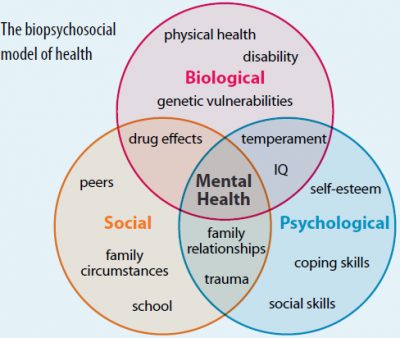
Key Takeaways
- Core Idea: Illness is often caused by biological, psychological and social factors acting together, not by the body alone (Engel, 1977).
- Three Levels: Each level adds causes. In chronic pain, fear-avoidance beliefs, mood and the social response keep disability going once the injury has healed (Gatchel et al., 2007).
- Strongest Test: A Cochrane review of 41 trials found measurable but modest gains for chronic low back pain (Kamper et al., 2015).
- Long COVID: Depression and anxiety are higher in people with long COVID, but cross-sectional studies cannot show cause (Engelmann et al., 2024).
- Main Criticism: The model is vague and hard to falsify (Ghaemi, 2009), and the evidence cannot say which level does the work.
- Culture: Culture influences how illness is experienced, and migrants’ health moves towards the host country’s norm (Berry, 1998).
- Alongside Biomedicine: It corrects the biomedical model rather than replacing it, so a health system needs both (Wade & Halligan, 2017).
Simply Psychology Answers
Instant answers built on 19+ years of trusted expertise.
How Does the Biopsychosocial Model Work?
Engel’s Proposal: The Person as a System

The model treats a person as a complex system, a set of parts that affect one another.
Illness is often caused by a combination of biological, psychological and social factors, not by any one alone (Engel, 1977). No single level tells the whole story.
Simply Psychology Answers

Instant answers built on 19+ years of trusted expertise.
Engel’s view is holistic, meaning the whole person must be taken into account. That includes their relationships and their environment.
Simply Psychology Answers
Instant answers built on 19+ years of trusted expertise.
The opposite stance is reductionism, which explains illness by breaking it down into its smallest parts, usually biochemistry.
The biomedical model is reductionist by design. It explains illness as a physical departure from a measurable norm. Engel’s model asks instead how several kinds of cause interact.
See the biomedical model for its assumptions and for Engel’s challenge to them.
Engel (1980) then applied the idea to clinical practice. That application appears under real-life examples below.
The Three Levels: Biological, Psychological and Social
The model sorts the causes of illness into three levels:
- Biological: the body itself, including genetics, viruses, bacteria, lesions (damaged tissue) and structural defects.
- Psychological: thoughts (such as expectations of health), emotions (such as fear of treatment) and behaviours (such as smoking, exercise, diet and alcohol use), plus stress and pain.
- Social: social norms, pressure from peers or parents, social values on health, social class, ethnicity and employment.
The levels overlap. Smoking, for example, is a behaviour at the psychological level. Whether smoking is normal is a social question.
How the Levels Interact
The levels do not work separately. Four points show how they combine.
First, causes come at two scales (Engel, 1980). Micro-level causes are small-scale, such as chemical imbalances. Macro-level causes are large-scale, such as the social support available.
Second, the two scales interact (Engel, 1980). For example, a chemical imbalance and a lack of social support can combine to shape health.
Third, a patient’s beliefs are part of the causal chain, as Halligan (2007) argues. What patients believe about their illness shapes how it shows up, how they respond to treatment and how they recover.
Fourth, psychological and social causes could reach the body.
Psychoneuroimmunology, the study of how psychological processes such as stress communicate with the nervous and immune systems, offers one proposed route. See stress and the immune system.
Simply Psychology Answers
Instant answers built on 19+ years of trusted expertise.
An Example: One Person with Long-Lasting Back Pain

Long-lasting back pain is a useful illustration of all three levels.
It is a form of chronic pain, meaning pain that lasts longer than the tissue damage behind it would normally take to heal. It is commonly defined as pain lasting more than three months, and it no longer serves as a warning.
Imagine one person whose back was injured. The injury has healed. Yet the pain continues, and so does the disability.
The account in Gatchel et al. (2007) is about chronic pain in general. Applied to one person, it suggests how the other levels come in.
Fear-avoidance beliefs are worries about pain that lead a person to avoid activity. The table sets out the case level by level.
| Level | What it covers | In this person |
|---|---|---|
| Biological | Physical causes, such as genes, viruses, bacteria and structural defects. | The original back injury, now healed. It began the problem but no longer explains why it continues. |
| Psychological | Thoughts, emotions and behaviour, plus stress and pain. | Fear-avoidance beliefs and mood, which help keep the disability going after the injury has healed. |
| Social | Social norms, peer and parental pressure, social class, ethnicity and employment. | Compensation systems, which pay people for injury or disability, and family reinforcement of the “sick role” (being treated as unwell). |
In this account, the psychological and social levels help explain why the disability lasts (Gatchel et al., 2007). A purely biological account struggles to explain why it lasts.
Disease vs. Illness: Why Culture Matters
Disease and illness are not the same thing.
Berry (1998) separates the two. Disease may be rooted in biological processes that are common to all people. Illness is the subjective experience of suffering and discomfort. Culture influences it.
How a condition is expressed is also linked to cultural norms (Berry, 1998). In some cultures, psychological problems are more often expressed somatically, meaning as bodily symptoms.
Cultural factors also matter for disease itself (Berry, 1998). Diet, substance abuse and family relationships contribute to how common diseases such as heart disease, cancer and schizophrenia are.
Berry’s evidence is some of the strongest that health responds to the social and cultural environment, not biology alone. Culture affects both the diseases people get and the way they experience illness.
Evidence for the Biopsychosocial Model
The model makes two claims that evidence can test. Psychological and social factors help cause illness, and treating them improves outcomes for patients.
Chronic pain, long COVID and migration each offer a test. The designs differ, so each section says what its evidence can and cannot show.
Why Chronic Pain Is the Test Case
Chronic pain is the model’s main test case. By definition, the pain outlasts the healing of the tissue behind it.
If psychological and social factors are real causes of illness, they should show up here.
Gatchel et al. (2007) reviewed several decades of pain research. They concluded that fear-avoidance beliefs, mood and the social response to disability are themselves drivers of continued disability once an initial injury has resolved.
That is the three-level interaction the model predicts (Engel, 1977), and a purely biomedical account struggles to explain it. The review explains the pattern. Whether the model also improves outcomes needs a separate test.
Does It Improve Outcomes? Kamper et al. (2015)
The key test of outcomes is a Cochrane systematic review by Kamper et al. (2015). It asked whether the model’s approach works for patients with chronic low back pain.
- Aim: To test whether multidisciplinary biopsychosocial rehabilitation (programmes combining physical and psychological treatment, delivered by a coordinated team) gives adults with chronic low back pain better outcomes than usual care, physical treatment alone, surgery or no treatment.
- Method: A systematic review and meta-analysis, which pools the results of many trials into one overall result. It combined 41 randomised controlled trials (people assigned to treatments by chance) with 6,858 participants.
- Results: Compared with usual care, the programmes improved pain and disability, based on moderate-quality evidence. Evidence of benefit over physical treatment alone was low quality. For return to work, they beat physical treatment but not clearly usual care.
- Conclusion: Treating chronic low back pain as a biopsychosocial problem, not a purely physical one, produces measurable but modest clinical gains. This suggests the model has practical value, not only explanatory value.
The design is strong. A meta-analysis of randomised trials ranks near the top of the evidence hierarchy, the ordering of study designs by how well they test a claim.
The gains are modest, though, and the evidence is rated moderate or low in quality. Quality ratings show how far the reviewers trusted a result.
The programmes vary widely, and the reviewers note that the review cannot say which part is doing the work.
A later review of physiotherapist-led programmes built on the model looked at spinal disorders. Disability and pain improved (Miki et al., 2023). The authors rated the evidence as low quality.
The gains came when psychological and social components were built into the physiotherapy itself, not added after physical treatment had failed.
A New Illness: Long COVID (Engelmann et al., 2024)
Long COVID, also called post-COVID-19 condition, offers a newer test. It has a known biological trigger, so it shows whether the model still fits when the biology is not in doubt.
- Aim: To review the evidence on psychological factors associated with long COVID.
- Method: A systematic review and meta-analysis. It pooled 113 studies and over 300,000 people with long COVID, and compared them with controls (comparison groups).
- Results: Depression and anxiety were both higher than in controls (odds ratios of 2.35 and 2.53, where 1 means no difference). Most other factors had too little or inconsistent evidence for firm conclusions.
- Conclusion: The authors framed depression and anxiety as contributing to symptoms persisting alongside biological (immune and vascular) mechanisms, not as sufficient explanations on their own.
The review is large, but its design limits it. Most of the underlying studies were cross-sectional, meaning they measured people at a single point in time.
Such studies cannot establish direction of causation. They cannot say whether depression and anxiety help cause long COVID, follow from it, or both.
They also cannot weigh the psychological factors against the biological ones, the same problem as in the pain reviews (Kamper et al., 2015).
More Simply Psychology Answers
Instant answers built on 19+ years of trusted expertise.
Health Across Cultures: Acculturation (Berry, 1998)
The social level also shows up in migration data.
Acculturation is the process of psychological and behavioural change. It happens when people from one culture live for a long time in another, the host culture.
Berry (1998) reports that the longer immigrants live in the host country, the more their health status moves towards the national norm.
Coronary heart disease moved in both directions. It rose among Polish immigrants to Canada, whose rates had started lower. Immigrants from Australia and New Zealand showed the reverse.
Rates for immigrants from 26 of the 29 countries studied moved towards those of people born in Canada. Stomach and intestinal cancer among immigrants to the USA show similar patterns.
Berry (1998) set out three competing explanations:
- Shared Environment: Immigrants and locals face the same physical risks, such as climate, pollution and pathogens, and have little choice about them.
- Behavioural Shift: Adopting the host culture’s diet, lifestyle and habits exposes immigrants to the risks that come with them.
- Acculturative Stress: The process of acculturation itself involves risk factors that lower health.
This evidence is observational, meaning researchers recorded what happened without assigning people to conditions. The three explanations are hard to tell apart. The data show that health follows culture, but not by which route.
Strengths of the Biopsychosocial Model
The model has four main strengths:
- Fits Modern Illness: Long-term conditions now account for most illness and most health-care spending in industrialised countries (Wade & Halligan, 2017).
- Beliefs Count: A patient’s beliefs about their illness become part of the causal chain, shaping how it shows up, how treatment works and how recovery goes (Engel, 1980; Halligan, 2007).
- Clinical Benefit: Rehabilitation built on the model improves pain and disability for chronic low back pain and spinal disorders, though the gains are modest (Kamper et al., 2015; Miki et al., 2023).
- Works With Biomedicine: It was framed as a corrective, not a replacement, so acute care and long-term care can each use the approach that fits (Engel, 1977; Wade & Halligan, 2017).
Limitations of the Biopsychosocial Model
Here is a one-line summary of the main limitations. The first three are explained in detail below.
- Vague and Hard to Falsify: It names three levels of cause without saying how they combine, which makes it closer to a checklist than a testable theory (Ghaemi, 2009).
- Cannot Isolate the Active Part: The reviews cannot say whether the biological, psychological or social component is doing the work (Engelmann et al., 2024; Kamper et al., 2015; Miki et al., 2023).
- Correlational Evidence: The migration and long COVID studies are observational or cross-sectional, so they cannot show which pathway causes what (Berry, 1998; Engelmann et al., 2024).
- Slow to Change Acute Medicine: It has been readily adopted in rehabilitation, primary care and pain management, but has made far less headway in acute medicine and surgery (Wade & Halligan, 2017).
Vague and Hard to Falsify
Ghaemi (2009) argues that in psychiatry the model has collapsed into “mere eclecticism”. Eclecticism means combining treatments with no principled account of why.
He says the model offers no mechanism for ruling anything in or out. It names three levels of cause. It does not say how they combine, how much each counts or how they interact in a given case.
That matters because a good theory should be falsifiable, meaning it must say which observations would prove it wrong. The idea comes from the philosopher Karl Popper.
Critics argue the model struggles to meet that standard, because it does not say how to weight its own parts.
The migration data show the problem (Berry, 1998). Shared environment, behavioural shift and acculturative stress all fit a biopsychosocial reading. The model does not predict which should apply.
It Cannot Say Which Component Does the Work
The model says all three levels matter. It gives no way to weigh them.
The reviews above tested whole programmes. These combine physical, psychological and social parts. Kamper et al.’s programmes range from exercise plus therapy to full pain clinics.
A programme that works supports the package, not any one part (Kamper et al., 2015; Miki et al., 2023).
Against physical treatment alone, the evidence of benefit was low quality (Kamper et al., 2015).
Long COVID meets the same wall (Engelmann et al., 2024). Depression and anxiety cannot be weighed against the biological mechanisms.
So the evidence supports the model as a package. It does not show how much each level contributes.
Some Key Evidence Is Correlational
The model’s central claim is causal: psychological and social factors help cause illness and shape recovery. Some key evidence only shows that things go together.
Cross-sectional studies measure people once. They cannot show which factor came first. Observational studies record what happens without assigning people to conditions. They cannot show which pathway does the causal work.
The migration data are observational, and the long COVID review drew mostly on cross-sectional studies (Berry, 1998; Engelmann et al., 2024).
The randomised trials behind the back-pain and spinal-disorder reviews are an exception (Kamper et al., 2015; Miki et al., 2023). They test whole programmes, not pathways.
One way forward is studies that follow people over time and track a single measurable pathway.
An example is tracking an inflammatory marker, a measurable sign of inflammation, from a social stressor to a health outcome. Until then, which pathway does the causal work stays open.
Real-Life Examples
Chronic Pain Clinics and Multidisciplinary Rehabilitation
The clearest use is the multidisciplinary pain clinic. A team from different professions, such as physiotherapy, psychology and medicine, treats the same case together.
The team delivers physical therapy, cognitive behavioural pain management, and attention to work, family and compensation factors as one plan.
Cognitive behavioural pain management is a psychological therapy that targets unhelpful thoughts and behaviours about pain. Separate, uncoordinated providers would otherwise deliver each part alone.
This is the model tested by Kamper et al. (2015) and, for spinal disorders, by Miki et al. (2023). Outcomes improved when psychological and social parts were built in from the start (Miki et al., 2023).
Everyday Clinical Practice and the WHO Classification
Engel (1980) applied the model to everyday clinical work. He argued that a clinician’s engagement with the patient is itself a biopsychosocial intervention. It is not merely a prelude to biomedical treatment.
Taking a history, building rapport and attending to how the patient frames their own illness all count.
The World Health Organisation’s International Classification of Functioning, Disability and Health (ICF) is built on the model (Wade & Halligan, 2017). It is a WHO system for classifying how health conditions affect functioning and disability.
Mental-Health Formulation
A biopsychosocial formulation is a structured summary of a person’s problem. It sorts biological, psychological and social factors by their role:
- Predisposing: what set the problem up.
- Precipitating: what triggered it.
- Perpetuating: what keeps it going.
- Protective: what protects against it.
Clinicians can use it to plan care that combines medication, therapy and social support, rather than relying on a single treatment.
Ghaemi (2009) warns that a formulation can become a checklist. It then licenses combining treatments without a principled account of why one factor should take priority over another. The limitations above return to this point.
Health Policy and Services
Long-term conditions, not acute infections, now account for most health-care spending in industrialised countries (Wade & Halligan, 2017).
Funding models built around acute biomedical care are poorly matched to where disease burden and cost now sit.
Planners who understand the model are better placed to design services (Wade & Halligan, 2017). Integrated pain services and long-term-condition pathways are examples. These address the psychological and social drivers of cost, not only the biological ones.
How Does the Biopsychosocial Model Compare with Other Models?
The Biomedical Model: A Corrective, Not a Replacement
Engel framed the model as a corrective to the biomedical model’s reductionism, not as its complete replacement (Engel, 1977, 1980).
Wade and Halligan (2017) argue that the two models are not simple rivals. Acute biomedical care and long-term biopsychosocial care answer different clinical questions. A health system needs both.
A fracture, an infection or a heart attack is an acute, single-cause problem that the biomedical model handles well. Long-term conditions call for the wider view. See the biomedical model for the full contrast.
The Biopsychosocial-Spiritual Model: Adding Meaning
Sulmasy (2002) argued that Engel’s three levels leave out a fourth that patients often treat as central, especially near the end of life.
That level is the spiritual: a person’s relationship to meaning, transcendence (something larger than themselves) and their own mortality.
His biopsychosocial-spiritual model keeps the biological, psychological and social levels. It adds spiritual well-being as a fourth domain for clinicians to assess.
It matters most in palliative and end-of-life care (Sulmasy, 2002). Palliative care eases symptoms and distress when illness cannot be cured.
A purely biopsychosocial approach can miss what patients themselves say matters most (Sulmasy, 2002).
Social Determinants of Health: The Population View
A different criticism is that the model still centres the individual patient, despite its social level.
Social determinants of health are the economic and social conditions, such as income, education, housing and discrimination, that shape health across whole populations.
Marmot’s (2005) framework starts from these conditions.
It begins from the finding that health follows a social gradient, meaning health improves step by step up the social scale. Marmot argues that policy on inequality can do more for population health than interventions aimed at individuals.
The two views can be read as complementary. The “social” factors in Engel’s model are, in large part, the individual-level expression of the structural conditions that Marmot’s framework analyses at population level.
More Simply Psychology Answers
Instant answers built on 19+ years of trusted expertise.
References
Berry, J. W. (1998). Acculturation and health: Theory and research. In S. S. Kazarian & D. R. Evans (Eds.), Cultural clinical psychology: Theory, research, and practice (pp. 39–57). Oxford University Press.
Engel, G. L. (1977). The need for a new medical model: A challenge for biomedicine. Science, 196(4286), 129–136. https://doi.org/10.1126/science.847460
Engel, G. L. (1980). The clinical application of the biopsychosocial model. American Journal of Psychiatry, 137(5), 535–544. https://doi.org/10.1176/ajp.137.5.535
Engelmann, P., Reinke, M., Stein, C., Salzmann, S., Löwe, B., Toussaint, A., & Shedden-Mora, M. (2024). Psychological factors associated with long COVID: A systematic review and meta-analysis. eClinicalMedicine, 74, Article 102756. https://doi.org/10.1016/j.eclinm.2024.102756
Gatchel, R. J., Peng, Y. B., Peters, M. L., Fuchs, P. N., & Turk, D. C. (2007). The biopsychosocial approach to chronic pain: Scientific advances and future directions. Psychological Bulletin, 133(4), 581–624. https://doi.org/10.1037/0033-2909.133.4.581
Ghaemi, S. N. (2009). The rise and fall of the biopsychosocial model. The British Journal of Psychiatry, 195(1), 3–4. https://doi.org/10.1192/bjp.bp.109.063859
Halligan, P. (2007). Belief and illness. The Psychologist, 20(6), 358–361.
Kamper, S. J., Apeldoorn, A. T., Chiarotto, A., Smeets, R. J. E. M., Ostelo, R. W. J. G., Guzman, J., & van Tulder, M. W. (2015). Multidisciplinary biopsychosocial rehabilitation for chronic low back pain: Cochrane systematic review and meta-analysis. BMJ, 350, Article h444. https://doi.org/10.1136/bmj.h444
Marmot, M. (2005). Social determinants of health inequalities. The Lancet, 365(9464), 1099–1104. https://doi.org/10.1016/S0140-6736(05)71146-6
Miki, T., Kondo, Y., Kurakata, H., Takebayashi, T., & Samukawa, M. (2023). Physical therapist–led interventions based on the biopsychosocial model provide improvement in disability and pain for spinal disorders: A systematic review and meta-analysis. PM&R, 16(1), 60–84. https://doi.org/10.1002/pmrj.13002
Sulmasy, D. P. (2002). A biopsychosocial-spiritual model for the care of patients at the end of life. The Gerontologist, 42(Suppl. 3), 24–33. https://doi.org/10.1093/geront/42.suppl_3.24
Wade, D. T., & Halligan, P. W. (2017). The biopsychosocial model of illness: A model whose time has come. Clinical Rehabilitation, 31(8), 995–1004. https://doi.org/10.1177/0269215517709890
