


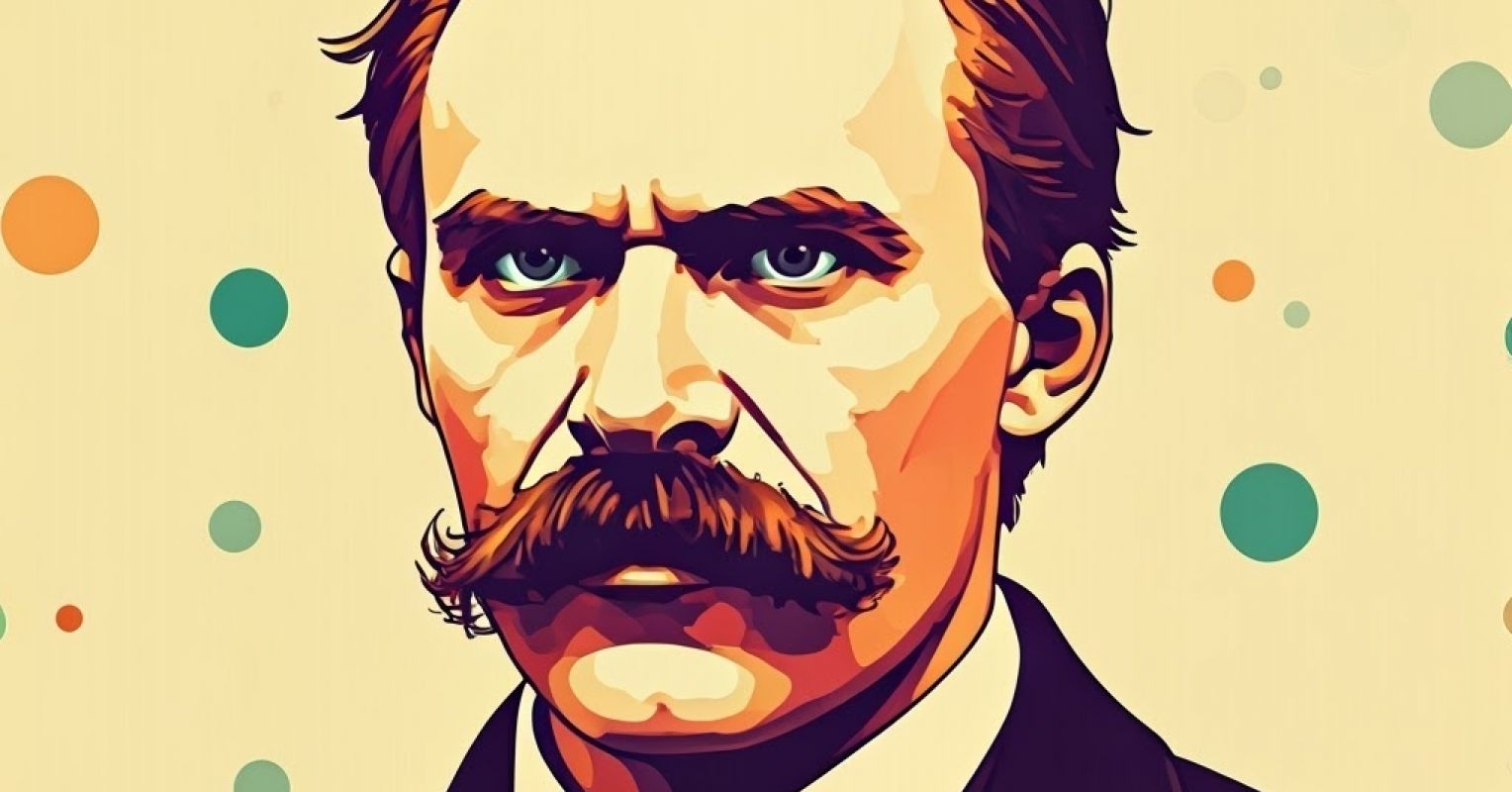
Who was Nietzsche? Philosopher, psychologist, poet, madman, provocateur—these names orbit around him but never settle. He is the “strange German,” dismissed by some as the father of nihilism and amorality, revered by others as the prophet of self-becoming. No thinker has hovered so closely to the abyss or beckoned so many to peer into its depths. Fewer still have so haunted the origins of the psychoanalytic revolution, both as inspiration and as fateful warning.
It is now legend: January 1889, a Turin square. Nietzsche, so the story goes, witnesses a cab driver savagely beating his exhausted horse. Moved by an overwhelming surge of empathy or pain, he rushes to the animal, clings to its neck, and weeps uncontrollably. Some accounts claim he shields the horse, collapsing in tears, uttering words of compassion or madness—begging forgiveness of the horse, of humanity, of the world itself. Some say it was the shattering weight of empathy; others, the return of the very shadows he had spent a lifetime mapping. From that day on, the boldest philosopher of his age was lost to private madness, cared for quietly by his family, haunting the conscience of modernity like a ghost.

Freud, the sculptor of the unconscious, never ceased mining Nietzsche’s “subterranean galleries.” Both gazed long into the night-side of the soul—into that labyrinth where forbidden wishes, childhood wounds, and the secret machinery of morality coil and writhe. “God is dead,” thundered Nietzsche; the gods, Freud replied, had taken up residence within us, as the punishing superego and the shape-shifting id. For Nietzsche, conscience was psychic cruelty—a tyranny of the internalized herd. For Freud, the very same ailments: civilization’s weight, the soul crushed by the transmission of religious terror across the generations.
Yet here, the true divergence opens—not simply on the question of healing, but on the meaning and possibility of transformation. Freud, at his core, wished to bring the unconscious into a daylight of comprehension, aiming for reconciliation with our limitations. Nietzsche, by contrast, saw real transformation as possible only through a plunge into darkness, affirming not adjustment but the transfiguration of being—a risk that borders on madness. Freud sought to render madness intelligible, to domesticate the daemons through the talking cure, integrating psychic torment into the manageable whole. His dream was not transcendence, but progress: to make madness livable, to serve it back to reality. The healer’s path was methodical, bounded, a quest for ordinary suffering over heroic collapse—a hope as sober as it was humane.
Nietzsche, by violent contrast, was no clinician. He did not wish to bring suffering back to earth, but to launch it into the heavens. His call was to stand alone, to become who one is, to risk destruction or madness for the sake of creation. He championed artistic alchemy, transmuting pain and chaos into the glory of the self-overcoming individual—the Übermensch, who laughs in the ruins, bearing the full burden of meaninglessness and forging it anew. Nobody truly knows why Freud so insistently downplayed Nietzsche’s influence—perhaps out of rivalry, perhaps out of discomfort with the abyssal depths Nietzsche was willing to plumb. But the fact remains: psychoanalysis was, and is, shaped by one who succumbed to the very myths he unmasked—a visionary who could transform suffering in art, but neither could nor would be healed.

In the theater of the modern soul, Nietzsche exposed the fault-lines beneath morality, sanity, and art. Freud and Jung, his intellectual heirs, mapped the unconscious—another abyss, echoing with dreams and dreads, creativity and shame. Both inherit Nietzsche’s challenge: to face suffering not as an enemy to be banished, but as the very ground of transformation. Whether as madness or as healing, both philosophy and psychoanalysis are children of the abyss—descendants of Nietzsche’s sleepless voice, who reminds us still: “One must still have chaos in oneself to give birth to a dancing star.”
