


In 1904, H. G. Wells published a short story titled, “The Country of the Blind” (Wells, 2004). The story takes place in a village located in a valley hidden deep in the Ecuadorean Andes. A landslide that occurred many generations earlier had isolated the inhabitants from the rest of humanity. Their ancestors led idyllic lives until tragedy struck: “A strange disease had come upon them, and had made all the children born to them there…blind.”
Blindness quickly spread through the population and became universal. Over time, their collective memories of sightedness devolved into myth, and eventually were forgotten. Words like “see” and “blind” disappeared from their language. The villagers no longer could even conceive of what sight was.

Wells’ story challenges the common view that people with a severe impairment are necessarily disabled. According to the narrative, although the villagers all were blind, none experienced limitations. They had created a society adapted to their needs and abilities.
Wells’ story raises a question about what we mean when we say that someone is disabled: is disability a part of the self—something internal to the impaired person? Or is disability something imposed from the outside—something about the external environment? In short, is disability something we have or something that happens to us (Hurst, 2000)?
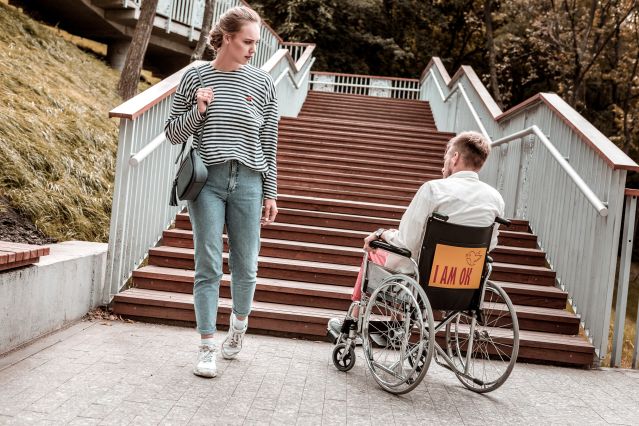
A woman walking past a man in a wheelchair, who is at the base of a staircase.

Source: Viacheslav Yakobchuk/Adobe Stock
Defining Disability
Most official definitions of disability are crafted by agencies responsible for determining who is eligible for benefits, services, or accommodations (Wasserman & Aas, 2023). One feature shared by many of these definitions is the notion that disability involves an impairment of body or mind that markedly reduces the ability to perform major life activities (Americans With Disabilities Act, 1990; Ricker, 2022).
The International Labor Organization noted that virtually “every existing definition of disability … mirrors a legal system and draws its meaning from [that] system” (Momm & Geiecker, 2011). They concluded that a “definition of disability that can be applied universally is impossible, since every country, and practically every administrative body, works with different concepts of disability.”
Social scientists and disability scholars group these definitions into broad categories referred to as “models of disability” (Wasserman & Aas, 2023). Each model describes the causes of the limitations associated with sensory, motor, cognitive, learning, and other impairments. Most discussions focus on two models: the medical model and the social model.
Models of Disability
The medical model equates disability with an impairment (i.e., a pathological condition) of the body or mind (Nario-Redmond, 2020; Wasserman & Aas, 2023). The impairment is either a damaged body part or a mental dysfunction. The impairment causes the limitations that define the disability. In short, the impairment is the disability. The environmental context is irrelevant.
According to the medical model, the only way to reduce or eliminate the disabling effects of an impairment is to use a medical intervention that corrects the impairment (Goering, 2015). A good example of this is the use of corrective lenses for nearsightedness.
Critics of the medical model argue that it ignores the obvious influence of environmental factors on functioning. For example, adding ramps to building entrances allows wheelchair users to enter a building. These criticisms initially came from proponents of the social model of disability.
The social model assumes a sharp distinction between an impairment and a disability (Goering, 2015; Nario-Redmond, 2020). The social model asserts that impairments do not disable people. Rather, the unimpaired majority constructs physical and social environments that disable the impaired minority. In other words, disability is the result of living in a world constructed by and for the statistically normal (Gibson, 2023).
Environment Essential Reads
For example, many websites are designed primarily for the majority of users who are sighted. These sites are less accessible to the blind minority who use screen readers and keyboard commands. Websites designed by people who are blind would not disable blind users. Wells (2004) made a similar point when he described how well the villagers functioned in an environment created by and for people who are blind.
But it is an oversimplification to say that impairments are never directly disabling or to imply that medical interventions are always misguided (Goering, 2015). Impairments such as chronic pain or dementia are obvious examples of impairments that directly disable people in almost all environmental contexts. Thus, the most comprehensive and useful definitions of disability will include aspects of both the medical and social models.
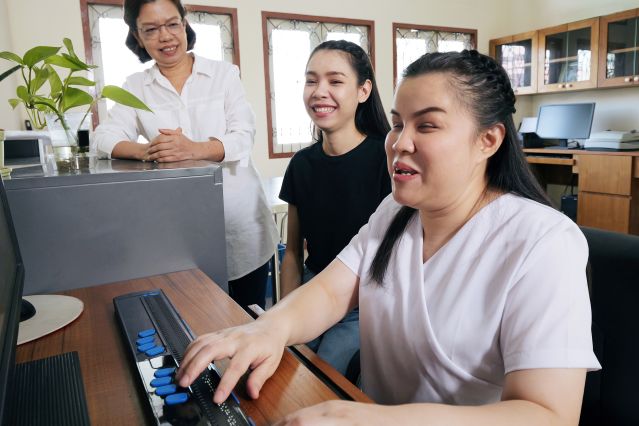
Coworkers supervising a blind person using a refreshable braille display.
Source: Chansom Pantip/Adobe Stock
One definition that includes insights from both models is what I am calling the “interactional model.” It views disability as the outcome of reciprocal interactions among several internal and external factors (Imrie, 2004). An interactional definition of disability is outlined in the International Classification of Functioning, Disability and Health (ICF; World Health Organization 2001). The ICF states “that every human being can experience a decrement in health and thereby experience some disability” (World Health Organization, 2002). The ICF labels actions, not people, as disabled or nondisabled.
According to the ICF, disability emerges from reciprocal interactions among three sets of factors:
- Health conditions (i.e., impairments, diseases, illnesses, etc.).
- Personal factors, such as age, education, coping style, and gender.
- Environmental factors, such as cultural background, social institutions, climate, and legal systems.
For example, a person experiences disability when:
- They recently lost their sight (health condition).
- They are over 65 years old and do not have the skills needed to cook, clean, pay bills, etc., as a blind person (personal factors).
- Local vocational rehabilitation programs have an age limit of less than 65 years (environmental factors).
Without skills training, this person will not be able to live independently and, therefore, experiences disability. The environment can be transformed from disabling to enabling by creating and financing a program that teaches independent living skills to older adults. In other cases, it may make more sense to alter personal factors or correct impairments.
By looking at disability as the outcome of several interacting factors, we can create a “Country of the Disabled” that is dedicated to enabling the majority of people who eventually will develop disabling impairments.

Acknowledgment: I want to thank Kiera Feng for her editorial assistance.
