


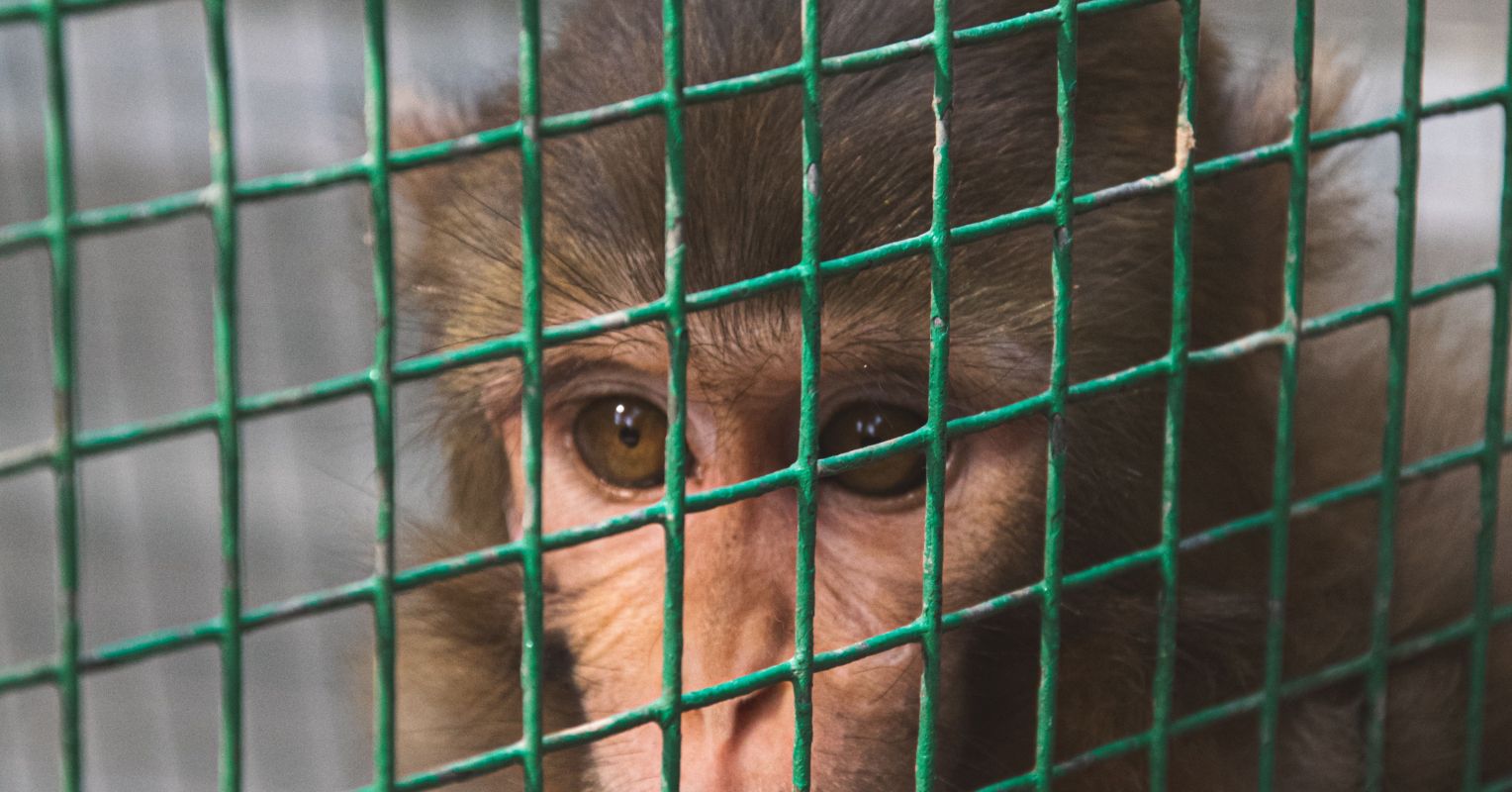
The vast majority of people have little to no idea what happens in a research lab. This is what award-winning writer and investigator Lindsay Oliver went undercover—not to stir up discontent, but to find out how the animals are treated and how people adapt to what they’re doing.
In her riveting new book, Marshmallows Are Their Favorite: Undercover at a Primate Lab, Oliver reports what went on at a primate lab and offers a unique and largely unknown story about its nonhuman residents and the humans who work there.

Marc Bekoff: Why did you write Marshmallows Are Their Favorite, and how did you come up with the eye-catching title?
Lindsay Oliver: Honestly, I wrote this book because I owe it to the monkeys. When I first walked into that facility and saw cages lining the cinderblock walls, with monkeys watching me through the bars, I knew almost immediately that I needed to write about it. Most people will never be allowed inside a primate lab, and I felt a heavy responsibility to tell these stories.
We all have favorites, and a favorite is personal. That is part of why I landed on Marshmallows Are Their Favorite. It tells you there is an individual there with preferences, opinions, and things they look forward to. I wanted readers to see the monkeys as individuals before they even opened the book.

MB: How does your book relate to your background and general areas of interest?
LO: Like many kids, I wanted to be a veterinarian growing up. Ironically, college was my first exposure to animal testing and what would have been required of me to be a vet. For the kid who walked out of a high school science class to protest dissecting a frog, this presented a fairly significant problem.
I couldn’t reconcile the two, so I walked away and became an undercover animal cruelty investigator instead. The investigation in the book was my very first lab case, and I had no idea how profoundly I would connect with the monkeys behind those walls.
MB: Who do you hope to reach?
LO: I know “everyone” is an obnoxious answer, but that’s what the monkeys deserve. I really want to reach people who would never assume that a book about a primate lab is for them. You can pick it up for the undercover element, covert cameras, the double life, the close calls, or the surprising relationships I built with my coworkers.
I also hope the book reaches people who work inside labs, especially those who feel conflicted or have been told that caring too much makes them bad at their jobs. It isn’t true. And to the person who sees “primate lab” and thinks, “That sounds too difficult for me to read”: I wrote it with you in mind.
MB: What are some of the topics you consider, and what are some of your major messages?
The book looks at what happens when something profoundly wrong becomes ordinary. The facility is in the middle of a town. It could be any town. A Target on one corner, a Starbucks on another, and on another, thousands of monkeys locked in cages. The lab is a workplace, which sounds obvious until you are standing inside it. People clocked in, complained about schedules, gossiped, flirted, and planned their weekends while monkeys screamed and pounded on the walls of their cages. What felt surreal to me was just another Tuesday at the lab.
Part of what makes that normalcy possible is identifying the monkeys by numbers or “subjects,” but these are highly intelligent, sensitive beings. They have distinct personalities, fears, and very strong opinions. Bo, for example, ate everything I handed him except the pretzels, which he threw to the ground as though personally offended by them. It’s through these little moments that you get to know them. And that changes you.
The people were more complicated than I expected, too. I went in assuming the employees were comfortable with what happened there. Some acted like they were, but I wasn’t convinced. Many cared a lot about the monkeys, found small ways to make their lives better, or struggled with what their jobs required of them.
The book also explores the strange reality of undercover work, which is far less James Bond and far more dingy hotels, microwave meals, and equipment that refuses to stay covert. I want readers to walk through those doors with me, get to know the monkeys and the people around them, and come away questioning how any of this became ordinary.
MB: How does your book differ from others that are concerned with some of the same general topics?
LO: Many books examine animal experimentation through science, ethics, or policy. While those are all incredibly helpful and needed, mine takes readers through an undercover employee entrance.
I became the inexperienced new technician, learned the routines, wore hidden cameras, made friends, and tried to help the monkeys without revealing why I was really there. Readers get to discover the facility as I did, from getting hired through my final shift.
It’s a story, not a report. There are close calls, strange workplace dynamics, moments of humor, and a relationship that gets a little too close. Facts can show the scale and systemic impact of an industry. I wanted this book to show what it feels like to be inside one.
MB: Are you hopeful that as people learn more about the lives of these animals they will re-evaluate their views on the use of nonhumans in this sort of research?
LO: Absolutely. I knew very little about what actually happens inside an animal lab before working in one, and it impacted me on a level I didn’t know was possible.
This book isn’t about the industry’s scientific failures, but those failures matter to animals and people. The public has been told this is life-saving research: it might hurt some animals, but it’s worth it for medical progress. Yet the FDA’s own 2025 roadmap for reducing animal testing states: “Over 90% of drugs that appear safe and effective in animals do not go on to receive FDA approval in humans predominantly due to safety and/or efficacy issues.” That number doesn’t fit the narrative we’ve been sold. And too much of it comes down to habit and inertia.

Continuing to rely on methods that poorly predict human outcomes harms animals and delays the cures we all want. The good news is that science is changing, and the FDA and NIH are beginning to prioritize technologies built around human biology. The challenge now is turning policy into practice. My hope is that meeting these monkeys gives people a reason to act.
