


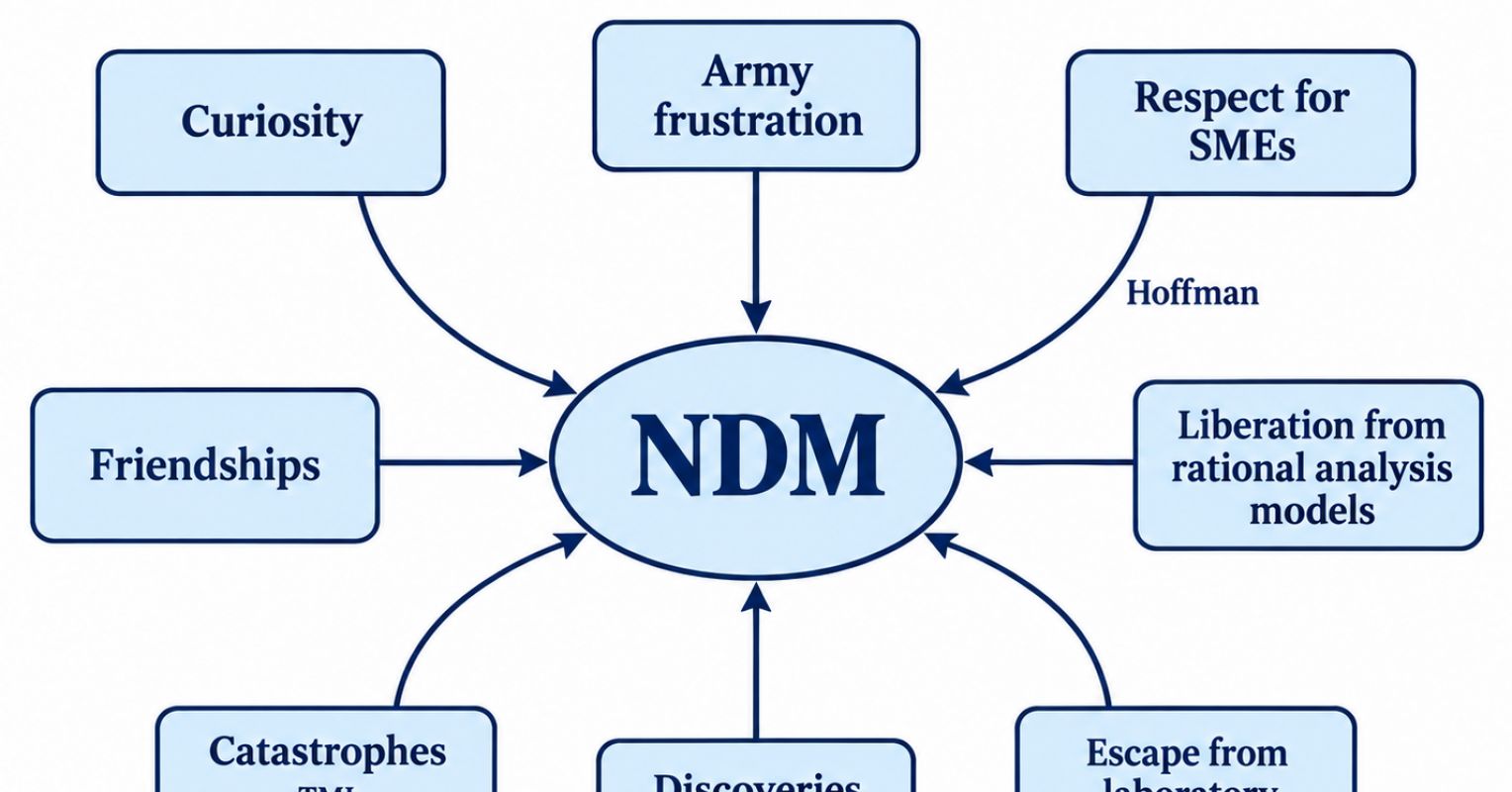
In late June 2026, we held the 18th Naturalistic Decision-Making (NDM) conference and celebrated the 40th anniversary of the movement. One question came up about how the NDM movement got started. Here are the eight causes that, in my opinion, contributed to the birth of NDM.
First, and perhaps most important, was simple curiosity. The original cohort of NDM researchers wondered how people could make good decisions under time pressure and uncertainty. They didn’t worry about doing the right kind of research. They just wanted to satisfy their curiosity.

Second, the government agency primarily responsible for decision research, the Army Research Institute, had been funding the traditional work described by the judgment and decision society. But after several years, they had become frustrated by the products of this research. The results didn’t seem to have much benefit to the military community. So they were looking for a fresh approach that they could fund. Judith Orasano set up this new program of a search, relying on guidance from Ken Hammond.
Third, the initial NDM researchers had a great respect for expertise and studied decision-makers who had expertise in fields such as firefighting, military intelligence, and naval operations, relying on researchers such as Robert Hoffman, who was advocating for the importance of expertise.
Fourth, the early NDM researchers tended not to come from university settings and were thus not constrained by the rational analysis models that were so prevalent in academia.

Fifth, in the same vein, the early NDM researchers were able to escape from the laboratory paradigms that dominated the judgment and decision-making research. The early NDM researchers didn’t have access to the large population of college sophomores that fueled this research. But in addition, the NDM researchers were skeptical of these laboratory paradigms because they relied on novel and artificial tasks that excluded expertise.
Sixth, the early NDM researchers were able to score some early wins in terms of new valuable models of decision-making; for example, the RAWFS model of uncertainty management, generated by Raanan Lipschitz, and the Recognition-Primed Decision (RPD) model generated by me. As a result, the judgment and decision community could not easily dismiss the NDMers because we had made important discoveries.
Seventh, the NDM community was able to learn from several high-profile tragedies, such as the Three Mile Island nuclear accident and the Vincennes shoot-down incident. Dave Woods and Emilie Roth studied nuclear power plant decision-making, and the Navy created a 10-year research program called TADMUS (Tactical Decision Making Under Stress) to try to understand how the Vincennes shoot-down could have happened.
Eighth, important and lasting bonds of friendship were created among the early cohort of NDM researchers, and this cemented a strong feeling of community within the NDM movement.
To summarize, a number of factors contributed to the emergence of the NDM movement in the late 1980s. In this essay, I have listed the eight factors that seemed most important to me. It was a very exciting time, filled with discoveries. None of the early members of the NDM movement would have predicted that it would still be going strong 40 years later. Looking back, we can appreciate the contributions and imagine a counterfactual—what would have been lost if the NDM movement never happened.
