


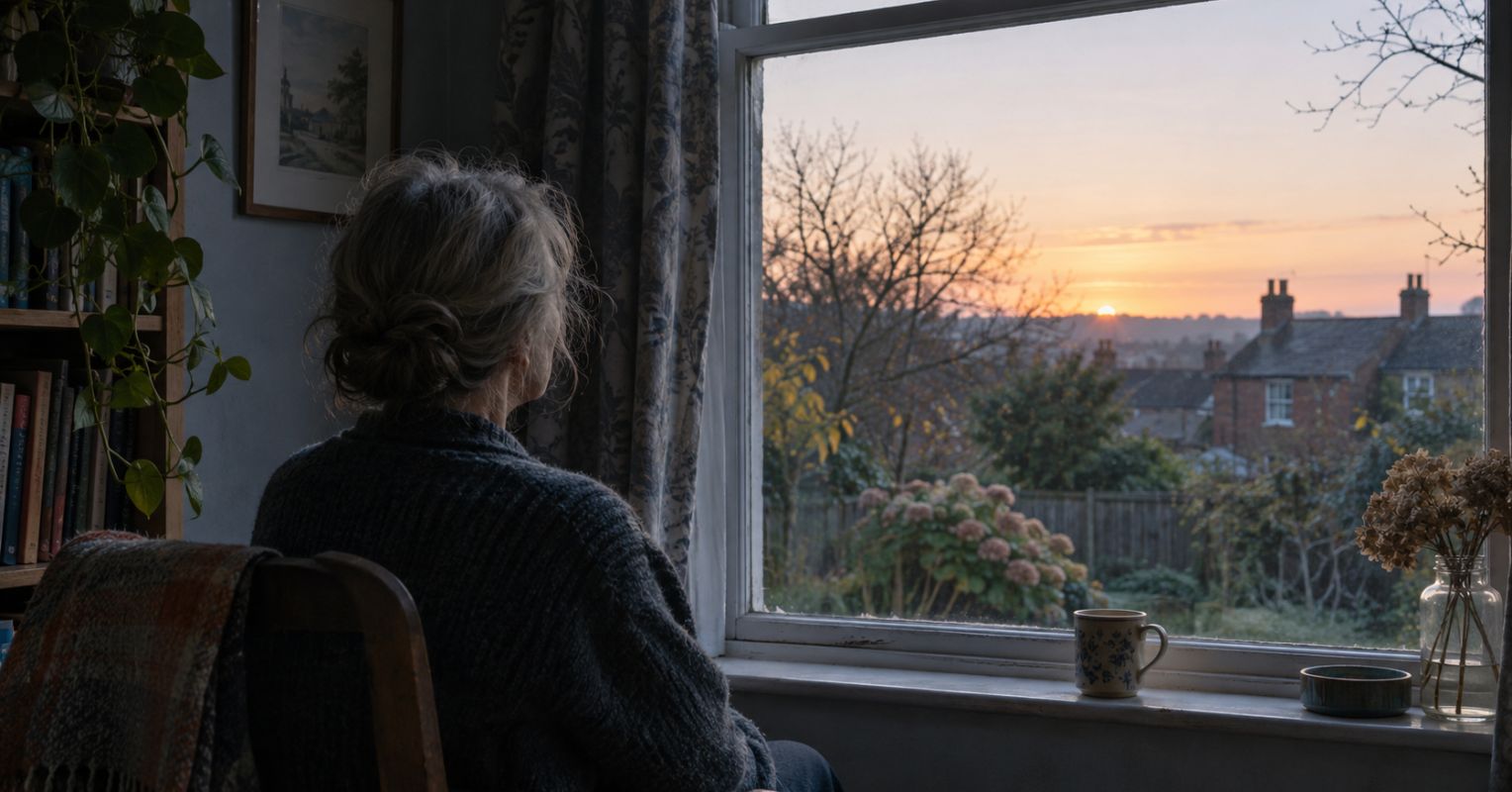
“I saw a beautiful sunrise yesterday morning, acknowledged it, and couldn’t care less if I saw another one,” she told me.
Nina, 72, was describing a growing sense that she was tired of being alive and ready to let go when the time came. She was in reasonably good health and told me she did not feel suicidal or depressed. Living, she said, had simply become less appealing than its alternative.

“You know, other people [family and friends] don’t get it,” she explained. “But I believe this is actually a positive thing, because it means that I am less and less attached to Earthly things—to being alive.”
Family members may find it difficult to hear this. In a study of relatives’ responses, some described avoiding the subject altogether.
As one family member put it: “I didn’t want to discuss it. Every time he brought it up, I didn’t want to hear it [so] we never really discussed it.” This is understandable but also risks leaving an older person’s inner perspective unheard.
Understanding Tiredness of Life

I have been a member of the European Understanding Tiredness of Life in Older People Research Network for the last five years. We are a group of geriatricians, psychiatrists, social scientists, psychologists, and death scholars, all of whom encounter older people who are tired of life in our work. Our project has sought to better understand and support what remains a little-understood phenomenon.
Nina’s words left me with a question that reaches beyond her individual circumstances. What happens when biological life continues while the relationships, roles, freedoms, and sources of meaning that make life worth living recede?
Tiredness of life may not have a single cause. It may in fact emerge when a person’s changing relationship to life meets the conditions a society offers for living it. The possibilities below help us look at the different parts of this question: how people approach death, what medicine can prolong, the value society places on older people, and what happens when connection is lost.
Turning Out the Lights
Care professor Helena Larsson and colleagues have described a gradual “turning out of the lights” in old age. Perhaps, they suggest, some people slowly loosen their attachment to life, reaching a point at which they feel ready to turn away from the outside world to face death.
There is something intuitively compelling about this idea in relation to tiredness of life. Could letting go of life be part of how some of us approach death? Might a person’s readiness to die develop gradually, rather than arriving in response to an acute illness or crisis?
Of course, we should be cautious about treating this as inevitable. Many older people remain deeply attached to life, even when facing serious and challenging losses.
The Long, Slow Fade
Another possibility is that societies have perhaps become better at prolonging biological life than at supporting the conditions that make life feel worth living. Surgeon and writer Atul Gawande has described how medicine can contribute to a “long, slow fade,” in which survival is prioritised while quality of life receives less attention.
Tiredness of life may, in some cases, expose the existential cost of this imbalance.
This does not mean that longer lives are a problem per se. The concern is not longevity itself, but whether the social and relational conditions that sustain a life can keep pace with it.
A Place in Society
A third possibility is that tiredness of life reflects the place older people are given in a society. Many cultures celebrate longevity while offering older people diminishing opportunities to contribute, to be heard, or to feel that their presence really matters. If old age is imagined mainly as decline and dependence, these images may shape how people understand their futures.
The fear of becoming dependent can be powerful. So can the experience of being treated as though one has little left to offer. These are not simply private feelings. They are shaped by social expectations and arrangements.
Chronic Disconnection
In my own work, I have heard older people describe losing partners, friends, careers, familiar roles, and physical capacities. These losses do not affect everyone in the same way. But over time, they may combine to produce a sense of chronic and profound disconnection: from other people, from the world, or from our idea of ourselves. It can become difficult to imagine how meaning might be rebuilt when the connections that once provided it are no longer available.
A study of 26 nursing-home residents found that tiredness of life reflected a threatened sense of self marked by losses of mattering, social connection, agency, and hope for the future. It supports the possibility that the experience is layered, emerging when personal circumstances and social conditions meet.
Taken together, these possibilities suggest that tiredness of life may emerge when the bonds, roles, freedoms, and recognition that make life feel meaningful become harder to sustain, even as life itself continues. It is neither simply a private failure of resilience nor an inevitable part of ageing. A wish to die should not be explained away as a natural part of growing older, but the experience can prompt us to ask whether the relationships, agency, and sense of mattering people need remain available to them in later life.
At The Inner Room, I write free essays about the common and less familiar dimensions of inner life. You’re warmly invited to subscribe.
